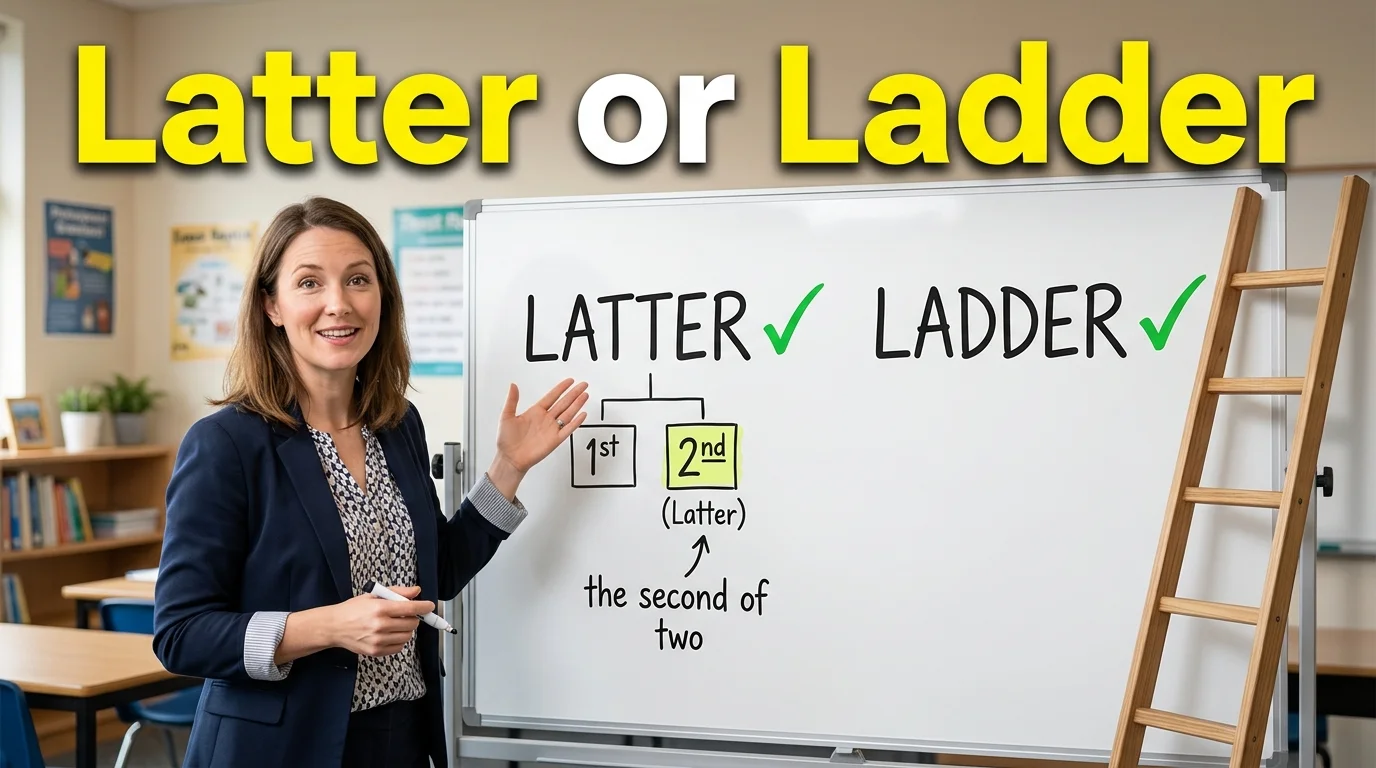
English has many words that sound similar but carry completely different meanings, and “latter” and “ladder” are a perfect example. Because these words differ by only one letter in their spelling and can sound alike in some accents, it is easy to confuse them when speaking or writing. However, choosing the right word is important because each one describes something entirely different.
The word “latter” refers to the second of two people, things, or options mentioned. For example, if someone says, “I can choose between tea and coffee, and I prefer the latter,” they mean they prefer coffee because it was mentioned second. You will often see “latter” in essays, articles, formal writing, and comparisons.
In contrast, a “ladder” is a piece of equipment with two long sides connected by horizontal steps, which people use to climb up or down. For example, “He used a ladder to reach the roof.” The word ladder is common in everyday conversations about household tasks, construction, and safety.
Quick Answer: Latter or Ladder?
Latter refers to the second of two people or things mentioned. For example, in “I prefer tea and coffee, but I usually choose the latter,” latter means coffee.
Ladder is a tool with steps or rungs that people use to climb up or down. For example, “He used a ladder to reach the roof.” In short, latter = second of two, while ladder = climbing tool.
Meaning of Latter

Latter is an adjective and, in some contexts, a noun. It refers to the second of two people, things, or options that have already been mentioned.
For example:
I have two choices: study now or study later. I prefer the latter.
Here, the latter means study later, because it is the second option mentioned.
The word latter is commonly used when writers want to avoid repeating a noun or phrase. Instead of saying “I prefer study later,” they can say “I prefer the latter.” This makes the sentence shorter and more polished.
What Does “The Latter” Mean?
The latter means the second of two previously mentioned items.
Consider this example:
Sarah bought a laptop and a tablet. The latter was more affordable.
In this sentence:
- The laptop = the first item
- The tablet = the second item
- The latter = the tablet
Therefore, the latter always points back to the second item in a pair.
Examples of “Latter” in British English
British English uses latter in the same way as American English.
- I considered travelling by train or bus, but I chose the latter.
- The manager discussed two proposals; the latter received more support.
- Between football and tennis, I prefer the latter.
- The first plan was expensive, while the latter was more practical.
- She offered me tea or coffee, and I selected the latter.
Examples of “Latter” in American English
American English follows the same grammatical rule.
- I can work in the morning or evening, but I prefer the latter.
- The company introduced two products, and the latter became more popular.
- He offered two explanations, but the latter seemed more convincing.
- Between reading and watching television, I usually choose the latter.
- We discussed two routes, and the latter was shorter.
Important: These examples show that latter does not change between British and American English.
Meaning of Ladder
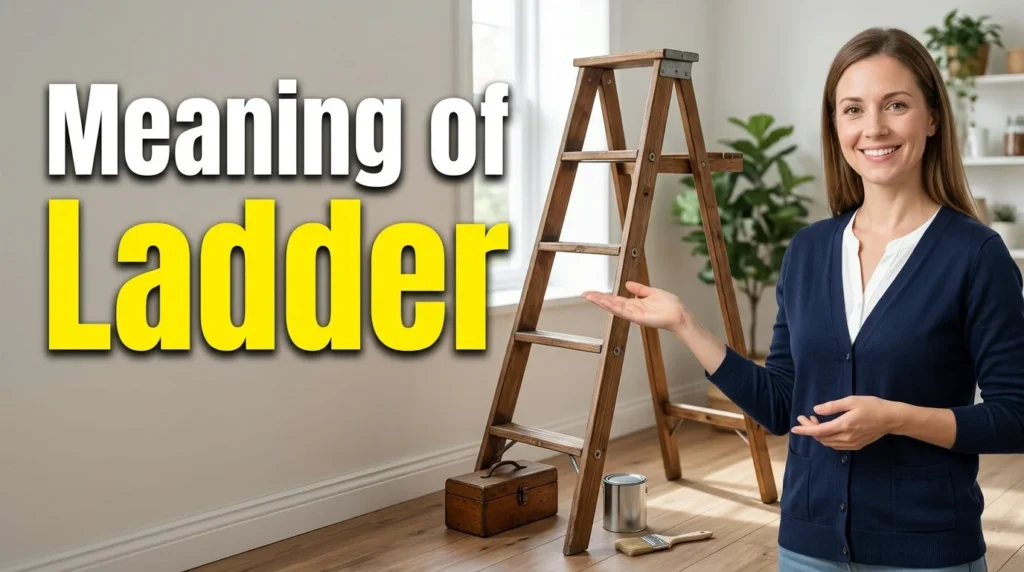
Ladder is a noun that refers to a structure with steps or rungs used for climbing. People use ladders to reach roofs, shelves, trees, windows, and other elevated places.
For example:
The painter climbed a ladder to reach the ceiling.
Here, ladder refers to the physical equipment the painter used.
A ladder can be made from different materials, including:
- Wood
- Aluminium
- Steel
- Fibreglass
- Other strong materials
Ladders come in different designs, such as step ladders, extension ladders, and folding ladders.
What Does “Ladder” Mean in Everyday English?
In everyday English, ladder usually refers to a climbing tool. However, it can also appear in figurative expressions.
For example:
She worked hard to climb the career ladder.
Here, career ladder does not mean a physical ladder. Instead, it refers to progressing through different levels of a career.
Similarly:
The team moved up the league ladder.
This means the team improved its position in the league rankings.
Examples of “Ladder” in British English
- He placed a ladder against the wall.
- The gardener used a ladder to trim the tree.
- Please hold the ladder while I climb.
- She bought a new step ladder for the kitchen.
- The worker climbed down the ladder carefully.
Examples of “Ladder” in American English
- He used a ladder to clean the windows.
- The painter climbed the ladder to reach the ceiling.
- Please move the ladder away from the doorway.
- She bought a folding ladder for household repairs.
- The worker carried the ladder into the garage.
Again, the spelling and meaning are the same in both varieties of English.
Latter vs Ladder: Key Differences
The easiest way to understand latter or ladder is to compare their meanings, word types, and uses.
| Feature | Latter | Ladder |
| Meaning | The second of two mentioned items | A tool used for climbing |
| Word type | Adjective or noun | Noun |
| Main use | Referring back to the second option | Describing physical equipment |
| Example | I chose the latter. | I climbed the ladder. |
| Related expression | The former and the latter | Career ladder |
| UK spelling | Latter | Ladder |
| US spelling | Latter | Ladder |
| Pronunciation | Often pronounced with a soft “t” sound | Often pronounced with a clear or flapped “d” sound |
The Main Difference in One Sentence
Latter helps you identify the second choice, whereas ladder helps you climb.
For example:
I mentioned a ladder and a staircase. The latter is safer.
Here, latter means staircase, not the climbing tool.
On the other hand:
I used a ladder to reach the top shelf.
Here, ladder refers to the physical object.
Is “Latter” the Same as “Later”?
No. Latter and later are different words, even though they look similar.
- Latter = the second of two mentioned things
- Later = at a time after now or after another time
Examples:
I prefer the latter option.
I will call you later.
The first sentence identifies the second option. The second sentence refers to time.
Latter vs Later
| Word | Meaning | Example |
| Latter | Second of two things | I chose the latter. |
| Later | At a future time | I will finish it later. |
This distinction matters because many learners accidentally write later when they mean latter.
Incorrect: I prefer the later.
Correct: I prefer the latter.
However, if you mean “after some time,” then later is correct.
Is “Latter” the Same as “Former”?
No. Former and latter are often used together to distinguish between two items.
- Former = the first of two mentioned items
- Latter = the second of two mentioned items
For example:
I have worked in London and Manchester. The former is larger, but the latter is closer to my family.
In this sentence:
- Former = London
- Latter = Manchester
Former and Latter Examples
- Between tea and coffee, the former is usually lighter in colour, while the latter often has a stronger flavour.
- She considered two jobs. The former paid more, but the latter offered better hours.
- We visited Paris and Rome. The former was colder, while the latter was warmer.
- He compared two phones. The former had a better camera, but the latter had a larger battery.
Tip: When you see former and latter, remember the order:
Former = First Latter = Last
Common Mistakes People Make
Although latter and ladder have different meanings, people often confuse them because of their similar spelling and pronunciation. Here are some common mistakes to watch for.
Mistake 1: Using “Ladder” When You Mean “Latter”
Incorrect:
I prefer the ladder option.
Correct:
I prefer the latter option.
Why? Because you are referring to the second option, not a climbing tool.
Mistake 2: Using “Latter” for a Physical Object
Incorrect:
He climbed the latter to reach the roof.
Correct:
He climbed the ladder to reach the roof.
Why? Because you need a tool for climbing, so ladder is the correct word.
Mistake 3: Confusing “Latter” With “Later”
Incorrect:
I will choose the latter after dinner.
This sentence may be grammatically possible if latter refers to a previously mentioned option, but many learners use it when they actually mean later.
Correct for time:
I will choose it later.
Correct for the second option:
I prefer the latter.
Mistake 4: Using “Latter” When More Than Two Items Are Listed
Traditionally, latter refers to the second of two items. If you list three or more things, it is clearer to say the last one, the final option, or name the item directly.
Less clear:
We discussed tea, coffee, and juice. I preferred the latter.
Clearer:
We discussed tea, coffee, and juice. I preferred the last one.
Or:
We discussed tea, coffee, and juice. I preferred juice.
Mistake 5: Using “The Latter” Without a Clear Reference
The reader needs to know which two items you mean.
Unclear:
The latter was better.
Clearer:
We compared two plans. The latter was better.
Without the earlier pair, the reader may not understand what latter refers to.
Mistake 6: Repeating “Latter” Too Often
Although latter can make writing concise, overusing it may make your writing sound formal or confusing.
For example:
I compared the first report and the second report. The latter was longer, but the latter also contained more details.
A clearer version is:
I compared the first report and the second report. The second was longer and contained more details.
Therefore, use latter when it improves clarity, not simply to sound formal.
Correct Usage in Sentences
The following examples show how to use latter and ladder correctly in real-life situations.
Sentences Using “Latter”
- I offered him tea or coffee, but he chose the latter.
- Between the two dresses, I prefer the latter.
- The company launched two services, and the latter became more popular.
- She considered studying medicine or law, but she chose the latter.
- We discussed two solutions; the latter was easier to implement.
- The first book was interesting, but the latter was more exciting.
- He compared two cars, and the latter had better fuel efficiency.
- I can meet you on Monday or Tuesday. The latter works better for me.
- She received two invitations and accepted the latter.
- The first explanation was complicated, while the latter was easier to understand.
Sentences Using “Ladder”
- He used a ladder to reach the roof.
- Please place the ladder against the wall carefully.
- The painter climbed the ladder to reach the ceiling.
- She bought a small step ladder for the kitchen.
- The worker carried the ladder into the garden.
- We need a longer ladder to reach the upper shelf.
- He climbed down the ladder slowly.
- The gardener used a ladder to cut the branches.
- She folded the ladder and stored it in the garage.
- The team hopes to climb the league ladder this season.
Mixed Examples: Latter and Ladder Together
These sentences use both words, making the difference easier to remember.
I mentioned a ladder and a staircase. The latter is safer for this task.
Here, ladder is the physical object, while latter refers to the second item, the staircase.
We compared a wooden ladder and a metal ladder. The latter was heavier.
Here, latter means the second ladder, which is the metal ladder.
He bought a ladder and a toolbox. The latter contained several useful tools.
Here, latter refers to the toolbox.
She considered buying a step ladder or an extension ladder. She chose the latter because it was taller.
Here, latter means extension ladder.
British English vs American English
Many learners wonder whether British English and American English use latter and ladder differently. The answer is simple: the spelling, meaning, and grammar are essentially the same.
Spelling Differences
There is no standard UK/US spelling difference for these words.
| British English | American English |
| latter | latter |
| ladder | ladder |
Both varieties use latter for the second of two things and ladder for a climbing tool.
Pronunciation Differences
The main difference may appear in pronunciation.
In many British accents, latter and ladder can sound more distinct because the t and d sounds are pronounced differently.
In many American accents, the t in latter may sound like a quick d or “flap” sound. As a result, latter and ladder can sound very similar.
For example:
- British English: latter often has a clearer t sound.
- American English: latter may sound closer to “ladder” in casual speech.
However, pronunciation varies by region and speaker. Therefore, context is often important when listening.
Grammar Differences
There is no major grammatical difference between British and American English when using these words.
British English:
I prefer the latter.
American English:
I prefer the latter.
British English:
He climbed the ladder.
American English:
He climbed the ladder.
The rules remain the same.
How to Remember Latter or Ladder
If you often confuse these words, a few simple memory tricks can help.
Memory Trick 1: Latter Has “Last” in Its Meaning
Think:
Latter = Last of two
The word latter refers to the second item, which comes last in a pair.
Example:
Tea or coffee? I choose the latter.
Coffee comes second, so latter is correct.
Memory Trick 2: Ladder Has “A” for Ascending
Think of the A in ladder as standing for ascending.
A ladder helps you ascend or climb.
Example:
He climbed a ladder to reach the roof.
Memory Trick 3: Latter Is About Choices; Ladder Is About Climbing
Ask yourself:
- Am I talking about the second of two options? → Latter
- Am I talking about something used to climb? → Ladder
This quick question can help you choose the correct word immediately.
Memory Trick 4: Former and Latter Go Together
Remember:
Former = First Latter = Last
This is one of the most useful ways to remember latter.
Memory Trick 5: Picture a Ladder
When you see ladder, imagine a physical ladder leaning against a wall. This visual connection makes the spelling easier to recall.
When Should You Use “The Latter”?
Use the latter when:
- You have already mentioned two items.
- You want to refer to the second item.
- The reader can easily identify both items.
- Repeating the second item would make the sentence unnecessarily long.
For example:
I can travel by train or bus. The latter is cheaper.
This works because the reader knows exactly which two options you mentioned.
When Should You Avoid “The Latter”?
Avoid the latter when:
- You have mentioned more than two items.
- The reference is unclear.
- The sentence sounds more confusing than the original wording.
- You are writing for beginners and a simpler word would be clearer.
For example:
I bought apples, oranges, bananas, and grapes. The latter was sweet.
This is unclear because the reader may not know whether latter refers to the second item or the last item.
A better sentence is:
I bought apples, oranges, bananas, and grapes. The grapes were sweet.
Why Correct Word Choice Matters
Choosing between latter or ladder may seem like a small detail. However, small spelling and word-choice mistakes can change the meaning of a sentence.
Compare these examples:
I chose the latter.
This means you chose the second of two options.
I chose the ladder.
This suggests you chose a climbing tool, which may sound unusual depending on the context.
Similarly:
She climbed the ladder.
This describes a physical action.
She climbed the latter.
This is usually incorrect unless latter refers to something previously mentioned that can be climbed, which is uncommon.
Therefore, correct word choice helps readers understand your message quickly and accurately.
Practice Exercise: Choose the Correct Word
Try selecting latter or ladder in each sentence.
- I compared two phones and chose the ______.
- He used a ______ to paint the ceiling.
- Between tea and coffee, I prefer the ______.
- The worker placed the ______ against the wall.
- She considered two jobs and accepted the ______.
- We need a taller ______ to reach the roof.
- The first option was expensive, but the ______ was affordable.
- He climbed the ______ carefully.
Answers
- latter
- ladder
- latter
- ladder
- latter
- ladder
- latter
- ladder
The key is to focus on meaning rather than pronunciation.
FAQs About Latter or Ladder
1. What is the difference between latter and ladder?
Latter means the second of two mentioned things, while ladder is a tool used for climbing. For example, “I chose the latter” refers to the second option, whereas “I climbed the ladder” refers to climbing equipment.
2. Is “latter” the correct word for the second option?
Yes. Latter is the correct word when you refer to the second of two previously mentioned options.
Example:
I can study maths or science. I prefer the latter.
Here, latter means science.
3. Is “ladder” the correct word for climbing?
Yes. Ladder is the correct word for a structure with steps or rungs that people use to climb.
Example:
He used a ladder to reach the roof.
4. Do British and American English spell latter and ladder differently?
No. Both British and American English use the same spellings: latter and ladder. The meanings and grammar are also the same.
5. Can “latter” refer to more than two things?
Traditionally, latter refers to the second of two things. When discussing three or more items, it is usually clearer to use the last one, the final option, or the specific item’s name.
6. What is the difference between former and latter?
Former refers to the first of two mentioned items, while latter refers to the second.
Example:
I like tea and coffee. The former is lighter, while the latter is stronger.
Here, former means tea, and latter means coffee.
7. What is an easy way to remember latter vs ladder?
Remember:
- Latter = Last of two
- Ladder = A tool for ascending
This simple association can help you choose the correct word.
Conclusion
Understanding latter or ladder is easier once you focus on their meanings. Latter refers to the second of two mentioned people or things, while ladder is a tool used for climbing. Although the words look and sound similar, they serve completely different purposes.
Remember that British and American English use the same spellings and grammar rules for both words. The main difference may be pronunciation, especially in casual American speech. Therefore, always consider the context before choosing a word.