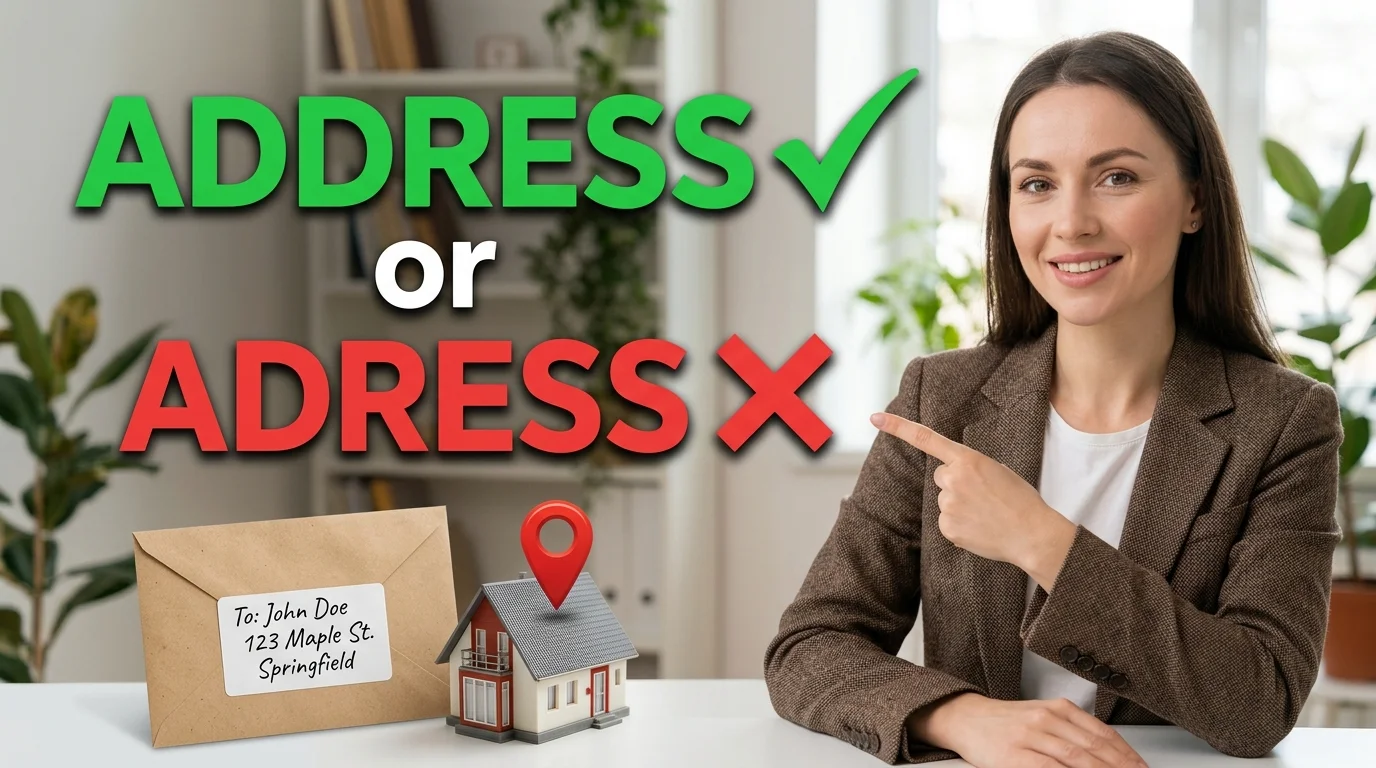
If you have ever typed “adress” and wondered whether it looks right, you are not alone. This spelling mistake is extremely common because the word address has a double d in the middle, which is easy to overlook when typing quickly. Whether you are writing an email, filling out an online form, sending a parcel, creating a CV, or entering your home details, using the correct spelling matters.
The correct spelling is address. The spelling adress is incorrect in standard English. This rule applies to both British English and American English. Although British and American English have many spelling differences, they do not differ on this particular word. Both use address.
Understanding the difference is useful because “address” is a very common English word with several meanings. It can refer to a location, an email address, a website address, or even a formal speech. Once you learn the correct spelling and understand how the word works in different contexts, you can avoid this common mistake with confidence.
Quick Answer: Adress or Address?
The correct spelling is address, with two d’s:
- Correct: address
- Incorrect: adress
For example:
- Please enter your home address.
- What is your email address?
- I need to change my delivery address.
The word adress is a common spelling mistake. It is not the standard English spelling in either British English or American English.
Meaning of the Correct Form: Address
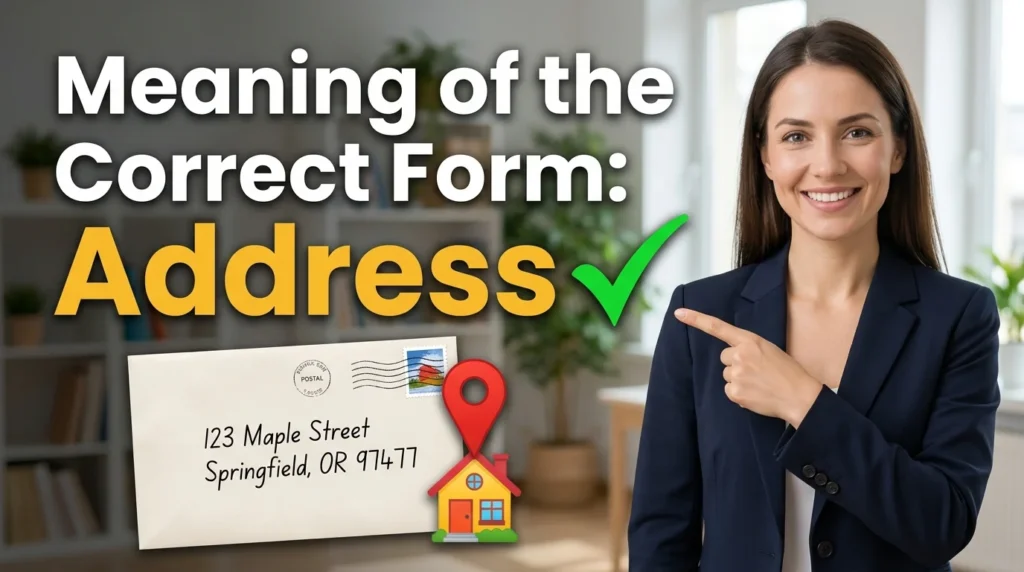
The correct word address has several meanings. Its most common meaning is a place or location where someone lives, works, or receives something.
For example:
Please write your full address on the envelope.
Here, “address” means the complete location information, such as a house number, street name, city, postcode or ZIP code, and country.
However, address can also have other meanings. Depending on the context, it can function as a noun or a verb.
Address as a Noun
As a noun, address commonly means a location.
Examples include:
- home address
- business address
- postal address
- mailing address
- office address
- delivery address
- residential address
- permanent address
- temporary address
- email address
- website address
For example:
My new address is 25 Green Street.
Here, “address” refers to a physical location.
Another example is:
Please send the documents to my office address.
Again, the word refers to a location where the documents should be delivered.
Address as an Email Term
The word address also appears in digital communication.
For example:
What is your email address?
An email address usually contains a username, the @ symbol, and a domain.
For example:
example@email.com
People often make the spelling mistake “adress” when discussing email addresses. However, the correct expression is always email address.
Address as a Website Term
You may also hear web address or website address.
For example:
Enter the website address into your browser.
In this context, “address” refers to the location of a website on the internet.
You may also see the term URL, which stands for Uniform Resource Locator. In everyday conversation, people sometimes use “web address” and “URL” in similar ways.
Address as a Verb
Address can also be a verb. In this form, it can mean to deal with something, speak to someone, or direct something toward a person or issue.
For example:
The manager addressed the customer’s concerns.
Here, “addressed” does not mean a physical location. It means the manager dealt with the concerns.
Another example is:
The teacher addressed the students.
In this sentence, “addressed” means the teacher spoke to the students.
You can also say:
The government needs to address the problem.
Here, “address” means to deal with or take action regarding a problem.
Meaning of the Incorrect Form: Adress
Adress is not the standard spelling of the English word. In most everyday writing, it is simply a spelling mistake for address.
For example:
❌ Please send it to my adress.
The correct version is:
✅ Please send it to my address.
Similarly:
❌ What is your email adress?
Correct:
✅ What is your email address?
The mistake usually happens because people remember the pronunciation of the word but forget that it contains two d’s.
Why Do People Write “Adress”?
There are several reasons.
First, people often type quickly. When someone writes a word repeatedly, they may accidentally leave out one of the letters.
Second, the pronunciation does not clearly remind you that there are two d’s. Therefore, someone may hear the word and spell it as “adress.”
Third, many English spelling mistakes come from dropping repeated letters. Similar problems happen with words such as:
- necessary
- successful
- accommodation
- beginning
- occurrence
However, with address, the easiest solution is simply to remember the double d.
Adress vs Address: Key Differences
The difference between adress and address is straightforward.
| Word | Correct? | Meaning | British English | American English |
| address | ✅ Yes | Location, email location, speech, or deal with an issue | Used | Used |
| adress | ❌ No | Not the standard spelling | Not standard | Not standard |
The important point is that British English and American English both spell the word “address.”
Therefore, you do not need to choose between a British spelling and an American spelling here.
Is “Address” British or American English?
It is both.
British English:
Please enter your postcode and address.
American English:
Please enter your ZIP code and address.
Notice that the word address stays exactly the same.
The difference appears in some of the surrounding vocabulary.
For example:
- British English often uses postcode.
- American English usually uses ZIP code.
However, both varieties spell the main word address with two d’s.
British English vs American English: Address
Although address has the same spelling in both varieties, its pronunciation can sometimes differ.
In British English, “address” can commonly be pronounced with stress on the second syllable:
uh-DRESS
In American English, it is also commonly pronounced with stress on the second syllable, although pronunciation can vary by speaker and region.
The spelling remains unchanged:
address
This is an important distinction. Pronunciation differences do not create a different spelling.
British English Examples
What is your home address?
Please include your postcode and address on the form.
The letter was sent to the wrong address.
American English Examples
What is your home address?
Please include your ZIP code and address on the form.
The package was delivered to the wrong address.
In all of these examples, address has the same spelling.
Common Mistakes People Make
Learning the correct spelling is easier when you understand the mistakes people commonly make.
Mistake 1: Writing “Adress”
This is the most obvious error.
❌ Please confirm your adress.
✅ Please confirm your address.
Remember that address contains two d’s.
Mistake 2: Using “Adress” in an Email
People frequently make this mistake when creating an email account or writing contact information.
❌ My email adress is…
✅ My email address is…
Because email communication is formal in many situations, spelling errors can make a message look less polished.
Mistake 3: Using “Adress” on Forms
Online forms often ask for:
- Full name
- Address
- City
- State or county
- Postcode or ZIP code
- Country
If you see an Address field, use the spelling exactly this way.
❌ Adress
✅ Address
Mistake 4: Forgetting the Second “d” While Typing
Typing quickly can lead to:
adress
instead of:
address
If you frequently make this mistake, slow down slightly when typing the word or use your browser’s spelling checker.
Mistake 5: Thinking British and American English Use Different Spellings
Some words really do have different British and American spellings.
For example:
- colour / color
- favourite / favorite
- centre / center
- organise / organize
However, address is not one of them.
Both British and American English use:
address
Correct Usage in Sentences
The best way to remember a word is to see it in real sentences.
Here are several examples.
Physical Location
I wrote my home address on the application form.
The courier delivered the package to the correct address.
Please confirm your current address before submitting the form.
She moved to a new address last month.
The restaurant’s address is listed on its website.
Email Address
Please send me your email address.
I accidentally entered the wrong email address.
Make sure you check the recipient’s email address before sending the message.
He gave me his business email address.
Mailing Address
Please write your mailing address clearly.
The company asked for my complete mailing address.
My mailing address has changed.
Business Address
The company’s business address appears on its official documents.
Please send the invoice to our office address.
The business recently moved to a new address.
Website Address
Type the website address into your browser.
I copied the web address and sent it to my friend.
The website address is printed on the advertisement.
Address as a Verb
The company addressed the customer’s complaint.
The speaker addressed the audience.
We need to address this problem quickly.
The report addresses several important issues.
These examples show that address has a wider meaning than simply “where someone lives.”
Adress or Address in Formal Writing
Correct spelling becomes especially important in professional and academic writing.
Suppose you are writing a job application.
Incorrect:
Please contact me at the following adress.
Correct:
Please contact me at the following address.
Similarly, in a business email:
Could you please confirm the delivery address?
Using the correct spelling helps your writing look accurate and professional.
In Academic Writing
You may see “address” used as a verb in academic writing.
For example:
This study addresses the main causes of the problem.
Here, “address” means examines or deals with.
Another example:
The article addresses several important questions.
Again, it does not refer to a physical location.
Address as a Noun vs Address as a Verb
Understanding the two main grammatical uses can make the word much easier to remember.
Address as a Noun
When address is a noun, it often refers to a location or a set of contact details.
Example:
I need your address.
Here, “address” is a noun.
Another example:
Her email address is easy to remember.
Address as a Verb
When address is a verb, it often means to deal with something or speak to someone.
Example:
We must address the problem.
Here, “address” is a verb.
Another example:
The manager addressed the team.
In this sentence, “addressed” means the manager spoke to the team.
Why the Double “d” Matters
One of the easiest ways to remember the correct spelling is to focus on the middle of the word.
The word is:
a + dd + ress
Notice the double d:
address
Not:
adress
A simple spelling breakdown can help:
A-D-D-R-E-S-S
You can say the letters mentally when you type the word.
Easy Memory Tricks for “Address”
If you often confuse adress and address, try one of these simple tricks.
Trick 1: Double D
Remember:
Address = Double D
The word contains two d’s.
Trick 2: “A DD Ress”
Break the word into:
A + DD + RESS
The “DD” reminds you to include both d’s.
Trick 3: Think About Two Directions
You can create a personal memory association:
An address needs two D’s.
The association itself is not a grammar rule, but it can help you remember the spelling.
Trick 4: Type It Slowly
Write:
A-D-D-R-E-S-S
Then repeat it several times.
After a little practice, the correct spelling will become automatic.
How to Spell Address Correctly
The spelling is:
A-D-D-R-E-S-S
Full word:
address
Common incorrect version:
adress
You can remember the word by dividing it into two parts:
add + ress
The first part helps remind you of the two d’s.
Adress or Address in Online Forms
Online forms are one of the most common places where you will see this word.
For example, a shopping website might ask you to enter:
Billing Address
or
Shipping Address
You may then need to provide:
- House or apartment number
- Street name
- City
- State, province, or county
- Postcode or ZIP code
- Country
In British English contexts, you may commonly see postcode.
In American English contexts, you will commonly see ZIP code.
Nevertheless, the heading remains:
Address
not:
Adress
Address in UK English
In the UK, people commonly use address when discussing homes, offices, postal information, and digital contact details.
Examples:
What is your new address?
Please enter your postcode and address.
I sent the letter to the wrong address.
The company’s registered address is shown on its website.
British English often uses postcode where American English uses ZIP code.
For example:
British English: Please enter your postcode.
American English: Please enter your ZIP code.
But:
Both: Please enter your address.
Address in US English
American English also uses address in exactly the same spelling.
Examples:
What is your mailing address?
Please enter your ZIP code and address.
I need your shipping address.
The package was sent to the wrong address.
Again, there is no “adress” spelling in standard American English.
Address in Everyday Conversation
You will hear address frequently in everyday conversations.
For example:
Person A: What is your address?
Person B: I live at 24 Oak Street.
Or:
Person A: Did you get my email?
Person B: I think you may have sent it to the wrong email address.
These everyday examples show why knowing the correct spelling is useful.
Address in Business Communication
Businesses use the word constantly.
For example:
Please confirm your billing address before completing your order.
Our office address has changed.
Please update your shipping address.
The invoice was sent to the wrong email address.
In professional writing, avoid the spelling adress.
A spelling mistake may not change the meaning, but it can make your communication look careless.
Address in Technology
Modern technology uses the word address in several ways.
You may encounter:
- email address
- web address
- IP address
- network address
- MAC address
- wallet address
- postal address
For example:
Please copy the email address carefully.
Or:
The website address appears at the top of the page.
The spelling remains:
address
IP Address
In computing, an IP address identifies a device or network interface using an Internet Protocol address.
For example, someone might say:
The server has a unique IP address.
This is another example where the correct spelling contains two d’s.
You should not write:
❌ IP adress
Instead:
✅ IP address
Common Search Queries About “Adress or Address”
People searching for this spelling often use queries such as:
- adress or address
- correct spelling of address
- is adress correct?
- how do you spell address?
- address spelling
- adress meaning
- address meaning
- correct address spelling
- address or adress in English
- is “adress” a word?
- email address spelling
- home address spelling
All of these questions point to the same basic answer: address is the standard English spelling.
Is “Adress” Ever Correct?
For standard English writing, adress is generally not the correct spelling of address.
If you are writing an email, article, essay, application, business document, website, or form, use:
address
not:
adress
There may be names, usernames, trademarks, or other special cases where unusual spellings appear. However, those special cases do not change the standard English spelling.
Quick Comparison Examples
Here is a simple side-by-side comparison:
| Incorrect | Correct |
| What is your adress? | What is your address? |
| Enter your email adress. | Enter your email address. |
| I changed my adress. | I changed my address. |
| Send it to this adress. | Send it to this address. |
| The adress is wrong. | The address is wrong. |
| Please confirm your adress. | Please confirm your address. |
| What is the company’s adress? | What is the company’s address? |
The pattern is easy to see: replace adress with address.
Common Spelling Patterns to Watch
English contains many words where repeated letters can be easy to forget. If you frequently make this kind of mistake, pay attention to words with double letters.
Examples include:
- address
- successful
- necessary
- accommodation
- committee
- occurrence
- beginning
- different
However, do not assume every English word follows the same spelling pattern. When you are unsure, checking a reliable dictionary or spell checker can help.
How to Avoid the “Adress” Mistake
Here are some practical habits.
1. Remember “Double D”
Think:
Address = DD
This is the fastest memory trick.
2. Use Spell Check
Modern word processors, browsers, and writing applications can detect many spelling mistakes automatically.
If you type adress, your software may suggest address.
3. Proofread Important Documents
Before submitting a job application, business form, email, or official document, check common words carefully.
4. Learn the Word as a Whole
Instead of trying to reconstruct the spelling every time, memorize:
address
Repeated exposure will make the correct spelling familiar.
5. Practise With Sentences
Write:
My address is easy to remember.
Then:
Please send the package to my address.
Then:
I changed my email address.
Using the word repeatedly helps reinforce its spelling.
Frequently Asked Questions
1. Is “adress” or “address” correct?
Address is correct. The word is spelled with two d’s:
address
“Adress” is a common spelling mistake.
2. Is “adress” a word in English?
Adress is not the standard spelling of the English word used for a location, email contact, or related meanings. In standard English writing, use address.
3. Is “address” British or American English?
Address is used in both British and American English. The spelling is the same in both varieties.
4. Does British English spell address differently?
No. British English spells it address, just like American English.
British English may use related terms such as postcode, while American English commonly uses ZIP code, but the spelling of address does not change.
5. How do you spell address?
The correct spelling is:
A-D-D-R-E-S-S
The important part to remember is the double d.
6. What is the plural of address?
The plural is:
addresses
For example:
I have three different mailing addresses.
Notice that the spelling changes slightly when adding the plural ending, but the word still begins with address.
7. Is “email adress” correct?
No. The correct phrase is:
email address
For example:
Please send me your email address.
8. Is “home adress” correct?
No. The correct phrase is:
home address
For example:
Please provide your home address.
9. Is “postal adress” correct?
No. The standard spelling is:
postal address
This phrase is common when discussing information used for physical mail.
10. Can “address” be a verb?
Yes. Address can be a verb as well as a noun.
For example:
The manager addressed the complaint.
Here, “addressed” means dealt with or responded to the complaint.
11. Does “address” always mean a home location?
No. It can refer to many types of locations or contact details.
For example:
- home address
- office address
- business address
- mailing address
- email address
- web address
- IP address
It can also mean to speak to someone or deal with an issue when used as a verb.
12. Why do people spell address as “adress”?
The most common reason is that people accidentally leave out one of the two d’s. Fast typing and uncertainty about the spelling can also cause the mistake.
Final Takeaway:
In conclusion, address is the correct spelling, while adress is a common spelling mistake. The word address can refer to a person’s home location, a mailing destination, or the act of speaking to someone or dealing with a particular issue. For example, you might write, “Please send the package to my home address.”
Remember that address contains two “d” letters and two “s” letters. Although the incorrect spelling may look similar, it is not accepted in standard English. Learning this simple spelling difference will help you write more accurately and confidently in emails, forms, articles, and everyday communication.