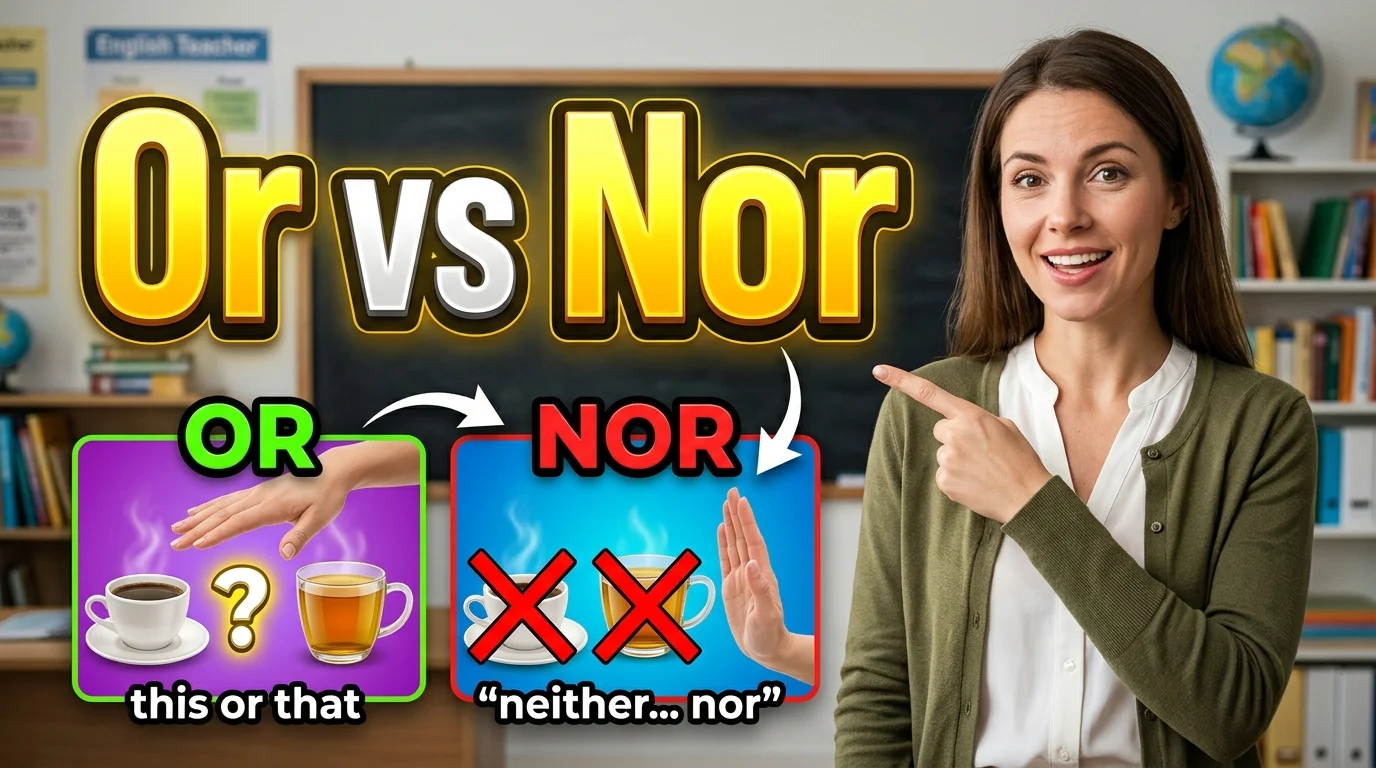
Choosing between “or” and “nor” can sometimes be confusing because both words connect ideas, choices, or alternatives in a sentence. However, they serve different purposes, and using the wrong one can change the meaning of what you want to say. “Or” is commonly used to present a choice between two or more possibilities, such as “Would you like tea or coffee?”
In contrast, “nor” is generally used to add another negative idea, often after words like “neither” or “not,” as in “Neither Sarah nor John attended the meeting.” Although these words may seem similar, understanding their grammatical roles makes writing clearer and more natural. Many students, English learners, and everyday writers struggle to decide when to use each one, especially when building longer sentences or connecting multiple ideas.
Learning the difference between “or” and “nor” can help you avoid common grammar mistakes and communicate more confidently in academic, professional, and casual writing. In this guide, we’ll explore what “or” and “nor” mean, explain their key differences, and share simple examples to show you how to use both words correctly.
Quick Answer: Or vs Nor
“Or” is generally used to introduce an alternative, choice, or possibility. For example: “Would you like tea or coffee?” It can also appear in negative sentences when you want to present alternatives.
“Nor” is generally used to add another negative idea. It often follows neither or a negative statement. For example: “I neither called him nor texted him.” You can also say, “She didn’t call, nor did she send a message.”
In simple terms:
- Or = an alternative or choice
- Nor = another negative alternative
- Either … or = one choice from alternatives
- Neither … nor = not one and not the other
The same basic rules apply in both British and American English.
Meaning of “Or”
Or is a coordinating conjunction that connects alternatives. It tells the reader or listener that there is a choice between two or more possibilities.
For example:
- Would you like tea or coffee?
- You can call me today or tomorrow.
- We can travel by bus or train.
- Is your answer yes or no?
- You can choose the red shirt or the blue one.
In each sentence, “or” presents an alternative.
“Or” for Choices
One of the most common uses of “or” is to show a choice.
Consider this sentence:
Would you like pizza or pasta?
The speaker offers two possibilities. The person can choose pizza, pasta, or potentially neither.
Another example is:
You can stay here or come with us.
Again, “or” connects two alternatives.
“Or” for Possibilities
“Or” can also describe different possible situations.
For example:
We may go to London or Manchester this weekend.
The speaker has not decided which city they will visit.
Similarly:
You might receive an email or a phone call.
The sentence describes two possible outcomes.
“Or” for Clarification
Sometimes “or” introduces another way to explain something.
For example:
The meeting starts at noon, or 12 p.m.
Here, the second expression clarifies the first.
You might also see:
The shop closes at 6 p.m., or six in the evening.
This use is common in everyday speech and explanatory writing.
Meaning of “Nor”
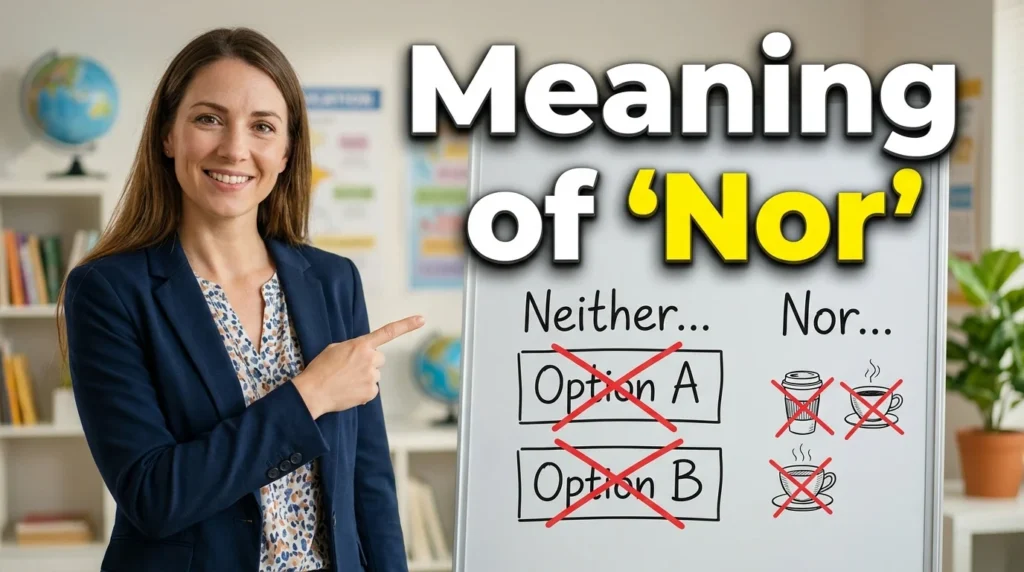
Nor is also a conjunction, but it generally connects negative ideas. It often means something similar to “and not” or “and neither.”
For example:
She doesn’t like coffee, nor does she like tea.
The first part is negative, and “nor” introduces another negative idea.
Another example:
He neither called nor emailed me.
This means he did not call and did not email.
“Neither … Nor”
One of the most familiar structures involving “nor” is:
neither … nor
This structure means that both options are negative.
For example:
I like neither tea nor coffee.
This means that I do not like tea and I do not like coffee.
Another example:
Neither John nor Sarah attended the meeting.
This means John did not attend and Sarah did not attend.
“Nor” After a Negative Statement
“Nor” can also appear after a negative clause without “neither.”
For example:
She didn’t apologise, nor did she explain what happened.
The first clause is negative:
She didn’t apologise.
The second clause is also negative:
She did not explain what happened.
When “nor” introduces the second clause, formal English often uses subject-auxiliary inversion:
nor did she explain
rather than:
nor she explained
This structure may seem difficult at first, but it becomes easier with practice.
Or vs Nor: Key Differences
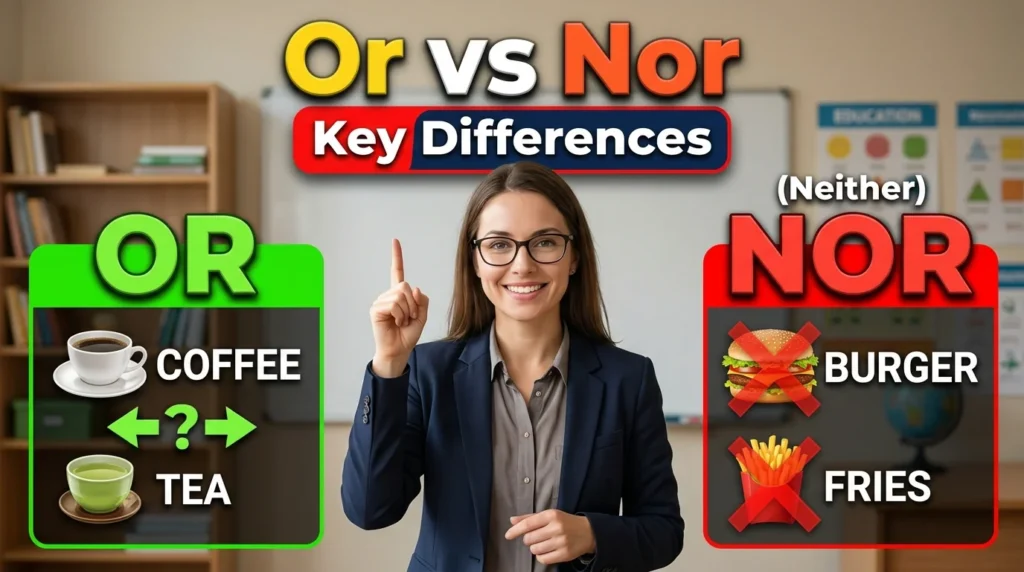
The main difference between or and nor is the type of relationship they express.
| Feature | Or | Nor |
| Main purpose | Shows alternatives | Connects negative alternatives |
| Common meaning | This or that | Not this and not that |
| Common structure | either … or | neither … nor |
| Usually negative? | No | Yes |
| Used for choices? | Yes | Usually negative choices |
| UK usage | Common | Common |
| US usage | Common | Common |
Simple Comparison
Compare these sentences:
You can have tea or coffee.
This gives a choice.
Now compare:
You can have neither tea nor coffee.
This means both options are excluded.
The difference becomes even clearer here:
I don’t want tea or coffee.
This can mean that the speaker does not want either option.
You could also say:
I want neither tea nor coffee.
Both communicate a negative meaning, but the grammatical structures differ.
Either … Or vs Neither … Nor
A very useful way to understand or vs nor is to learn these two patterns together.
Either … Or
Either … or presents two alternatives.
Examples:
- You can either call me or email me.
- We can either walk or take a taxi.
- She will either study medicine or study law.
- Either James or Michael will attend.
The meaning is generally that one of the alternatives is possible or selected.
Neither … Nor
Neither … nor makes both alternatives negative.
Examples:
- I want neither tea nor coffee.
- Neither Tom nor Harry was available.
- She speaks neither Spanish nor Italian.
- We visited neither London nor Oxford.
A simple memory trick is:
Either goes with or.
Neither goes with nor.
This is one of the easiest rules to remember.
Is “Nor” the Opposite of “Or”?
Not exactly.
It is tempting to think of “or” and “nor” as direct opposites, but grammar is slightly more complicated.
Or normally connects alternatives:
Would you like tea or coffee?
Nor usually connects negative alternatives:
I want neither tea nor coffee.
Therefore, “nor” does not simply mean “the opposite of or.” Instead, it normally appears in negative constructions.
Think of the relationship this way:
- either → or
- neither → nor
This pairing helps you choose the right conjunction quickly.
Common Mistakes With Or and Nor
Even though the basic rule is simple, several mistakes appear frequently in everyday writing.
Mistake 1: Using “or” After “neither”
A common error is:
I like neither tea or coffee.
The standard construction is:
I like neither tea nor coffee.
The pattern is:
neither + option 1 + nor + option 2
Mistake 2: Using “nor” After “either”
Another common mistake is:
You can either stay nor leave.
The correct construction is:
You can either stay or leave.
Remember:
either … or
not:
either … nor
Mistake 3: Forgetting the Negative Meaning
“Nor” generally carries a negative relationship.
For example:
She didn’t call, nor did she text.
Both actions are negative.
If you simply want to present two choices, use “or”:
She can call or text.
Mistake 4: Incorrect Word Order After “Nor”
When “nor” introduces an independent clause, formal English commonly uses inversion.
Incorrect:
He didn’t apologise, nor he explained his actions.
Better:
He didn’t apologise, nor did he explain his actions.
Notice the auxiliary verb did comes before the subject he.
Mistake 5: Mixing “Neither” and “Or”
Incorrect:
Neither John or Sarah came.
Correct:
Neither John nor Sarah came.
This is one of the most common errors involving these conjunctions.
Correct Usage of “Or” in Sentences
Here are several examples that show how naturally “or” works in everyday English.
Everyday Examples
- Would you like tea or coffee?
- Should we leave now or wait?
- You can pay by card or cash.
- Do you want the large size or the small size?
- Is the appointment on Monday or Tuesday?
- We can watch a film or play a game.
- You can send the document by email or post.
- Would you prefer to sit inside or outside?
These examples work naturally in both British and American English.
British English Examples
British English commonly uses “or” in everyday choices:
Would you like tea or coffee?
Shall we travel by train or bus?
You can pay by card or cash.
The vocabulary around the conjunction may vary in British English, but the use of “or” remains essentially the same.
American English Examples
American English uses the same grammatical pattern:
Do you want coffee or tea?
Should we drive or take the train?
Would you like to pay by card or cash?
Again, there is no major UK-US difference in the basic use of “or.”
Correct Usage of “Nor” in Sentences
Now let’s look at examples using “nor.”
With Neither
- I like neither tea nor coffee.
- She speaks neither French nor German.
- Neither Jack nor Emily attended.
- He owns neither a car nor a bicycle.
- We visited neither Paris nor Rome.
- Neither answer is correct.
- She wants neither money nor fame.
After a Negative Statement
“Nor” can also follow another negative statement:
I didn’t see him, nor did I speak to him.
She hasn’t called, nor has she sent a message.
He wasn’t interested, nor was he willing to participate.
They didn’t complain, nor did they ask for help.
These constructions are particularly common in formal writing.
Or vs Nor in British English
British English follows the same fundamental distinction between “or” and “nor.”
For example:
Would you like coffee or tea?
This expresses a choice.
I would like neither coffee nor tea.
This expresses a negative choice.
British writers may encounter “nor” frequently in formal writing, literature, academic contexts, and official communication.
For example:
The applicant neither accepted the offer nor rejected it.
This sentence sounds formal but grammatically natural.
British English Style Note
British English sometimes uses structures such as:
He didn’t complain, nor did he ask for a refund.
This is perfectly grammatical and can sound formal or polished.
However, in casual conversation, speakers may choose simpler wording:
He didn’t complain, and he didn’t ask for a refund either.
Both sentences communicate essentially the same idea.
Or vs Nor in American English
American English uses the same core rules.
For example:
Do you want pizza or burgers?
This presents alternatives.
I want neither pizza nor burgers.
This excludes both choices.
American English also commonly uses “nor” after negative statements:
She didn’t call, nor did she text.
In casual conversation, however, speakers may prefer a simpler construction:
She didn’t call, and she didn’t text either.
Therefore, the difference is not that British English uses “nor” while American English uses “or.” Both varieties use both words.
Are There Any Major UK and US Differences?
There is no major grammatical difference between British and American English when it comes to the basic use of “or” and “nor.”
Both varieties generally follow these patterns:
- either … or
- neither … nor
- alternatives → or
- additional negative idea → nor
Differences may appear in vocabulary, punctuation preferences, or conversational style, but the fundamental conjunction rules remain the same.
For example:
British English:
You can either take the bus or walk.
American English:
You can either take the bus or walk.
The grammar is identical.
Parallel Structure With Or and Nor
When using “or” or “nor” to connect words or phrases, try to maintain parallel structure.
Parallel structure means that the connected items follow the same grammatical pattern.
For example:
She likes reading or writing.
Both “reading” and “writing” are -ing forms.
A less balanced sentence would be:
She likes reading or to write.
A better version is:
She likes reading or writing.
Similarly:
He wants either to study medicine or to study engineering.
The structures match.
You can also shorten it:
He wants to study either medicine or engineering.
Good parallel structure makes your writing easier to understand.
Subject-Verb Agreement With Either … Or and Neither … Nor
Another area that can confuse learners is subject-verb agreement.
When either … or or neither … nor connects two subjects, the verb can depend on the subjects and their placement.
For example:
Either the manager or the employees are responsible.
Here, “employees” is plural and appears close to the verb, so are is natural.
Compare:
Either the employees or the manager is responsible.
Here, “manager” is singular and appears close to the verb, so is is used.
The same principle applies to “neither … nor”:
Neither the manager nor the employees are available.
Neither the employees nor the manager is available.
This is especially useful in formal writing.
More Examples of Or vs Nor
Let’s look at several examples side by side.
| Or Example | Nor Example |
| Do you want tea or coffee? | I want neither tea nor coffee. |
| We can stay or leave. | We can do neither. |
| Choose red or blue. | Choose neither red nor blue. |
| You can call or email. | She didn’t call, nor did she email. |
| Is it Monday or Tuesday? | It is neither Monday nor Tuesday. |
| He can drive or walk. | He can neither drive nor walk. |
This comparison makes the difference much easier to see.
When Should You Use “Or”?
Use or when you want to:
- Present alternatives
- Give someone a choice
- Describe possibilities
- Connect alternative words or phrases
- Clarify or restate information
- Show that one possibility may happen instead of another
Examples:
Call me or send me a message.
We can meet today or tomorrow.
Is this your book or mine?
You can choose either option.
When Should You Use “Nor”?
Use nor when you want to:
- Connect negative alternatives
- Complete the structure “neither … nor”
- Add another negative idea
- Follow a negative clause in formal constructions
Examples:
Neither answer is correct, nor is the question clear.
She didn’t call, nor did she email.
He neither laughed nor smiled.
A Simple Memory Trick
If you often confuse these words, remember this:
OR = Options and Opportunities
Think of OR as giving you options.
Tea or coffee?
Bus or train?
Stay or leave?
NOR = Negative
Think of NOR as connected with “not.”
Neither tea nor coffee.
He didn’t call, nor did he text.
This is not a complete grammar rule, but it is a useful memory aid.
Another easy trick is:
Either → Or
Neither → Nor
If you remember only one thing from this article, remember that pair.
How to Improve Your Use of Or and Nor
You can improve your grammar quickly by paying attention to the meaning of the sentence.
First, ask yourself:
Am I presenting a choice?
If yes, or will usually be appropriate.
Do you want pizza or pasta?
Next, ask:
Am I connecting two negative ideas?
If yes, nor may be appropriate.
I want neither pizza nor pasta.
Then check whether you are using a paired construction.
- either → or
- neither → nor
Finally, check your sentence structure.
If “nor” introduces a new clause, make sure the word order sounds correct:
She didn’t respond, nor did she explain why.
Or vs Nor in Formal Writing
Both words can appear in formal writing, but “nor” can sound particularly formal when it follows a negative clause.
For example:
The report does not provide sufficient evidence, nor does it explain the methodology.
This sounds more formal than:
The report doesn’t provide enough evidence, and it doesn’t explain the methodology either.
Neither is inherently wrong. The best choice depends on the tone and context.
Academic Writing
In academic writing, you may see:
The study neither confirms nor rejects the hypothesis.
This is concise and formal.
Another example:
The research did not examine age differences, nor did it consider regional variation.
Again, “nor” efficiently connects two negative statements.
Everyday Writing
In casual writing, you may prefer:
I don’t want pizza or burgers.
Or:
I don’t want pizza, and I don’t want burgers either.
The formal construction:
I want neither pizza nor burgers.
is also correct.
Common Questions Learners Ask
Is “nor” always negative?
Usually, nor appears in a negative construction or adds another negative idea. The most familiar example is “neither … nor.”
Can I use “or” after “neither”?
In standard English, the normal paired construction is neither … nor, not “neither … or.”
Correct:
Neither John nor Mary came.
Incorrect:
Neither John or Mary came.
Can I use “nor” after “either”?
Normally, no. The standard pair is either … or.
Correct:
You can either stay or leave.
Incorrect:
You can either stay nor leave.
Is “nor” more formal than “or”?
“Nor” can sound more formal in constructions such as:
He didn’t call, nor did he write.
However, “nor” is not exclusively formal. It is a standard English conjunction.
Do British and American English use “or” differently?
The basic grammatical use of “or” is the same in British and American English.
Do British and American English use “nor” differently?
There is no major difference in the basic grammar. Both varieties use “nor” in constructions such as neither … nor and after negative clauses.
Is “neither … nor” always correct?
Yes, when you want to express that two alternatives are both excluded.
For example:
Neither option is suitable.
Neither Tom nor Sarah attended.
What is the easiest way to remember “or vs nor”?
Remember:
Either goes with or.
Neither goes with nor.
Also remember that or usually presents alternatives, while nor commonly connects negative alternatives.
FAQs About Or vs Nor
1. What is the main difference between “or” and “nor”?
Or usually presents an alternative or choice, while nor generally connects another negative idea. For example, “Do you want tea or coffee?” gives a choice, while “I want neither tea nor coffee” excludes both choices.
2. Which is correct: “neither or” or “neither nor”?
The standard construction is neither … nor.
Correct:
She likes neither tea nor coffee.
3. Which is correct: “either or” or “either nor”?
The standard construction is either … or.
Correct:
You can either stay or leave.
4. Can “nor” be used without “neither”?
Yes. “Nor” can follow a negative clause.
For example:
He didn’t call, nor did he send a message.
This is grammatically correct.
5. Is “or” used in both British and American English?
Yes. British and American English both use “or” to introduce alternatives and choices.
6. Is “nor” common in American English?
Yes. American English uses “nor,” particularly in constructions such as neither … nor and formal sentences following negative statements.
7. Should I use “nor” in everyday conversation?
You can. However, in casual speech, people sometimes choose simpler structures.
For example:
I didn’t call, and I didn’t text either.
is more conversational than:
I didn’t call, nor did I text.
Both are grammatically acceptable.
8. Does “nor” mean “or not”?
Not exactly. “Nor” generally connects negative alternatives or adds another negative statement. It should not simply be treated as a direct replacement for “or.”
9. Can “or” appear in negative sentences?
Yes.
For example:
I don’t want tea or coffee.
However, depending on the intended meaning and style, you could also write:
I want neither tea nor coffee.
10. Is “neither … nor” more formal than “not … or”?
It can sound more formal or polished, but both constructions can be correct depending on the sentence and intended meaning.
Final Takeaway:
In conclusion, or and nor are both conjunctions, but they serve different purposes in English grammar. Or is used to present choices, alternatives, or possibilities between two or more options. For example, “Would you like tea or coffee?” Nor, on the other hand, is used to connect negative ideas and often follows words such as neither or not. For example, “She likes neither tea nor coffee.”
Understanding the difference between these two words helps you construct grammatically correct sentences and express your ideas more clearly. Remember to use or when offering choices and nor when connecting negative alternatives in your writing.