If you have ever written the word “pyjamas” and wondered whether it should actually be “pajamas,” you are not alone. Both spellings appear frequently online, in books, clothing shops, advertisements, and everyday conversations. At first glance, the difference looks like a simple spelling mistake. However, both forms are correct, and the choice mainly depends on the variety of English you are using.
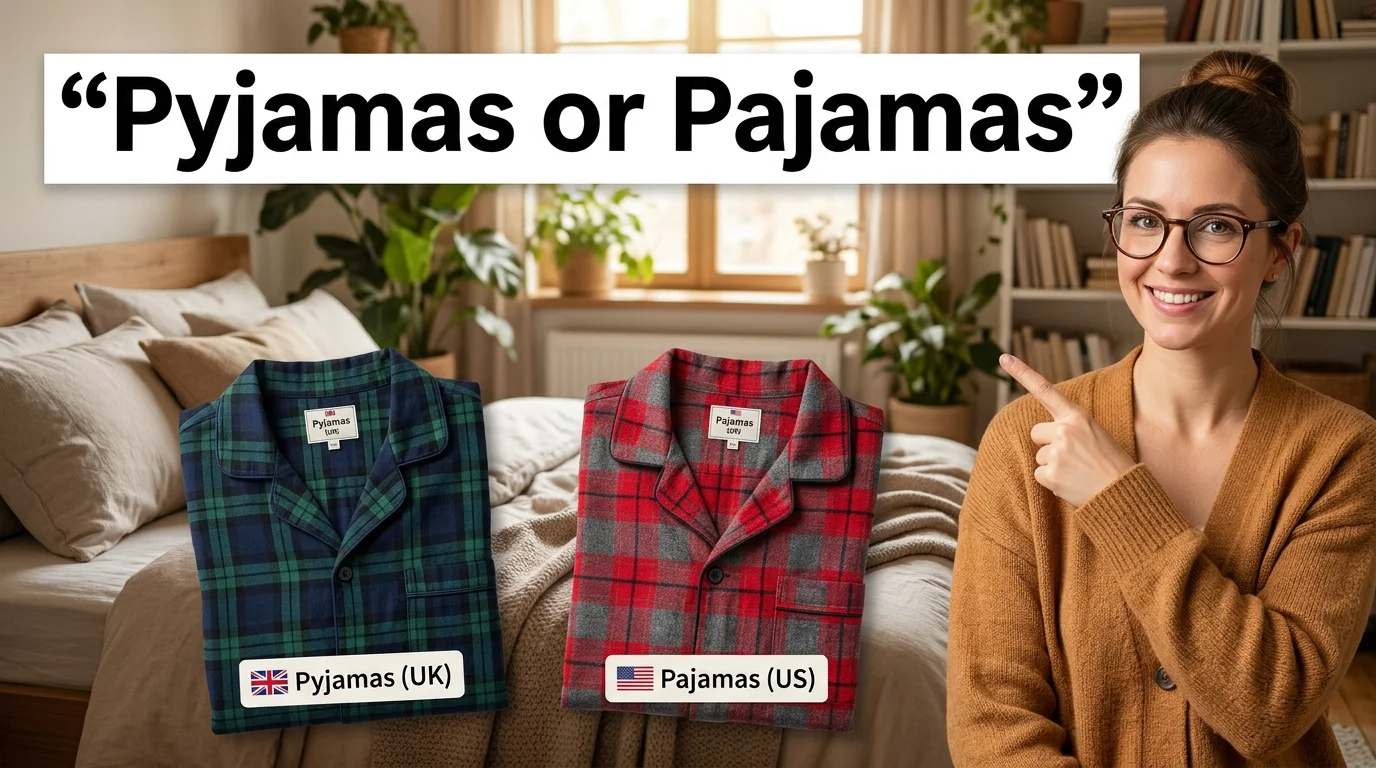
The main difference is between British English and American English. In British English, “pyjamas” is the standard spelling. In American English, “pajamas” is the standard spelling. Therefore, neither spelling is universally wrong. The important thing is to understand which version fits your audience, location, or style of English.
This distinction becomes especially useful when writing for an international audience. For example, someone in the UK might say, “I need to buy new pyjamas,” while someone in the US would normally write, “I need to buy new pajamas.” The meaning remains exactly the same.
Quick Answer: Pyjamas or Pajamas?
“Pyjamas” and “pajamas” are both correct spellings. The difference comes from regional English.
- Pyjamas = standard British English spelling 🇬🇧
- Pajamas = standard American English spelling 🇺🇸
Both words refer to clothing worn for sleeping or relaxing, usually consisting of a top and trousers or shorts.
So, if you are writing in British English, use pyjamas. If you are writing in American English, use pajamas.
For example:
- UK: I bought a new pair of pyjamas.
- US: I bought a new pair of pajamas.
Neither spelling changes the pronunciation or basic meaning.
Meaning of the Correct Form
The word pyjamas or pajamas refers to clothing people normally wear while sleeping. The word can also describe comfortable clothing worn around the house, especially before going to bed or after waking up.
A typical pair may include:
- A loose-fitting shirt or top
- Trousers or pants
- Shorts in warmer weather
- A matching sleepwear set
The spelling changes depending on the type of English, but the meaning does not.
Pyjamas in British English
In British English, pyjamas is the standard spelling.
For example:
I put on my pyjamas before going to bed.
Another example is:
My children have new pyjamas for Christmas.
British speakers may also use informal expressions such as “PJs” or “jammies,” although these are more casual.
Pajamas in American English
In American English, pajamas is the standard spelling.
For example:
I put on my pajamas before going to bed.
You might also see:
She bought a new pair of pajamas yesterday.
Americans commonly shorten the word to “PJs.”
Therefore, if you are writing for American readers, pajamas will generally look more natural.
Why Are There Two Spellings?

The difference comes from the historical development of English and the influence of other languages.
The word ultimately comes from a term associated with clothing worn in South Asia and later entered English through other languages. Over time, different varieties of English developed different spellings.
British English retained the spelling pyjamas, while American English generally adopted pajamas.
This kind of difference appears in many other English words.
For example:
| British English | American English |
| pyjamas | pajamas |
| colour | color |
| favourite | favorite |
| centre | center |
| travelling | traveling |
| programme | program |
| jewellery | jewelry |
Therefore, pyjamas vs pajamas is part of a much larger pattern of British and American spelling differences.
Pyjamas vs Pajamas: Key Differences
The most important difference is spelling rather than meaning.
| Feature | Pyjamas | Pajamas |
| English variety | British English | American English |
| Meaning | Sleepwear | Sleepwear |
| Pronunciation | Essentially the same | Essentially the same |
| Standard usage | UK and some other varieties | US |
| Singular form | Pyjama | Pajama |
| Common short form | PJs | PJs |
| Correct? | Yes | Yes |
As you can see, both forms are legitimate.
British English: Pyjamas
If your audience is primarily in the United Kingdom, use pyjamas.
Examples:
- I need to wash my pyjamas.
- These pyjamas are very comfortable.
- She wore her pyjamas all morning.
- Where did you buy those pyjamas?
American English: Pajamas
If your audience is primarily in the United States, use pajamas.
Examples:
- I need to wash my pajamas.
- These pajamas are very comfortable.
- She wore her pajamas all morning.
- Where did you buy those pajamas?
Notice that the sentence structure and meaning stay the same. Only the spelling changes.
Is “Pyjamas” Wrong?
No. “Pyjamas” is not wrong.
It is the standard spelling in British English.
For example:
I am wearing my pyjamas.
This sentence is completely correct in British English.
However, an American writer would normally choose:
I am wearing my pajamas.
Therefore, calling pyjamas an incorrect spelling would be misleading. It is simply the British form.
Is “Pajamas” Wrong?
No. “Pajamas” is also correct.
It is the standard American English spelling.
For example:
I bought new pajamas for the winter.
This sentence is perfectly natural in American English.
A British writer would generally use:
I bought new pyjamas for the winter.
Again, the difference is regional rather than grammatical.
Common Mistakes People Make
Although both spellings are correct, people often make mistakes when choosing between them.
Mistake 1: Thinking One Spelling Is Always Correct
A common mistake is assuming that one version must be correct and the other must be wrong.
For example:
“Pajamas is misspelled. It should always be pyjamas.”
That statement is incorrect because pajamas is standard American English.
Likewise:
“Pyjamas is misspelled.”
That is not correct when discussing British English.
Mistake 2: Mixing British and American Spelling
Another common problem occurs when writers mix spelling systems within the same piece of writing.
For example:
My favourite pajamas are blue.
Here, favourite follows British English, while pajamas follows American English.
There is nothing inherently wrong with understanding both forms. However, if you are intentionally writing in one variety of English, consistency usually makes your writing cleaner.
A British version would be:
My favourite pyjamas are blue.
An American version would be:
My favorite pajamas are blue.
Mistake 3: Changing the Meaning
Some learners believe that pyjamas and pajamas refer to different types of clothing.
They do not.
Both words describe sleepwear.
The spelling does not tell you whether the clothing is for children, adults, men, or women.
Mistake 4: Assuming Pronunciation Changes
The spelling looks different, so some learners assume the pronunciation must be different.
In normal English usage, the pronunciation is essentially the same.
The major difference is simply the spelling:
pyjamas → British English
pajamas → American English
Mistake 5: Using Both Forms Randomly
If you are creating a professional article, website, book, or educational resource, randomly switching between pyjamas and pajamas can make your writing appear inconsistent.
For example:
I bought new pajamas. My pyjamas are very comfortable.
A reader can understand the sentence, but it is better to select one spelling according to your intended variety of English.
Correct Usage in British English Sentences
Here are several natural examples using pyjamas.
Example 1
I put on my pyjamas before going to bed.
Example 2
My new pyjamas are soft and comfortable.
Example 3
She received a pair of pyjamas as a birthday present.
Example 4
The children changed into their pyjamas after dinner.
Example 5
I forgot to pack my pyjamas for the trip.
Example 6
These pyjamas are too warm for summer.
Example 7
He walked downstairs wearing his pyjamas.
Example 8
I need to buy some new pyjamas this weekend.
All of these examples use the standard British spelling.
Correct Usage in American English Sentences
Now compare those examples with American English.
Example 1
I put on my pajamas before going to bed.
Example 2
My new pajamas are soft and comfortable.
Example 3
She received a pair of pajamas as a birthday present.
Example 4
The children changed into their pajamas after dinner.
Example 5
I forgot to pack my pajamas for the trip.
Example 6
These pajamas are too warm for summer.
Example 7
He walked downstairs wearing his pajamas.
Example 8
I need to buy some new pajamas this weekend.
The meaning remains unchanged.
Pyjama or Pajama: What About the Singular Form?
You may also wonder about the singular form.
The British spelling is:
pyjama
The American spelling is:
pajama
For example:
British English:
I found a pyjama top in the bedroom.
American English:
I found a pajama top in the bedroom.
However, in everyday usage, people often refer to the clothing as a set or use the plural forms pyjamas and pajamas.
You may therefore encounter phrases such as:
- pyjama top
- pyjama trousers
- pyjama set
- pajama top
- pajama pants
- pajama set
Pyjamas or Pajamas in Online Shopping
This spelling difference is especially noticeable when shopping online.
A British clothing website may advertise:
- Women’s pyjamas
- Men’s pyjamas
- Children’s pyjamas
- Cotton pyjama sets
- Winter pyjamas
An American website may instead use:
- Women’s pajamas
- Men’s pajamas
- Children’s pajamas
- Cotton pajama sets
- Winter pajamas
Both versions communicate the same idea.
However, online retailers usually choose wording that matches their primary market.
Pyjamas or Pajamas in Formal Writing
When writing formally, the most important rule is consistency.
If you are writing for a British audience, use pyjamas.
If you are writing for an American audience, use pajamas.
For example, a British school resource might say:
Students should bring comfortable pyjamas for the overnight activity.
An American school resource might say:
Students should bring comfortable pajamas for the overnight activity.
Neither sentence is more grammatically correct than the other. The spelling reflects the intended variety of English.
Which Spelling Should You Use for SEO?
If you are creating online content, your choice can depend on your target audience.
For a UK-focused website, pyjamas is usually the natural spelling.
For a US-focused website, pajamas is usually the natural spelling.
If you target an international English-speaking audience, you can mention both forms naturally.
For example:
In British English, the word is usually spelled “pyjamas,” while American English uses “pajamas.”
This approach can help readers immediately understand the difference without making the article confusing.
SEO Tip
Do not force both spellings into every paragraph simply to target keywords.
Instead, explain the difference naturally.
Search engines can understand related words and variations, so useful content should remain your priority.
Pyjamas or Pajamas in Different Countries
British and American English influence many other English-speaking regions. As a result, usage can vary by country.
United Kingdom
Pyjamas is the standard spelling.
Example:
I need to buy some new pyjamas.
United States
Pajamas is the standard spelling.
Example:
I need to buy some new pajamas.
Australia
Australian English generally follows British spelling conventions in many cases, so pyjamas is commonly used.
New Zealand
New Zealand English also commonly follows British-style spelling conventions, making pyjamas a familiar form.
However, actual usage can vary by individual, brand, publication, and context.
Why Consistency Matters
Consistency helps readers understand the variety of English you are using.
Imagine reading a long article that repeatedly switches between:
- colour and color
- favourite and favorite
- centre and center
- pyjamas and pajamas
The reader may still understand everything, but the writing can feel inconsistent.
Therefore, once you choose British or American English, try to maintain that choice throughout the article.
This is particularly important for:
- Websites
- Blogs
- Books
- Academic writing
- Business documents
- Product descriptions
- Educational materials
- Professional emails
Easy Tips to Remember Pyjamas vs Pajamas
Remembering the difference is actually quite simple.
Tip 1: Think “Y” for the UK
The British spelling contains Y:
PYJAMAS
You can remember:
Y = Your UK spelling
This is only a memory trick, but it can make the spelling easier to remember.
Tip 2: Think “A” for America
The American spelling contains A:
PAJAMAS
You can remember:
A = America
So:
- PYJAMAS → UK
- PAJAMAS → US
Tip 3: Remember the Pattern
British English often retains spellings that differ from American English.
For example:
- colour → color
- favourite → favorite
- centre → center
- pyjamas → pajamas
When you see pyjamas, think of the British spelling family.
Tip 4: Match Your Audience
Instead of memorising complicated rules, simply ask:
“Who am I writing for?”
If the answer is British readers, choose pyjamas.
If the answer is American readers, choose pajamas.
This is one of the easiest ways to make the correct choice.
Pyjamas vs Pajamas: Quick Comparison
Here is the difference at a glance:
| Question | Answer |
| Is pyjamas correct? | Yes |
| Is pajamas correct? | Yes |
| Which is British? | Pyjamas |
| Which is American? | Pajamas |
| Do they have the same meaning? | Yes |
| Do they refer to sleepwear? | Yes |
| Is one a spelling mistake? | No |
| Does the pronunciation usually change? | No |
| Which should UK writers use? | Pyjamas |
| Which should US writers use? | Pajamas |
Frequently Asked Questions
1. Is it pyjamas or pajamas?
Both are correct. Pyjamas is the standard British English spelling, while pajamas is the standard American English spelling.
2. Is “pyjamas” British or American?
Pyjamas is primarily the British English spelling. It is also used in other varieties of English influenced by British spelling conventions.
3. Is “pajamas” American English?
Yes. Pajamas is the standard spelling in American English.
4. Do pyjamas and pajamas mean the same thing?
Yes. Both words refer to clothing worn for sleeping or relaxing. The difference is mainly regional spelling.
5. Which spelling should I use in the UK?
If you are writing standard British English, use pyjamas.
For example:
I bought a new pair of pyjamas.
6. Which spelling should I use in the US?
If you are writing standard American English, use pajamas.
For example:
I bought a new pair of pajamas.
7. Is “pyjamas” a spelling mistake in American English?
It is not necessarily a mistake, because American readers can understand it and may encounter it in British English content. However, pajamas is the standard American spelling.
8. Is “pajamas” wrong in British English?
No. British readers will understand pajamas, but pyjamas is the standard British spelling.
9. What is the singular of pyjamas?
The singular form is pyjama in British English.
For example:
I found a pyjama top.
The American equivalent is pajama.
10. Are “PJs” and “pyjamas” the same?
Yes, PJs is a common informal abbreviation for pyjamas or pajamas. The exact spelling of the full word depends on the variety of English.
11. Can I use “pyjamas” and “pajamas” in the same article?
You can, especially when explaining the British-American difference. However, if you are writing in one specific variety of English, it is generally better to use the appropriate spelling consistently.
12. How do you pronounce pyjamas and pajamas?
The two forms are generally pronounced the same or very similarly. The main difference is the spelling, not the pronunciation.
Conclusion
So, pyjamas or pajamas which one should you use? The answer depends on the variety of English you are writing. Pyjamas is the standard British English spelling, while pajamas is the standard American English spelling. Both words have the same meaning and refer to clothing worn for sleeping or relaxing. Therefore, neither form should automatically be considered wrong.
If your audience is in the UK, choose pyjamas. On the other hand, if your audience is in the US, choose pajamas. For international content, you can mention both forms and clearly explain the regional difference.