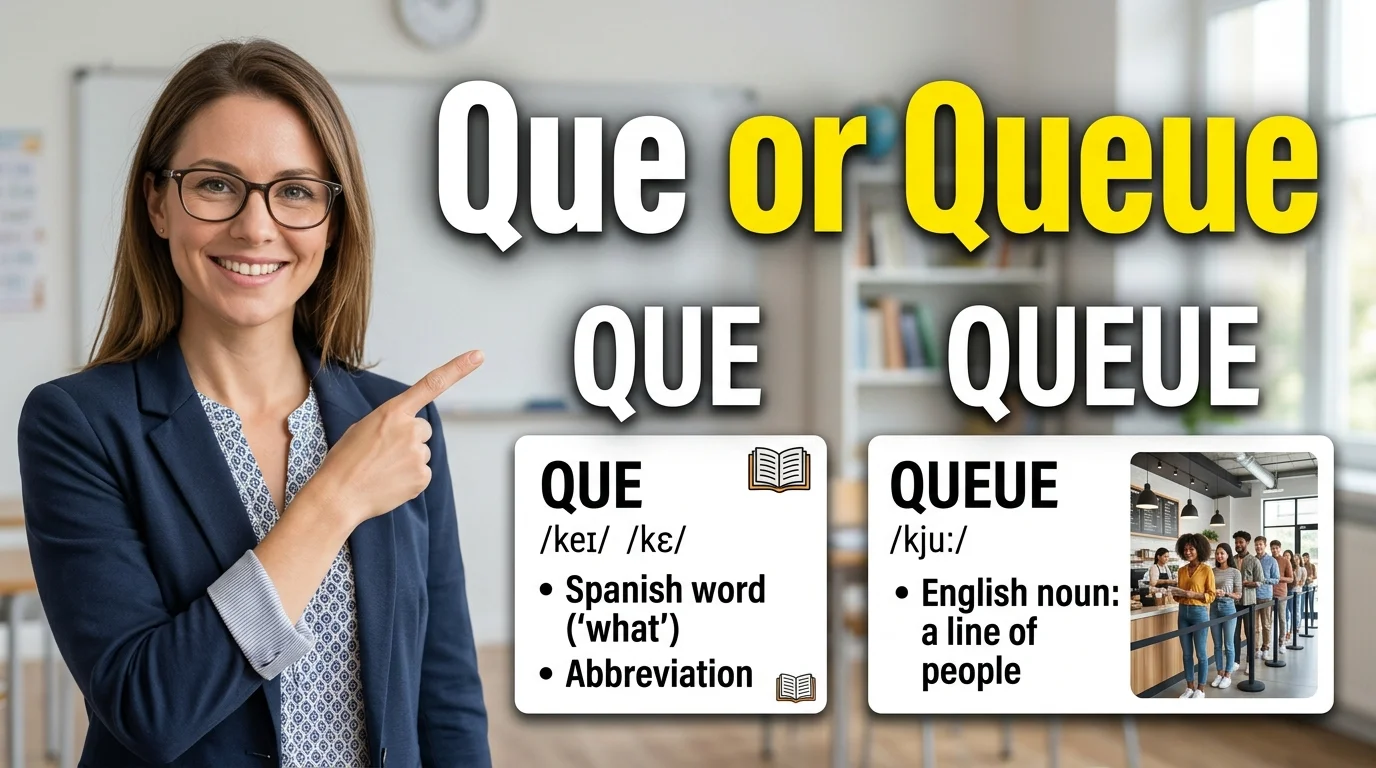
Some English words can be confusing because they sound alike but have different spellings and meanings. “Que or queue” is a common spelling question, especially because both words are pronounced the same in everyday English. However, they are not interchangeable. “Queue” is the correct English word when referring to a line of people or vehicles waiting for their turn.
It can also be used as a verb meaning to wait in line or arrange something in a particular order. For example, “We had to stand in a queue to buy tickets” describes people waiting for their turn. On the other hand, “que” is not the standard English spelling of this word. It appears in other languages, including Spanish, where it has different grammatical meanings, but it should not replace “queue” in standard English writing.
The unusual spelling of queue often makes it difficult for learners because several letters are silent when the word is pronounced. Understanding the difference between que and queue will help you avoid spelling mistakes in emails, school assignments, professional writing, and everyday communication.
Quick Answer: Que or Queue?
Queue is the correct English spelling when you mean a line of people or vehicles waiting for something, or a list of items waiting to be processed. For example:
- “We waited in a queue outside the shop.”
- “Please join the queue.”
- “There is a long queue at the ticket counter.”
Que is generally not the standard English spelling for this meaning. If you are talking about people waiting in a line, use queue in British English and line in American English.
So, the easiest rule is:
British English: queue
American English: line is more common, but queue is also understood and used in some technical contexts.
What Does Queue Mean?

The word queue is a noun and a verb. Its meaning depends on how you use it in a sentence.
As a noun, queue means a group or line of people, vehicles, or things waiting for their turn.
For example:
- “There was a long queue outside the cinema.”
- “We stood in the queue for twenty minutes.”
- “The queue moved very slowly.”
As a verb, queue means to wait in a line or to arrange something so that it will be dealt with later.
For example:
- “Customers queued outside the store.”
- “We queued for tickets.”
- “The files are queued for processing.”
The word appears frequently in British English. Therefore, if you are writing for a UK audience, queue is an important word to know.
Queue in British English
In British English, queue is a very normal everyday word.
A British speaker might say:
- “I had to queue for the bus.”
- “There was a huge queue at the supermarket.”
- “How long is the queue?”
- “Please wait in the queue.”
- “The queue starts over there.”
In these examples, queue refers to people waiting for something.
Queue in American English
American English generally prefers line or stand in line in everyday situations.
For example, an American speaker would commonly say:
- “I waited in line at the store.”
- “There was a long line at the bank.”
- “Please get in line.”
- “How long is the line?”
- “We stood in line for tickets.”
However, queue still exists in American English. You may encounter it in computing, technical writing, formal contexts, or when referring to British usage.
For instance:
- “The print jobs are in a queue.”
- “The requests are waiting in a processing queue.”
- “The songs have been added to the queue.”
Therefore, queue is not exclusively British. The main difference is how frequently people use it in everyday conversation.
What Does “Que” Mean?

The spelling que causes confusion because people often use it as a shortened or misspelled version of queue.
If you mean a line of people waiting, que is not the standard spelling.
For example:
❌ “There was a long que outside the shop.”
The standard spelling is:
✅ “There was a long queue outside the shop.”
Similarly:
❌ “Please stand in the que.”
Correct:
✅ “Please stand in the queue.”
The extra letters in queue may seem unnecessary, but English spelling contains many words with letters that do not sound obvious when spoken.
Is “Que” Always Wrong?
Not necessarily. Que can appear in other languages or as part of a proper name, abbreviation, or specialized expression. For example, Spanish uses qué in certain questions, meaning “what,” and que can have other grammatical functions.
However, if you are writing ordinary English and want to describe a line of people waiting, use queue.
This distinction matters because many spelling mistakes happen when writers rely only on pronunciation.
Queue vs Que: Key Differences
The biggest difference is straightforward:
| Word | Standard English Use | Meaning |
| Queue | Yes | A line or sequence waiting for something |
| Que | Usually not for this meaning | Often a misspelling of “queue” |
| Line | Yes, especially in US English | A group of people waiting |
For example:
British English:
“We waited in a queue for twenty minutes.”
American English:
“We waited in line for twenty minutes.”
Both sentences communicate the same basic idea.
Queue vs Line
This is actually the more useful comparison for UK and US readers.
British English commonly uses queue:
“There was a long queue at the post office.”
American English commonly uses line:
“There was a long line at the post office.”
Therefore, if you are writing an article for an international audience, you may want to mention both forms.
Why Is Queue Spelled With So Many Letters?
One reason people struggle with queue is its unusual spelling.
The word contains five letters:
Q-U-E-U-E
Yet its pronunciation is approximately:
“kyoo”
That creates an obvious spelling challenge. When people hear “kyoo,” they may naturally want to write cue, que, or Q.
However, the standard English spelling for the waiting line is queue.
Interestingly, cue is also a real English word, but it has a different meaning.
Queue vs Cue
These words sound alike in many varieties of English, but their meanings differ.
Queue means a line or sequence waiting.
“We stood in a queue.”
Cue means a signal or prompt.
“The actor waited for his cue.”
This is an example of a homophone: words that sound the same but have different spellings and meanings.
Therefore, you should not replace queue with cue when talking about a waiting line.
Common Mistakes People Make
Learning the correct spelling becomes easier when you recognize the mistakes people commonly make.
1. Writing “Que” Instead of “Queue”
This is probably the most common mistake associated with this keyword.
Incorrect:
“There was a long que outside.”
Correct:
“There was a long queue outside.”
The problem comes from trying to spell the word according to how it sounds.
2. Writing “Cue” Instead of “Queue”
Because both words can sound like “kyoo,” writers sometimes confuse them.
Incorrect:
“We stood in the cue for tickets.”
Correct:
“We stood in the queue for tickets.”
Remember that cue means a signal or prompt, while queue means a waiting line.
3. Using “Queue” When “Line” Sounds More Natural in US English
This is not necessarily a grammatical error. However, it can sound less natural in casual American English.
For example:
“I waited in the queue at Walmart.”
An American speaker would more naturally say:
“I waited in line at Walmart.”
The word queue is still understandable, but line is the more common everyday choice in American English.
4. Forgetting the Verb Form
Queue can also function as a verb.
British English:
“We queued outside the restaurant.”
American English:
“We stood in line outside the restaurant.”
Therefore, do not assume that queue only works as a noun.
5. Confusing Queue With “Queue Up”
Both queue and queue up can be used.
For example:
“Customers queued outside.”
or:
“Customers queued up outside.”
Both can be natural depending on the sentence and variety of English.
Correct Usage of Queue in Sentences
Let’s look at several examples so you can see how queue works naturally.
Everyday British English Examples
- “I joined the queue at the supermarket.”
- “The queue was longer than I expected.”
- “We had to queue for the bus.”
- “There was a queue outside the restaurant.”
- “Please wait in the queue.”
- “The queue moved quickly.”
- “Someone pushed into the queue.”
- “How long have you been queuing?”
- “We queued for nearly an hour.”
- “The queue at the bank was surprisingly short.”
American English Examples
American English usually uses line in these everyday situations:
- “I stood in line at the supermarket.”
- “The line was longer than I expected.”
- “We had to wait in line for the bus.”
- “There was a line outside the restaurant.”
- “Please wait in line.”
- “The line moved quickly.”
- “Someone cut in line.”
- “How long have you been waiting in line?”
- “We waited for nearly an hour.”
- “The line at the bank was surprisingly short.”
Notice that the meaning stays almost identical. The vocabulary changes according to regional preference.
Queue in Technology and Computing
The word queue has an important technical meaning as well.
In computing, a queue is a structure where items wait to be processed in a particular order.
For example, a printer may receive several documents at the same time. Instead of printing everything simultaneously, the computer places the jobs in a print queue.
You might see sentences such as:
- “Your document is in the print queue.”
- “There are five jobs in the queue.”
- “The server processes requests from a queue.”
- “The message has been added to the queue.”
This usage appears in both British and American English.
What Does “Queue” Mean in Technology?
In technical contexts, a queue generally describes items waiting to be handled.
For example:
Email queue: messages waiting to be sent.
Print queue: documents waiting to be printed.
Task queue: tasks waiting to be processed.
Message queue: messages waiting for processing or delivery.
Therefore, if you work in technology, you will encounter queue frequently regardless of whether you use British or American English.
Queue as a Verb
Many learners know queue as a noun but do not realize that it can also act as a verb.
As a verb, queue means to join a line or arrange something to wait for processing.
British English
“We queued outside the theatre.”
“They queued for tickets.”
“People were queuing for coffee.”
Technical English
“The system queued the request.”
“The files have been queued for processing.”
“The application queues tasks automatically.”
In American everyday English, people are more likely to say:
“We waited in line outside the theatre.”
However, technical users in the United States regularly use queue as a noun and verb.
Queue, Que, and Cue: A Simple Comparison
These three spellings are easy to confuse.
| Word | Meaning | Example |
| Queue | A line or waiting sequence | “We joined the queue.” |
| Que | Usually not the standard spelling for this English meaning | “Que” is often a spelling error for “queue.” |
| Cue | A signal, prompt, or indication | “That was my cue to leave.” |
A quick way to remember the difference is:
Queue = waiting
Cue = signal
Que = usually not the spelling you want when you mean a waiting line
British English vs American English: Queue or Line?
This regional difference deserves special attention.
In the UK
Queue is extremely common.
People may say:
- “Join the queue.”
- “Stand in the queue.”
- “Queue for tickets.”
- “There is a queue outside.”
- “How long is the queue?”
British English also commonly uses the verb queue.
“We queued for half an hour.”
In the US
Line is generally preferred in everyday situations.
People commonly say:
- “Get in line.”
- “Wait in line.”
- “Stand in line.”
- “There is a long line.”
- “How long is the line?”
The verb phrase wait in line is especially common.
For example:
“I waited in line for two hours.”
A British speaker might instead say:
“I queued for two hours.”
Neither expression is inherently wrong. They reflect regional vocabulary preferences.
Is Queue a British Word?
People often ask whether queue is a British word.
The answer is no, not exclusively.
English speakers in both the UK and US understand the word queue. However, British English uses it much more frequently when talking about people waiting.
American English generally prefers line for this everyday meaning.
At the same time, Americans use queue regularly in technical contexts.
For example:
“The job is waiting in the queue.”
So, the difference is mainly about frequency and context, rather than whether the word is understood.
How to Pronounce Queue
The pronunciation of queue is much simpler than its spelling.
It is pronounced approximately:
/kjuː/
This sounds like “kyoo.”
That is why learners often confuse it with:
- cue
- Q
- que
The unusual spelling makes queue one of those English words that can be difficult to spell correctly even when its pronunciation is easy.
A Useful Spelling Trick
Think of the word as:
Q + U + EUE
Or simply remember:
Queue has five letters but sounds like “Q.”
This little fact can help you remember the spelling.
Easy Tips to Remember Queue
If you frequently forget whether to write que or queue, try these memory tricks.
Tip 1: Remember the Five Letters
QUEUE has five letters.
You can think:
“A queue has many people, and QUEUE has many letters.”
It is a playful way to remember the unusual spelling.
Tip 2: Think “Waiting = Queue”
Whenever you mean people or things waiting for their turn, think:
Waiting → Queue
For example:
“I am waiting in a queue.”
Tip 3: Separate Queue and Cue
Remember:
Queue = line
Cue = signal
For example:
“The queue was long.”
But:
“The director gave me a cue.”
Tip 4: US Readers Can Think “Queue = Line”
If you mainly use American English, mentally connect:
Queue = line
This helps you recognize the word when reading British English.
Tip 5: Do Not Spell by Sound
English contains many words whose spellings do not directly match their pronunciation.
Instead of writing what you hear, memorize the standard spelling:
QUEUE
More Real-Life Examples
Let’s explore some practical situations.
At a Supermarket
British:
“There was a long queue at the checkout.”
American:
“There was a long line at the checkout.”
At an Airport
British:
“We had to queue to check in.”
American:
“We had to wait in line to check in.”
At a Cinema
British:
“People were queuing for tickets.”
American:
“People were standing in line for tickets.”
At a Bank
British:
“The queue at the bank was very long.”
American:
“The line at the bank was very long.”
Online or Technical System
Both varieties:
“Your request has been added to the queue.”
This last example shows why queue remains important in American English even though line is more common in everyday speech.
Is “Que” Correct in English?
If you are asking whether que is the correct spelling for a line of people waiting, the answer is no.
Use:
Queue
For example:
❌ “We stood in the que.”
✅ “We stood in the queue.”
However, do not assume that the sequence que can never appear in English. It can occur within names, borrowed expressions, abbreviations, and other contexts. The important point is that que is not the standard spelling of queue when you mean a waiting line.
Common Search Questions About Que or Queue
People often search for this topic because they have encountered different spellings online. Here are some quick answers.
“Que or queue” — which is correct?
Queue is correct when you mean a line of people or things waiting. Que is usually a misspelling in this context.
Should I use queue or line?
Use queue when following British English conventions. Use line for everyday American English.
Is queue British or American?
Both British and American English recognize queue, but British English uses it much more often for everyday waiting lines.
Is “que” a word?
Que can occur in other languages and specialized contexts, but it is not the standard English spelling for a waiting line.
Is “cue” the same as queue?
No. Cue means a signal or prompt, while queue means a waiting line or sequence.
Frequently Asked Questions
1. Is “que” or “queue” correct?
Queue is the correct spelling when you mean a line of people, vehicles, or tasks waiting for something. “Que” is generally a spelling mistake in this context.
2. Do Americans say queue?
Yes. Americans understand and use queue, especially in technical and computing contexts. However, in everyday situations, line is generally more common.
3. Do British people say queue?
Yes. Queue is a very common word in British English. British speakers frequently use it for people waiting for something.
4. What is the American English equivalent of queue?
The most common everyday American equivalent is line.
For example:
British:
“I waited in the queue.”
American:
“I waited in line.”
5. Why is queue spelled so strangely?
The spelling reflects the history of the English word and its development from French. Modern pronunciation is much shorter than the spelling, which is why learners often find it unusual.
6. Is “cue” the same as “queue”?
No. They are pronounced similarly, but their meanings differ. Queue means a waiting line or sequence, while cue means a signal or prompt.
7. Can queue be used as a verb?
Yes. For example:
“We queued outside the shop.”
It can also be used in technical contexts:
“The request was queued for processing.”
8. Is “queue” used in computing?
Yes. Queue is a very common technical term. It can describe tasks, messages, print jobs, or other items waiting to be processed.
9. How do you pronounce queue?
Queue is pronounced approximately “kyoo.” Its pronunciation is much shorter than its five-letter spelling might suggest.
10. What does “queue up” mean?
Queue up means to form or join a line, or to arrange something so that it waits for processing.
For example:
“Customers queued up outside.”
In technology, something can also be queued up for processing.
Conclusion
When choosing between que or queue, remember that queue is the standard English spelling when you mean a line of people, vehicles, or items waiting for their turn. For example, British English commonly says, “I am waiting in the queue.” American English usually expresses the same idea as, “I am waiting in line.”
The spelling que is generally not the correct choice for this meaning. In addition, do not confuse queue with cue. A queue is a waiting line or sequence, while a cue is a signal or prompt. Therefore, keeping these meanings separate will help you avoid one of the most common spelling and vocabulary mistakes.