Punctuation plays an important role in clear and effective writing, but some punctuation marks can be confusing because they look similar and serve related purposes. “Semicolon or colon” is a common grammar question, especially for students, writers, and anyone who wants to improve their English. Both marks help connect ideas and organize information, but they are used in different situations.
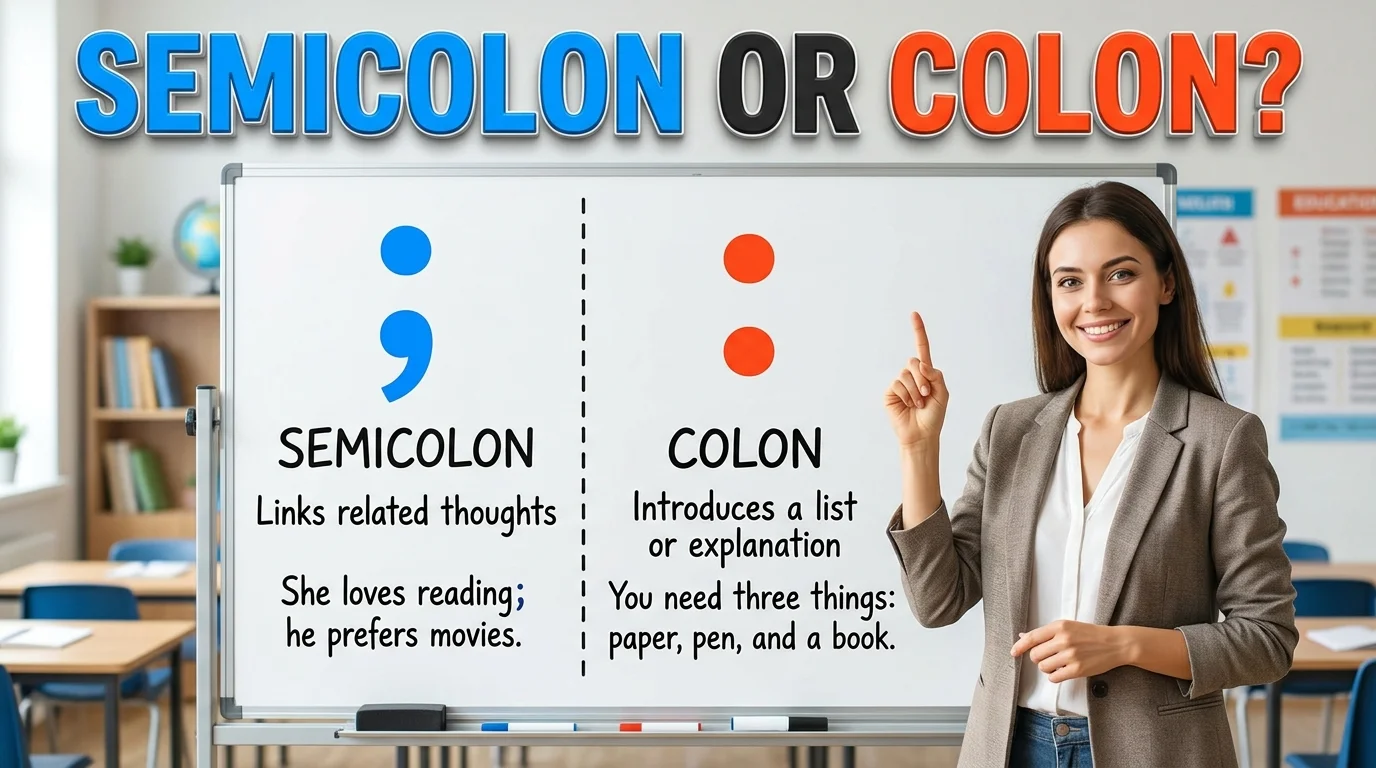
A semicolon (;) connects two closely related independent clauses that could each stand as a complete sentence. For example, “I wanted to go outside; it started raining.” A colon (:), on the other hand, introduces a list, explanation, example, or important detail that follows a complete introductory statement. For instance, “I need three things: a notebook, a pen, and a ruler.” Although these punctuation marks may seem interchangeable at first, using the wrong one can affect the meaning and flow of a sentence.
Understanding the difference between a semicolon and a colon can help you write more clearly, improve your grammar, and make your sentences easier to read. In this guide, we’ll explore their meanings, grammatical rules, differences, and practical examples so you can confidently choose the correct punctuation mark in academic, professional, and everyday writing.
Quick Answer: Semicolon or Colon?
Use a semicolon (;) when you want to connect two closely related complete sentences without using a conjunction such as and, but, or, so.
Example:
I wanted to go for a walk; it started raining.
Use a colon (:) when the second part explains, expands on, or introduces something mentioned in the first part.
Example:
I need three things from the shop: bread, milk, and eggs.
In simple terms:
- Semicolon (;) = connects related complete thoughts.
- Colon (:) = introduces or explains what comes next.
This basic rule works in both British English and American English. The main differences between UK and US usage usually involve style preferences rather than a completely different grammatical rule.
Meaning of the Correct Form: What Is a Semicolon?
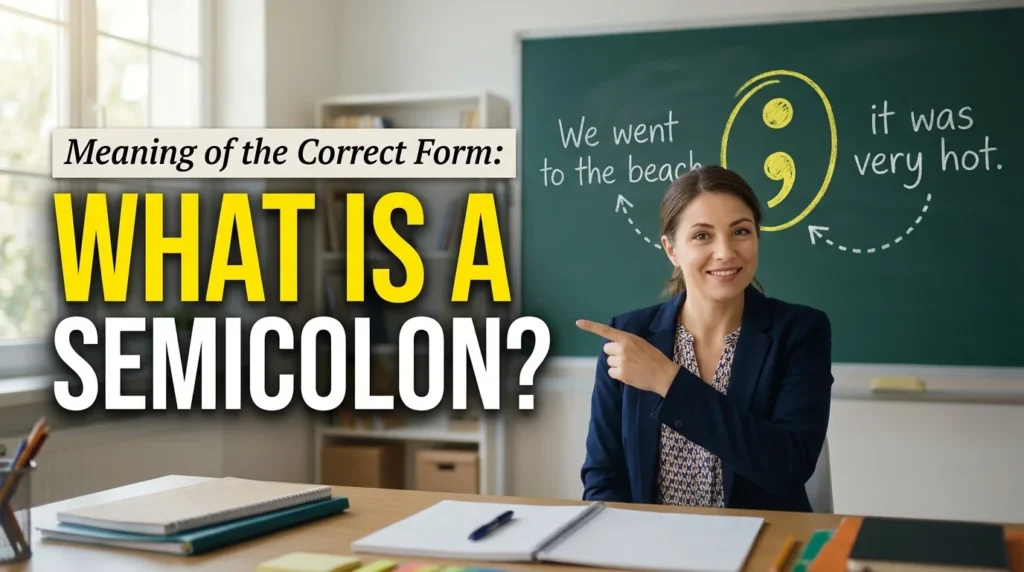
A semicolon (;) is a punctuation mark that creates a stronger break than a comma but a weaker break than a full stop or period.
Writers commonly use a semicolon to connect two independent clauses that are closely related.
An independent clause is a group of words that can stand alone as a complete sentence.
For example:
The meeting ended; everyone went home.
The first part is complete:
The meeting ended.
The second part is also complete:
Everyone went home.
Because the two ideas are closely connected, you can join them with a semicolon.
Semicolon Examples
Here are some simple examples:
- The weather was terrible; we stayed inside.
- Sarah finished her homework; she then watched television.
- I wanted to buy the jacket; it was too expensive.
- The restaurant was busy; however, we found a table.
- He studied all night; therefore, he felt prepared for the exam.
Notice that the semicolon does not simply mean “pause here.” It connects two related grammatical units.
Semicolon in British English
British English uses semicolons in much the same way as American English.
For example:
The train was delayed; we arrived late.
You might see this structure in British newspapers, academic writing, business documents, and formal correspondence.
Semicolon in American English
American English follows essentially the same principle:
The train was delayed; we arrived late.
Therefore, there is no major UK-versus-US difference in the basic grammatical function of the semicolon.
Meaning of the Correct Form: What Is a Colon?

A colon (:) is a punctuation mark that often tells the reader that something important is about to follow.
It can introduce:
- A list
- An explanation
- An example
- A quotation
- A conclusion
- A clarification
- An elaboration
For example:
She bought three fruits: apples, oranges, and bananas.
The colon tells us that a list is coming.
Another example is:
There was only one problem: we had no money.
The second part explains the problem.
Colon Examples
Consider these sentences:
- I have one goal: to improve my writing.
- He brought everything we needed: food, water, and blankets.
- She had one request: please arrive on time.
- Remember this rule: practice makes progress.
- We knew the truth: the plan had failed.
The colon creates a relationship between the first part and what follows.
Semicolon vs Colon: Key Difference

The easiest way to understand the difference is to ask what relationship exists between the two parts of your sentence.
A semicolon generally says:
These are two closely related complete thoughts.
A colon generally says:
Here is more information about what I just mentioned.
Consider these examples:
Semicolon:
I was tired; I went to bed early.
Both sides can stand alone.
Colon:
I went to bed early for one reason: I was tired.
The second part explains the first.
Quick Comparison Table
| Feature | Semicolon (;) | Colon (:) |
| Main purpose | Connect related ideas | Introduce or explain information |
| Can connect two independent clauses? | Yes | Not usually in the same way |
| Often introduces a list? | No | Yes |
| Often introduces an explanation? | Not usually | Yes |
| Common in UK English? | Yes | Yes |
| Common in US English? | Yes | Yes |
| Main idea | Connection | Introduction or explanation |
When Should You Use a Semicolon?
There are several common situations where a semicolon works well.
1. To Connect Two Related Independent Clauses
This is one of the most important uses.
Example:
The shop was closed; we went home.
Both parts are complete sentences:
- The shop was closed.
- We went home.
Because they are closely related, a semicolon can connect them.
More examples:
- I called him; he did not answer.
- The exam was difficult; many students struggled.
- She loves reading; her brother prefers football.
- The sun was setting; we continued walking.
2. Before Certain Transitional Words
A semicolon can appear before transitional expressions such as:
- however
- therefore
- nevertheless
- consequently
- moreover
- furthermore
- instead
- otherwise
For example:
I wanted to attend the event; however, I was working.
Another example:
He did not prepare properly; therefore, he struggled during the presentation.
The semicolon separates the two independent clauses, while the transition word shows the relationship between them.
3. To Separate Complicated Items in a List
A semicolon can help when list items already contain commas.
For example:
The conference attracted speakers from London, England; Paris, France; and Madrid, Spain.
The semicolons make the separate locations easier to identify.
Without them, the many commas could make the sentence difficult to read.
4. To Create a Stronger Pause Than a Comma
A semicolon creates a pause that is stronger than a comma but weaker than a full stop.
Compare:
I finished my work, and I went home.
Finished my work; I went home.
I finished my work. I went home.
All three can communicate a similar basic idea, but the punctuation creates a different rhythm.
When Should You Use a Colon?
A colon has several important functions.
1. To Introduce a List
This is probably the most familiar use.
Example:
I need four things: paper, pens, folders, and envelopes.
The colon introduces the list.
More examples:
- We visited three cities: London, Manchester, and Bristol.
- She packed everything she needed: clothes, shoes, and toiletries.
- The recipe requires four ingredients: flour, sugar, eggs, and butter.
- I have two choices: stay or leave.
2. To Introduce an Explanation
A colon can introduce information that explains what came before it.
Example:
He had one reason for leaving: he was unhappy with the situation.
The second part explains the reason.
Another example:
We cancelled the picnic: the weather became dangerous.
The second part explains why the picnic was cancelled.
3. To Introduce an Example
A colon can introduce an example or examples.
Example:
Some animals are excellent swimmers: dolphins, otters, and seals, for example.
The information after the colon provides examples of the statement before it.
4. To Introduce a Quotation
A colon can sometimes introduce a quotation, particularly in formal writing.
For example:
The teacher gave the students one important message: “Always check your work.”
The quotation provides the message that was introduced by the first part.
5. To Introduce an Important Conclusion or Statement
A colon can signal that an important point is coming.
Example:
She finally understood the truth: she had been mistaken.
The second part reveals or explains the truth.
Semicolon or Colon Before a List?
This is one of the most common questions.
In standard usage, a colon is normally the punctuation mark used to introduce a list.
Correct:
I bought five items: bread, milk, eggs, cheese, and butter.
A semicolon is not normally needed before a simple list.
Incorrect or unnecessarily complicated:
I bought five items; bread, milk, eggs, cheese, and butter.
However, semicolons can separate individual items within a complicated list.
For example:
The winners were James Smith, London; Emma Brown, Bristol; and Daniel Jones, Manchester.
Here, the semicolons help separate each complete list item because each item already contains a comma.
Semicolon or Colon Between Two Sentences?
This is where the difference becomes particularly important.
Suppose you have:
I was hungry. I made a sandwich.
You could combine the ideas with a semicolon:
I was hungry; I made a sandwich.
This works because both parts are independent clauses.
A colon would normally change the relationship:
I had one solution to my hunger: I made a sandwich.
Now the second part explains or expands on the first.
Therefore, ask yourself:
Am I connecting two related complete thoughts?
If yes, a semicolon may work.
Am I introducing an explanation, example, list, or clarification?
If yes, a colon may work.
Common Mistakes People Make
Understanding the rules is useful, but knowing common mistakes can make your writing even stronger.
Mistake 1: Using a Comma Instead of a Semicolon
A common error is joining two independent clauses with only a comma.
Incorrect:
I was tired, I went to bed.
This is known as a comma splice.
Better:
I was tired; I went to bed.
Or:
I was tired, so I went to bed.
Or:
I was tired. I went to bed.
Mistake 2: Using a Colon Where a Semicolon Is Needed
Consider:
The shop was closed: we went home.
Depending on the intended relationship, this may be possible if the second clause explains the first. However, if you simply want to connect two related independent thoughts, a semicolon may be more natural:
The shop was closed; we went home.
The colon creates a more specific expectation that the second part will explain, expand, or illustrate the first.
Mistake 3: Using a Semicolon to Introduce a Simple List
Incorrect:
I bought three things; bread, milk, and eggs.
Better:
I bought three things: bread, milk, and eggs.
The colon introduces the list.
Mistake 4: Using a Colon After a Preposition
A colon generally should not be inserted unnecessarily between a verb or preposition and its object.
For example:
I need: bread, milk, and eggs.
This is generally unnecessary.
Better:
I need bread, milk, and eggs.
Or:
I need three things: bread, milk, and eggs.
The second version works because the words before the colon create a natural introduction to the list.
Mistake 5: Thinking the Two Marks Are Interchangeable
They are not.
Consider:
She had one goal: to become a doctor.
The colon introduces the goal.
Now consider:
She wanted to become a doctor; her parents supported her.
The semicolon connects two related independent clauses.
Changing one punctuation mark for the other can change the relationship between the ideas.
Correct Usage in Sentences
Here are more practical examples to help you recognise the difference.
Everyday Examples
Semicolon:
- I need to leave now; my bus arrives in ten minutes.
- He likes coffee; she prefers tea.
- We missed the first train; we caught the next one.
- The room was cold; I closed the window.
- She called me; I answered immediately.
Colon:
- I need one thing: your help.
- There is one problem: we are out of time.
- She brought three snacks: crisps, fruit, and biscuits.
- He had one message: stay calm.
- We reached one conclusion: the plan needed to change.
Workplace Examples
Semicolon:
- The report is finished; I will send it this afternoon.
- The client approved the design; we can begin production.
- The meeting was postponed; everyone was informed.
- We completed the first phase; the second phase begins tomorrow.
Colon:
- The project has three priorities: quality, speed, and reliability.
- We have one important update: the deadline has changed.
- Please remember the following: all documents must be submitted by Friday.
- The manager gave us one instruction: finish the task before noon.
Academic Writing Examples
Semicolon:
Some students prefer online learning; others prefer traditional classrooms.
Colon:
The study reached one important conclusion: regular practice improves performance.
Academic writers use both punctuation marks to make relationships between ideas clear.
British English vs American English
Many learners wonder whether the rules for semicolons and colons change between British and American English.
The good news is that the basic rules are largely the same.
Semicolons
British English:
The weather was poor; the match was cancelled.
American English:
The weather was poor; the game was cancelled.
The punctuation rule is the same.
Colons
British English:
We need three things: time, money, and patience.
American English:
We need three things: time, money, and patience.
Again, the basic punctuation is the same.
Vocabulary Differences
The difference may appear because British and American English sometimes use different vocabulary.
For example:
British English:
The team cancelled the match because of the weather.
American English:
The team cancelled the game because of the weather.
The colon or semicolon rule does not change just because the vocabulary changes.
Capitalisation After a Colon
Capitalisation after a colon can vary depending on style guide, sentence structure, and whether the material following the colon is a complete sentence.
For example:
She knew one thing: she needed more time.
Many writers use lowercase she because the material after the colon continues the sentence.
In some formal contexts, especially when the colon introduces an independent sentence, a capital letter may be used depending on the relevant style guide.
Therefore, if you are writing for school, university, work, or a publication, follow its preferred style guide.
How to Know Which One to Use
When you are unsure, use a simple three-step test.
Step 1: Look at What Comes Before the Punctuation
Ask:
Is it a complete sentence?
For example:
I finished my work
Yes, it can stand alone.
Step 2: Look at What Comes After It
If the second part is also a complete sentence, a semicolon may work.
I finished my work; I went home.
If the second part is a list or explanation, a colon may be better.
I finished my work for one reason: I wanted to leave early.
Step 3: Ask What Relationship You Want
Do you want to show:
Connection? → Semicolon
Introduction or explanation? → Colon
This simple question can solve many punctuation problems.
Easy Memory Tricks
Here are some simple ways to remember the difference.
The Semicolon = Two Sides
Think of the semicolon as joining two related sentences.
Sentence A; Sentence B
For example:
It was late; I went home.
You have two complete thoughts.
The Colon = Look Ahead
Think of a colon as saying:
“Here comes more information.”
For example:
I need several things: food, water, and medicine.
The colon points forward to the information that follows.
Remember “List or Explain = Colon”
If you are introducing a list or explanation, think colon.
I have three choices: stay, leave, or wait.
Remember “Two Complete Thoughts = Semicolon”
If you have two closely related complete sentences, think semicolon.
I wanted to stay; I had to leave.
Semicolon or Colon: Side-by-Side Examples
The following examples show how the meaning and structure differ.
Example 1
Semicolon:
The weather was cold; we stayed inside.
Colon:
We had one reason for staying inside: the weather was cold.
The semicolon connects two related thoughts. The colon introduces the reason.
Example 2
Semicolon:
She worked hard; she achieved her goal.
Colon:
She achieved her goal for one reason: she worked hard.
Again, the punctuation reflects the relationship between the ideas.
Example 3
Semicolon:
I have finished my assignment; I can relax now.
Colon:
I have one plan for tonight: finish my assignment.
The semicolon joins related complete thoughts, while the colon introduces a plan.
Can a Colon Connect Two Complete Sentences?
Yes, a colon can sometimes appear between two complete clauses, but the relationship matters.
The second clause should generally explain, illustrate, expand upon, or directly follow from the first.
For example:
There was only one thing left to do: we had to start again.
Both sides can function as complete thoughts, but the second part explains what the “one thing” was.
However, you should not assume that every pair of complete sentences can be joined with a colon.
If you simply want to connect two closely related independent clauses, a semicolon may be more appropriate.
Can You Use a Semicolon Before “However”?
Yes.
For example:
I wanted to go; however, I was too busy.
This is a common and correct structure.
The semicolon separates the independent clauses, while however acts as a transitional expression.
You can also write:
I wanted to go. However, I was too busy.
The exact choice depends on your sentence structure and writing style.
Can You Use a Colon Before “However”?
Usually, you should not use a colon simply because the word however appears next.
For example:
I wanted to go: however, I was too busy.
This does not create the natural relationship that a colon normally signals.
Instead, use:
I wanted to go; however, I was too busy.
Or:
I wanted to go. However, I was too busy.
Can a Semicolon Introduce a List?
A semicolon can separate items within a complicated list, but it does not normally introduce the list itself.
For example:
The guests came from Birmingham, UK; Boston, USA; and Toronto, Canada.
The colon could introduce the list:
The guests came from several cities: Birmingham, UK; Boston, USA; and Toronto, Canada.
Notice the two punctuation marks have different jobs:
- Colon: introduces the list.
- Semicolons: separate complicated list items.
Semicolon or Colon in Formal Writing
Both punctuation marks can make formal writing clearer when used correctly.
Formal Example With a Semicolon
The company experienced several difficulties; nevertheless, it completed the project on time.
Formal Example With a Colon
The company faced three major challenges: limited funding, staff shortages, and a tight deadline.
These structures work well in reports, essays, business writing, and professional communication.
However, punctuation should support clarity rather than make writing look unnecessarily complicated.
Common Search Questions About Semicolon or Colon
People often search for answers to questions such as:
- Should I use a semicolon or colon?
- What is the difference between a colon and semicolon?
- Is a colon stronger than a semicolon?
- Can I use a semicolon before a list?
- Can a colon connect two sentences?
- Is semicolon usage different in British English?
- Is colon usage different in American English?
The key point is that the punctuation mark should match the relationship between the ideas.
FAQs
1. What is the main difference between a semicolon and a colon?
A semicolon (;) connects closely related independent clauses. A colon (:) usually introduces a list, explanation, example, clarification, or elaboration.
2. Should I use a colon or semicolon before a list?
Use a colon to introduce a list.
Example:
I bought three items: bread, milk, and eggs.
Semicolons can then separate complicated items within the list.
3. Is a semicolon the same as a colon?
No. They have different functions. A semicolon mainly connects closely related complete thoughts, while a colon introduces information that explains or expands on what came before it.
4. Is semicolon usage different in British and American English?
The basic rules are very similar. Both British and American English use semicolons to connect closely related independent clauses and to separate complicated list items.
5. Is colon usage different in British and American English?
The basic use is also similar. Both varieties use colons to introduce lists, explanations, examples, and related information. Some style preferences, especially around capitalisation after a colon, can vary.
6. Can I use a semicolon before “however”?
Yes. A common structure is:
I wanted to attend; however, I was busy.
The semicolon separates the independent clauses.
7. Can I use a colon between two complete sentences?
Sometimes. A colon can connect two complete clauses when the second part explains, expands on, or illustrates the first.
Example:
There was one problem: we had no time.
8. Which punctuation mark introduces an explanation?
A colon commonly introduces an explanation.
Example:
She had one reason for leaving: she was exhausted.
9. Which punctuation mark creates a stronger connection between two sentences?
A semicolon connects two closely related independent clauses without completely separating them with a full stop.
10. Is a semicolon more formal than a comma?
Not necessarily. A semicolon has a specific grammatical function. It is not simply a “more formal comma.” You should use it when the sentence structure calls for it.
Final Tips for Using Semicolons and Colons
Before choosing between these punctuation marks, remember these practical tips:
- Use ; to connect closely related complete thoughts.
- Use : to introduce a list.
- Use : to introduce an explanation.
- Use : to introduce an example.
- Use ; before transitional words such as however when appropriate.
- Do not use a semicolon as a random replacement for a comma.
- Do not add a colon between a verb and its object without a grammatical reason.
- Use semicolons to separate complicated list items when those items contain commas.
- Check your organisation’s or publication’s style guide for detailed capitalisation preferences.
- Remember that the basic rules apply to both British and American English.
Conclusion
Understanding semicolon or colon usage becomes much easier when you focus on the relationship between the ideas in your sentence. A semicolon (;) generally connects two closely related independent clauses, while a colon (:) usually introduces a list, explanation, example, quotation, or clarification.
For example, write “I was tired; I went to bed” when you want to connect two related complete thoughts. On the other hand, write “I had one goal: to finish my work” when the second part explains or expands on the first.