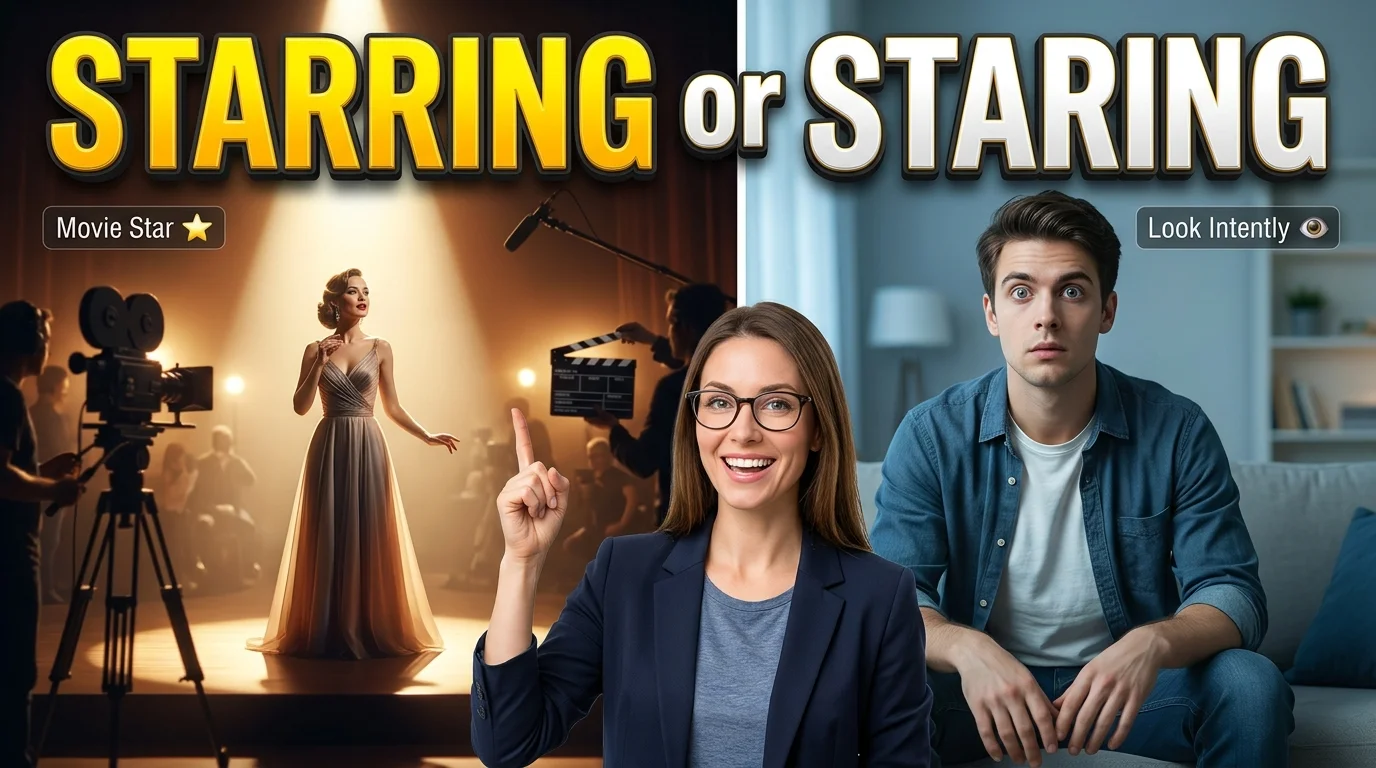
English spelling can sometimes be confusing because two words may differ by just one letter while having completely different meanings. “Starring or staring” is a common example, as both words sound the same but are used in different situations. The correct choice depends on what you want to express. “Starring” comes from the verb “star” and is commonly used when describing an actor who has an important role in a movie, television show, or performance.
For example, “The new movie is starring a famous Hollywood actress.” It can also refer to marking something with a star symbol. On the other hand, “staring” comes from the verb “stare,” which means looking at someone or something for a long time, often without blinking.
For example, “The little boy was staring at the beautiful painting.” Although these words have similar pronunciation, their meanings and grammatical uses are very different. Understanding the difference between starring and staring will help you avoid spelling mistakes and choose the right word in conversations, emails, school assignments, movie descriptions, and everyday writing. In this guide, we’ll explore their meanings, differences, grammar rules, and simple examples to make their correct usage easy to remember.
Quick Answer: Starring or Staring?
“Starring” and “staring” are both correct words, but they have different meanings.
- Starring means appearing as a main or important performer in a film, television programme, play, or other production.
- Staring means looking at someone or something fixedly, continuously, or intensely.
For example:
- The new movie is starring two famous actors. → The actors have important roles in the movie.
- He was staring at the new movie poster. → He was looking at the poster for a noticeable amount of time.
So, use starring when you are talking about a performance or cast. Use staring when you are talking about looking.
Meaning of “Starring”
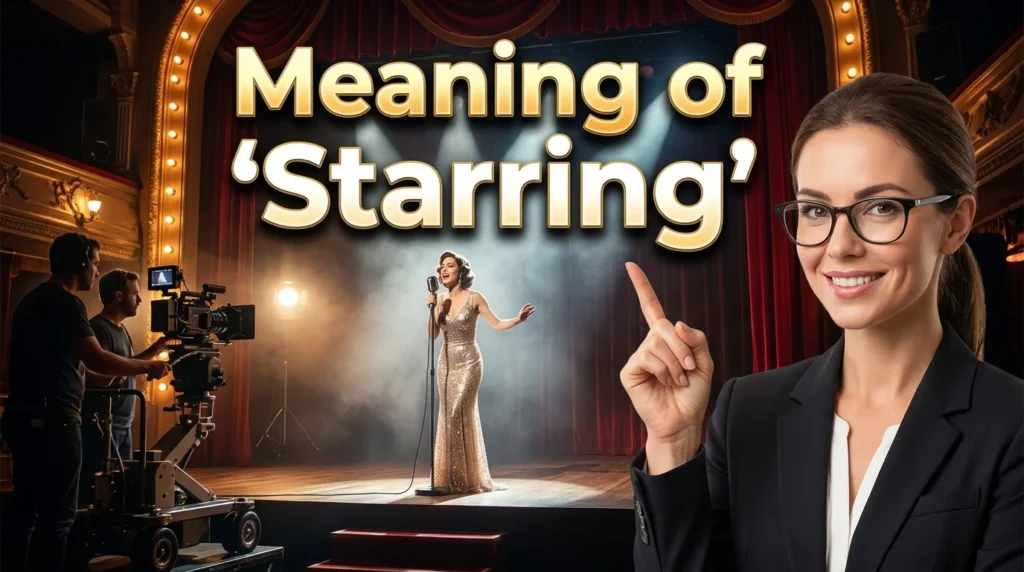
Starring is the present participle of star when “star” means to perform as an important actor or performer in a production.
The word star can function as both a noun and a verb. As a noun, a “star” can mean a famous performer. As a verb, “to star” means to have a leading or important role in a film, television programme, play, or similar production.
When we add -ing, the verb becomes starring.
Examples of “Starring”
- The new film is starring Emma Stone.
- The television series is starring several well-known actors.
- The play is starring a talented young performer.
- They announced a new movie starring several international stars.
- The documentary features a famous actor starring in the lead role.
In these examples, starring relates to acting or performing.
“Starring” in British English
British English commonly uses starring when discussing films, television programmes, theatre productions, and performers.
For example:
The new film is starring a popular British actor.
Another example:
The theatre production is starring several talented performers.
Notice that British English may use programme where American English often uses program when referring to a television programme. However, this difference does not affect the spelling of starring.
“Starring” in American English
American English uses starring in essentially the same way.
For example:
The new movie is starring a famous Hollywood actor.
Another example:
The television show is starring a talented young actress.
The spelling starring remains the same in both varieties.
Why Is “Starring” Spelled With Two Rs?

This is one of the main reasons people confuse starring and staring.
The base verb is star.
When we add -ing, we get:
star + ing → starring
The final r is doubled before adding -ing because of the spelling rule used with certain short verbs ending in a consonant-vowel-consonant pattern.
Compare:
- star → starring
- run → running
- sit → sitting
- plan → planning
The double r is therefore an important part of the spelling.
If you write staring when you mean “appearing in a leading role,” you have changed the word completely.
Meaning of “Staring”
Staring is the present participle of stare.
The verb stare means to look at someone or something continuously, directly, or intensely.
When we add -ing, we get:
stare + ing → staring
The final e is removed before adding -ing.
Therefore:
stare → staring
Examples of “Staring”
- She was staring at the painting.
- Why are you staring at me?
- He sat quietly, staring out of the window.
- The children were staring at the magician.
- I caught him staring at the unusual object.
In all these examples, staring has nothing to do with acting or movies. It describes the action of looking.
“Staring” in British English
British English uses staring in the same way as American English.
For example:
The man was staring at the train.
Another example:
She kept staring out of the window during the journey.
British English may use vocabulary that differs from American English in some situations, but staring itself remains unchanged.
“Staring” in American English
American English also uses staring to describe fixed or prolonged looking.
For example:
Why is that person staring at us?
Or:
He was staring at his phone while waiting for the bus.
Again, the spelling is identical in both British and American English.
Starring vs Staring: Key Differences
The easiest way to understand the difference is to focus on the base verbs.
| Word | Base Verb | Meaning | Example |
| Starring | Star | Appearing in an important role | The movie is starring a famous actor. |
| Staring | Stare | Looking fixedly or intensely | She is staring at the painting. |
The spelling differs by only one letter, but the meanings are completely different.
Starring
Think about:
- Movies
- Television
- Theatre
- Actors
- Performers
- Leading roles
- Cast members
Example:
The new comedy is starring two popular actors.
Staring
Think about:
- Looking
- Eyes
- People
- Objects
- Attention
- Surprise
- Curiosity
Example:
The child was staring at the colourful balloons.
Starring or Staring: Spelling Rule
A useful way to remember the difference is to look at the original verb.
Star → Starring
The word star already ends in r, so adding -ing gives:
star + ing = starring
The r is doubled.
Stare → Staring
The word stare ends in a silent e. When adding -ing, the final e disappears:
stare + ing = staring
This gives us:
star → starring
but
stare → staring
This simple comparison can prevent many spelling mistakes.
Why Do People Confuse Starring and Staring?
The confusion happens because the two words look extremely similar.
Compare:
starring
staring
The only obvious difference is the extra r.
However, that small spelling difference changes the meaning.
For example:
The movie is starring Tom.
This means Tom appears in an important role.
But:
Tom is staring at the movie poster.
This means Tom is looking at the poster.
The words can even appear in the same sentence:
The actor starring in the film was staring at the poster.
Here, starring describes the actor’s role, while staring describes the actor’s action.
Common Mistakes People Make
Because the words are so similar, writers often accidentally choose the wrong one.
Mistake 1: Using “staring” for a movie cast
Incorrect:
The new movie is staring a famous actress.
Correct:
The new movie is starring a famous actress.
Why? Because the actress is appearing in the movie. Therefore, you need starring.
Mistake 2: Using “starring” for looking
Incorrect:
He was starring at me.
Correct:
He was staring at me.
Why? Because the sentence describes someone looking at another person. Therefore, staring is correct.
Mistake 3: Writing “star” + “ing” incorrectly
Some people assume that:
star + ing = staring
But this is incorrect when you mean “to appear as a star.”
The correct form is:
star + ing = starring
Mistake 4: Confusing the meaning from pronunciation
In everyday speech, starring and staring can sound very similar, especially in fast conversation.
Therefore, listening alone may not always help you distinguish them. Context matters.
If the sentence talks about an actor or film, starring is probably the intended word.
If it talks about looking, staring is probably correct.
Correct Usage in Sentences
Let’s look at several examples to make the distinction clearer.
Examples With “Starring”
- The new movie is starring a famous American actor.
- The British television drama is starring several award-winning performers.
- They announced a new comedy starring two popular comedians.
- The theatre production is starring a talented young actress.
- The film features an impressive cast, starring a well-known director’s favourite actor.
- The upcoming movie is starring a rising Hollywood performer.
- The series is starring actors from both the UK and the US.
- She is starring in a new television drama.
- He will be starring in the next season of the show.
- The production is starring several experienced theatre actors.
Examples With “Staring”
- She was staring at the computer screen.
- Why are you staring at me?
- He sat there staring out of the window.
- The children were staring at the strange object.
- I noticed someone staring at the painting.
- She kept staring at her phone.
- The dog was staring at the door.
- He stood quietly, staring into the distance.
- Everyone was staring at the unexpected performance.
- The student was staring at the difficult question.
British English vs American English
One of the most useful things to know is that there is no British-versus-American spelling difference between “starring” and “staring.”
Both varieties use:
- starring
- staring
The meanings also remain the same.
British English Example
The new film is starring a well-known British actor.
American English Example
The new movie is starring a well-known American actor.
The vocabulary surrounding the words may sometimes differ. For example, British English often says film, while American English commonly says movie. British English also commonly uses programme for television, whereas American English generally uses program.
Nevertheless, these differences do not change the spelling or meaning of starring and staring.
Starring in Movies and Television
When discussing entertainment, starring usually introduces the performer or performers who have important roles.
For example:
The film is starring a famous actress.
You may also see phrases such as:
- starring in a movie
- starring in a television series
- starring in a play
- starring as the main character
- starring alongside another actor
Examples:
She is starring in a new drama.
He is starring as the lead character.
The actor is starring alongside several well-known performers.
The word can also appear in promotional material:
Starring: Jane Smith and John Brown
Here, starring tells readers which performers have major roles.
Staring in Everyday Situations
Unlike starring, staring appears in ordinary conversations about people’s behaviour.
You might stare because you are:
- Surprised
- Curious
- Confused
- Interested
- Shocked
- Deep in thought
- Distracted
For example:
She was staring at the beautiful sunset.
Or:
He was staring at the menu because he could not decide what to order.
However, staring can sometimes be considered rude depending on the situation.
For example:
It is generally polite to avoid staring at strangers.
The exact social meaning depends on context.
“Starring In” vs “Staring At”
A very useful trick is to remember the preposition that often follows each word.
Starring in
We commonly say:
starring in a film
In a television show
starring in a play
Examples:
She is starring in a new film.
He is starring in a popular series.
Staring at
We commonly say:
staring at someone
staring at something
Examples:
He is staring at me.
She is staring at the screen.
This creates a simple memory pattern:
Starring in a production.
Staring at something.
A Simple Memory Trick
Here is an easy way to remember the difference.
Think: “Two Rs = Role”
Starring has two r’s.
The extra r can remind you of a role.
So:
starring → role → actor → movie
For example:
The movie is starring a famous actor.
Think: “Staring = Eyes”
Staring has one r and contains are:
st-are-ing
You can associate it with looking:
She is staring with wide eyes.
This is not a formal spelling rule, but it is a useful memory trick.
Another Easy Way to Remember
Ask yourself one question:
“Is someone performing, or is someone looking?”
If the person is performing, use:
starring
If the person is looking, use:
staring
For example:
The actor is starring in the film.
Performing → starring
The actor is staring at the camera.
Looking → staring
This simple question works in most everyday situations.
Starring vs Staring in Questions
You may encounter both words in questions.
Questions With “Starring”
Who is starring in the new movie?
Which actors are starring in the series?
Who is starring as the main character?
These questions are about performers.
Questions With “Staring”
Why are you staring at me?
What is he staring at?
Why was everyone staring at the screen?
These questions are about looking.
Starring vs Staring in Social Media
These words also appear frequently on social media.
For example:
New film starring some of the biggest names in entertainment!
Here, starring introduces the cast.
Meanwhile:
Why is everyone staring at me today?
Here, staring describes people’s behaviour.
Because social media often relies on short captions, spelling mistakes can easily change the intended meaning. Therefore, choosing the correct word is particularly important when writing captions, posts, headlines, and comments.
Starring vs Staring in Professional Writing
Professional writing also requires the correct form.
Imagine writing a film review:
The movie is starring two internationally recognised actors.
That is correct.
Now imagine writing a workplace message:
I noticed that he was staring at his screen during the meeting.
That is also correct.
Using the wrong word can make your writing look careless or create unintended humour.
For example:
The conference video is staring a famous speaker.
The intended meaning is probably:
The conference video is starring a famous speaker.
Although the mistake is only one letter, the sentence becomes grammatically and semantically incorrect.
Can “Starring” Be a Noun?
Usually, starring functions as a present participle or gerund related to the verb star.
For example:
She is starring in a new movie.
It can also appear in descriptions such as:
A new production starring several well-known performers.
In these contexts, it identifies participation in a production.
Can “Staring” Be a Noun?
Yes. Staring can function as a gerund, referring to the act of looking fixedly.
For example:
Staring at a screen for too long can make you tired.
Here, staring acts as a noun-like form describing an activity.
Another example:
Staring at strangers can make them uncomfortable.
Therefore, staring does not always describe an action performed by the subject in a continuous tense. It can also function as a gerund.
Starring and Staring in Continuous Tenses
Both words can appear in continuous verb structures because both come from verbs.
Starring
She is starring in the new production.
They were starring in a popular television series.
Staring
She is staring at the screen.
They were staring at the strange object.
The difference comes from the original verbs:
star → starring
stare → staring
More Examples for UK Readers
Here are some examples using contexts common in British English:
The new film is starring a well-known British actor.
The actress is starring in a West End production.
He was staring at the timetable.
The children were staring at the double-decker bus.
The television programme is starring several experienced performers.
Notice that the spelling remains unchanged even when British vocabulary differs.
More Examples for US Readers
Here are examples using common American English contexts:
The new movie is starring a popular actor.
The actress is starring in a Broadway production.
He was staring at the television.
The children were staring at the huge truck.
The TV program is starring several talented performers.
Again, starring and staring have exactly the same spellings in both varieties.
Quick Comparison Chart
| Feature | Starring | Staring |
| Base verb | Star | Stare |
| Meaning | Appearing in an important role | Looking fixedly or intensely |
| Common context | Films, TV, theatre | Everyday behaviour |
| Spelling | Double “r” | Single “r” |
| Common preposition | Starring in | Staring at |
| UK spelling | Starring | Staring |
| US spelling | Starring | Staring |
| Example | She is starring in a film. | She is staring at the screen. |
Frequently Asked Questions
1. Is “starring” or “staring” correct?
Both are correct words, but they have different meanings. Starring relates to performing in an important role, while staring means looking at someone or something continuously or intensely.
2. Is it “starring in” or “staring in”?
When you mean that an actor has a role in a film, show, or play, use “starring in.”
Correct:
She is starring in a new movie.
Staring in is generally not correct when you mean acting in a production.
3. Is it “staring at” or “starring at”?
When you mean looking at something or someone, use “staring at.”
Correct:
He was staring at the screen.
The phrase starring at does not normally express the meaning of looking.
4. Why does “starring” have two Rs?
Starring comes from star + ing. The final consonant is doubled before adding -ing, producing starring.
5. Why does “stare” become “staring”?
The final silent e in stare is removed before adding -ing:
stare → staring
This is why staring has only one r.
6. Is “starring” different in British and American English?
No. Both British English and American English use starring with the same spelling and meaning.
There can be vocabulary differences around it, such as film versus movie, but the word itself remains unchanged.
7. Is “staring” rude?
It can be, depending on the situation. Looking at someone continuously or intensely may make them uncomfortable. However, staring can also describe neutral situations, such as staring at a beautiful view or a difficult question.
8. Can “starring” and “staring” appear in the same sentence?
Yes. For example:
The actor starring in the film was staring at the camera.
Here, starring refers to acting, while staring refers to looking.
9. What is the easiest way to remember starring vs staring?
Remember:
Starring = role
Staring = looking
You can also remember:
starring in a movie
staring at a person
10. Which one should I use when talking about an actor?
Use starring when you mean that the actor appears in an important role.
For example:
The movie is starring a famous actor.
Conclusion
The difference between starring and staring is simple once you connect each word to its original verb. Starring comes from star and means appearing in an important or leading role in a film, television programme or program, play, or another production. Staring comes from stare and means looking at someone or something continuously, directly, or intensely.
The spelling difference is small, but the meanings are completely different. Starring has two r’s, while staring has one. A useful memory trick is to associate starring with an actor’s role and staring with looking.