Have you ever typed “wierd” and then wondered whether it actually looks right? You are not alone. The words “wierd” and “weird” look very similar, and the difference is only the order of two letters. However, only one spelling is considered correct in standard English. This small spelling mistake appears frequently in texts, social media posts, school assignments, emails, and everyday online conversations.
The correct spelling is “weird.” The spelling “wierd” is a common misspelling. Even though many people accidentally write “wierd,” dictionaries and standard English usage recognise “weird” as the correct form. The good news is that once you learn a simple memory trick, you can avoid this mistake much more easily.
This topic matters to both British English and American English users because the spelling does not change between the two varieties. Unlike words such as “colour” and “color” or “centre” and “center,” “weird” has the same spelling in both UK and US English. Therefore, whether you are writing a school essay in Britain, a work email in the United States, or a casual message online, you should use “weird.”
Quick Answer: WierD or Weird?
The correct spelling is “weird.”
“Wierd” is incorrect in standard English and is usually a spelling mistake. The letters I and E are reversed in the incorrect version.
- ❌ Wierd
- ✅ Weird
For example:
- That was a weird experience.
- He has a weird sense of humour. — British English
- He has a weird sense of humor. — American English
Notice that the spelling of weird remains exactly the same in both examples. Only “humour/humor” changes according to the English variety.
Meaning of the Correct Form: “Weird”
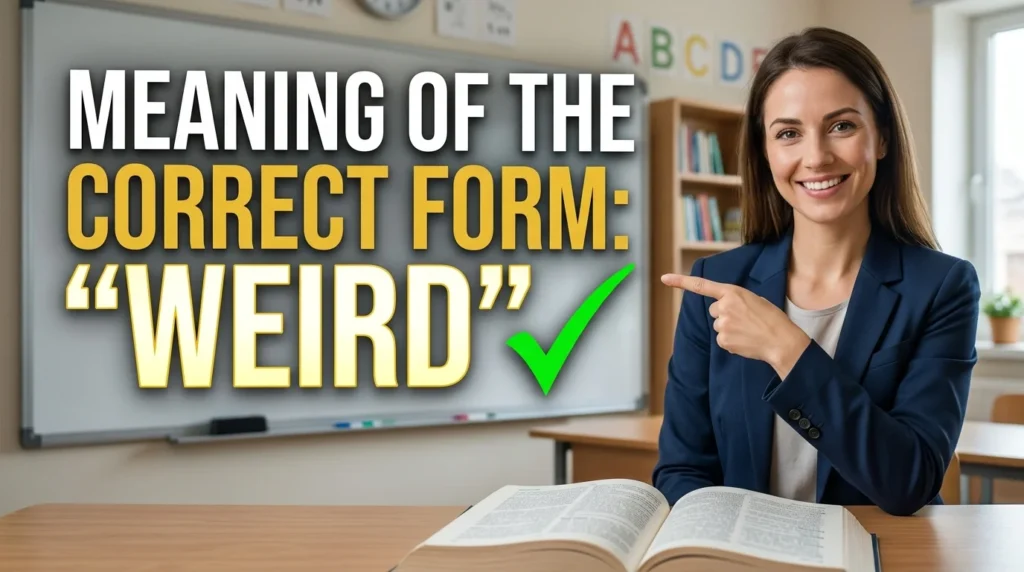
The word “weird” is an adjective. We use it to describe something that seems strange, unusual, unexpected, mysterious, or different from what we normally experience.
For example:
That was a weird dream.
This sentence means that the dream was unusual or strange.
Similarly:
She had a weird feeling that something was wrong.
Here, “weird” describes a feeling that is unusual or difficult to explain.
The meaning can change slightly depending on context. Sometimes “weird” describes something that is simply unusual. In other situations, it can describe something that feels uncomfortable, confusing, or even frightening.
Examples of “Weird” in Everyday English
- That is a weird question.
- I had a weird dream last night.
- This food tastes weird.
- Why is your phone acting weird?
- He told me a weird story.
- There was a weird noise outside.
- That movie had a weird ending.
- She has a weird sense of humour.
- Something weird happened at work today.
- This website is behaving weirdly.
As you can see, “weird” works naturally in many different situations.
What Does “Weird” Mean in British English?

In British English, “weird” generally means strange, unusual, or unexpected.
For example:
That bloke is a bit weird.
In informal British English, this could mean that someone behaves unusually or differently.
Another example is:
It was weird seeing my old school after so many years.
Here, “weird” expresses an unusual or slightly uncomfortable feeling.
British speakers may also use expressions such as:
- a bit weird
- really weird
- very weird
- proper weird — informal
- weird-looking
- weird feeling
- weird behaviour
For example:
That was a really weird conversation.
The spelling remains weird, regardless of whether the speaker uses British vocabulary, pronunciation, or spelling conventions elsewhere in the sentence.
What Does “Weird” Mean in American English?
In American English, “weird” has essentially the same meaning. Americans commonly use it to describe something strange, unusual, uncomfortable, unexpected, or difficult to understand.
For example:
That was a weird movie.
Or:
My computer is acting weird today.
American English also uses common expressions such as:
- That’s weird.
- You’re being weird.
- That sounds weird.
- What a weird situation.
- That was weird.
- I had a weird dream.
Therefore, there is no US spelling such as “wierd.” American English uses “weird.”
Meaning of the Incorrect Form: “Wierd”
“Wierd” is generally a misspelling of “weird.”
It does not represent a separate standard English word. If you write:
❌ That was a wierd experience.
you should change it to:
✅ That was a weird experience.
The mistake happens because English spelling does not always follow the pronunciation in an obvious way. Many people remember the letters in the wrong order and automatically type “wierd.”
This mistake is especially common because several familiar English words use the “ie” pattern.
For example:
- field
- friend
- piece
- believe
- achieve
Because of these familiar patterns, people sometimes assume that “weird” should also contain “ie.” However, the correct spelling is different:
W-E-I-R-D
not:
W-I-E-R-D
Why Do People Spell “Weird” as “Wierd”?
The spelling mistake usually comes from letter-order confusion.
When people hear or say the word, they cannot see the spelling. Therefore, they have to remember whether the word contains “ei” or “ie.”
The word “weird” can be particularly confusing because its spelling does not match the simple patterns people learn from words such as “friend” or “piece.”
For example:
- friend → ie
- piece → ie
- believe → ie
- weird → ei
Therefore, simply relying on a general “i before e” rule can cause problems.
Wierd or Weird: Key Differences
| Feature | Wierd | Weird |
| Standard spelling | ❌ Incorrect | ✅ Correct |
| Meaning | No standard separate meaning | Strange or unusual |
| British English | ❌ Incorrect | ✅ Correct |
| American English | ❌ Incorrect | ✅ Correct |
| Common online mistake | Yes | No |
| Recommended in formal writing | No | Yes |
| Letters | W-I-E-R-D | W-E-I-R-D |
The most important difference is simple: “weird” is the correct spelling.
There is no meaningful UK-versus-US spelling difference here.
Is “Weird” Spelled Differently in the UK and US?
No. “Weird” is spelled the same in British and American English.
This is important because many English words have different spellings in the UK and US.
For example:
| British English | American English |
| colour | color |
| favourite | favorite |
| centre | center |
| realise | realize |
| travelling | traveling |
| humour | humor |
However:
| British English | American English |
| weird | weird |
So, whether you write for a British audience or an American audience, always spell the word:
W-E-I-R-D
Common Mistakes People Make
Understanding common mistakes can help you recognise and avoid them.
1. Writing “Wierd”
This is the most common error.
❌ That movie was wierd.
✅ That movie was weird.
The problem is that the I and E are in the wrong order.
2. Assuming “I Before E” Always Works
Many English learners hear the familiar spelling rule:
“I before E except after C.”
However, English contains many exceptions, and weird is one of the words that can cause problems with this rule.
Therefore, do not automatically write “wierd” just because you remember “ie” as a common pattern.
3. Using “Wierd” in Formal Writing
You might see “wierd” in casual online messages, comments, or social media posts. However, that does not make it an accepted standard spelling.
In formal writing, use:
✅ weird
For example:
The report describes a weird pattern in the data.
4. Confusing Spelling With Pronunciation
Some learners try to spell a word based entirely on how it sounds.
However, English spelling can be unpredictable. Therefore, learning the written form is important.
5. Assuming the UK Uses “Wierd”
Some people believe British English may use “wierd” because British spelling sometimes differs from American spelling.
That is not the case.
British English uses “weird.”
American English also uses “weird.”
Correct Usage in Sentences
The easiest way to remember the spelling is to see the word used naturally.
Everyday Examples
- That was a weird question.
- I had a weird dream last night.
- Something weird happened this morning.
- This milk tastes weird.
- Why is your computer acting weird?
- He has a weird sense of humour.
- She told me a weird story.
- That was a weird experience.
- The movie became weird near the end.
- I heard a weird noise outside.
British English Examples
British English may use different vocabulary or spelling in other parts of the sentence, but weird remains unchanged.
That was a weird experience at the railway station.
He has a weird sense of humour.
It feels weird being back here after so many years.
The weather has been weird lately.
American English Examples
That was a weird experience at the train station.
He has a weird sense of humor.
It feels weird being back here after so many years.
The weather has been weird lately.
Notice that weird is identical in both varieties.
“Weird” as an Adjective
“Weird” is most commonly used as an adjective.
An adjective describes a person, place, thing, experience, feeling, or situation.
For example:
That is a weird idea.
“Weird” describes the idea.
Another example:
She heard a weird sound.
“Weird” describes the sound.
More examples include:
- weird behaviour
- weird situation
- weird feeling
- weird person
- weird idea
- weird story
- weird sound
- weird dream
- weird experience
- weird movie
“Weird” Can Describe Positive or Negative Situations
Interestingly, “weird” does not always mean something bad.
Sometimes people use it negatively:
That behaviour is weird.
However, people can also use it positively or playfully:
I love this weird little café.
Here, “weird” can suggest that the café is unusual in an interesting or charming way.
Similarly:
She has a weird but creative sense of humour.
The speaker may not be criticising her. Instead, they may mean that her humour is unusual and interesting.
Therefore, always consider the context and tone.
Weird vs Strange
“Weird” and “strange” are closely related.
Both can describe something unusual or unexpected.
Compare:
That is a strange idea.
That is a weird idea.
Both sentences suggest that the idea is unusual.
However, “weird” often sounds more informal and conversational, while “strange” can sound slightly more neutral.
For example:
Informal:
That guy is weird.
More neutral:
That behaviour is strange.
Both can communicate a similar basic idea, but the tone can differ.
Weird vs Unusual
“Unusual” generally sounds more neutral than “weird.”
Compare:
She has an unusual hobby.
This sounds neutral.
She has a weird hobby.
This may sound more personal, informal, or judgmental depending on context.
Therefore, choose the word according to the tone you want.
Weird vs Odd
“Odd” is another synonym for “weird.”
For example:
That sounds odd.
and:
That sounds weird.
Both can mean that something does not seem normal.
However, “odd” can sometimes sound softer or more formal.
How to Remember the Spelling of “Weird”
The biggest challenge is remembering EI, not IE.
Here are several easy tricks.
Trick 1: Remember “WE” First
Start the word with:
WE
Then add:
IRD
Together:
WE + IRD = WEIRD
This can be easier than trying to remember the entire word at once.
Trick 2: Remember “Weird Has EI”
Say to yourself:
“Weird has EI.”
The key is the sequence:
WEI
not:
WIE
So:
- ❌ WIErd
- ✅ WEIrd
Trick 3: Think “Weird Is Weird”
You can use the word itself as a memory trick:
“The spelling of WEIRD is weird.”
Because the spelling is unusual, remembering that unusual EI pattern can help.
Trick 4: Write It Three Times
Write:
weird
weird
weird
Then use it in a sentence:
That was a weird situation.
Repeating the correct form can strengthen your memory.
Trick 5: Compare the Two Forms
Put them side by side:
❌ WIERD
✅ WEIRD
Look specifically at the middle letters:
- WIERD ❌
- WEIRD ✅
The correct word contains EI.
A Simple Spelling Formula
If you often forget the spelling, break the word into smaller parts:
WE + IRD
Now pronounce it naturally:
WEIRD
The most important visual pattern is:
WEI
Once you remember those first three letters, the rest becomes much easier.
Why “Weird” Can Be Difficult to Spell
English has many spelling patterns that do not behave consistently.
For example, learners may know:
- believe → ie
- receive → ei
- field → ie
- ceiling → ei
- weird → ei
Therefore, memorising individual words can sometimes be more reliable than applying one spelling rule to every word.
The important point is not to worry if you have made this mistake before. “Wierd” is a very common spelling error. What matters is learning the correct form.
Wierd or Weird in Text Messages
In texting and social media, you may encounter both versions.
For example:
That was wierd lol
This is understandable, but the spelling is incorrect.
The standard version is:
That was weird lol.
Casual communication often contains spelling mistakes, abbreviations, and slang. However, if you are writing an article, application, email, assignment, or professional message, use the standard spelling.
Wierd or Weird in School Writing
For students, spelling accuracy matters because teachers may mark spelling errors even when the meaning is clear.
Instead of:
❌ The ending of the story was wierd.
write:
✅ The ending of the story was weird.
Similarly:
❌ I had a wierd dream last night.
✅ I had a weird dream last night.
Learning common spelling mistakes like this can improve your writing accuracy over time.
Wierd or Weird in Professional Writing
In professional emails, reports, websites, and business communication, use “weird.”
For example:
The software is behaving weirdly after the latest update.
Or:
We noticed a weird error in the system.
However, in formal professional writing, you might sometimes choose a more precise word than “weird,” depending on the situation.
Instead of:
We found a weird problem.
you could write:
We found an unusual problem.
or:
We found an unexpected problem.
The choice depends on the tone and meaning you want.
Common Search Queries About Wierd or Weird
People search for this spelling question in several ways, including:
- wierd or weird
- is wierd or weird correct
- is wierd a word
- how do you spell weird
- correct spelling of weird
- weird spelling
- wierd meaning
- weird meaning
- weird or wierd which is correct
- how to spell weird
- is “wierd” correct English
- weird British spelling
- weird American spelling
All of these questions generally lead to the same answer:
The correct standard spelling is “weird.”
Quick Correction Guide
If you are unsure while writing, use this simple guide:
| If you wrote… | Change it to… |
| wierd | weird |
| wierd feeling | weird feeling |
| wierd person | weird person |
| wierd dream | weird dream |
| wierd sound | weird sound |
| wierd story | weird story |
| wierd situation | weird situation |
| wierd behaviour | weird behaviour |
| wierd behavior | weird behavior |
Remember that behaviour is the British spelling, while behavior is the American spelling. However, weird stays the same.
British vs American English: A Quick Guide
Here is a useful comparison:
| Expression | British English | American English |
| Correct spelling | weird | weird |
| Colour spelling | colour | color |
| Humour spelling | humour | humor |
| Behaviour spelling | behaviour | behavior |
| Favourite spelling | favourite | favorite |
| Correct form of “wierd” | weird | weird |
This shows why it is important not to assume that every spelling difference between British and American English affects every word.
“Weird” is a shared spelling.
When Should You Use “Weird”?
Use “weird” when you want to describe something that is:
- strange
- unusual
- unexpected
- mysterious
- unfamiliar
- unconventional
- difficult to explain
- outside the normal pattern
For example:
I heard a weird noise.
That is a weird coincidence.
He had a weird dream.
This situation feels weird.
However, choose another word when you need a more precise or formal description.
For example, instead of:
The results are weird.
you might write:
The results are unusual.
or:
The results are unexpected.
When Should You Avoid “Weird”?
Although “weird” is a normal English word, context matters.
When describing another person, “weird” can sometimes sound rude or judgmental.
For example:
He is weird.
could sound insulting.
A softer alternative might be:
He has an unusual personality.
or:
He behaves differently from most people.
Therefore, consider your audience before using the word.
This is especially important in professional, academic, or sensitive conversations.
Frequently Asked Questions
1. Is it “wierd” or “weird”?
“Weird” is the correct spelling. “Wierd” is a common misspelling.
2. Is “wierd” a correct English word?
In standard modern English, “wierd” is generally treated as an incorrect spelling of “weird.” Use “weird” in standard writing.
3. How do you spell weird correctly?
Spell it:
W-E-I-R-D
The middle letters are EI, not IE.
4. Is “weird” spelled the same in British and American English?
Yes. Both British English and American English use “weird.”
5. Why do people spell “weird” as “wierd”?
People often confuse the order of I and E, partly because many familiar English words contain “ie.”
6. What does “weird” mean?
“Weird” usually means strange, unusual, unexpected, or different from what is considered normal.
7. Is “weird” informal?
“Weird” is common in everyday English and is relatively conversational. It can still appear in many types of writing, although a more precise word such as “unusual” or “unexpected” may be better in some formal contexts.
8. Is “weird” an adjective?
Yes. “Weird” is an adjective.
For example:
That is a weird idea.
“Weird” describes the noun “idea.”
9. What is the opposite of weird?
Depending on context, possible opposites include normal, ordinary, usual, familiar, conventional, or typical.
10. Is “wierd” acceptable in texting?
People may understand “wierd” in a text message, but it is still a spelling mistake. The standard spelling is “weird.”
11. Is “weird” pronounced differently in the UK and US?
The pronunciation can vary slightly according to accent, but the spelling remains weird in both varieties.
12. What is an easy way to remember “weird”?
Remember:
WEI = correct
WIE = incorrect
You can also use the phrase:
“WEIRD has EI.”
Final Takeaway:
In conclusion, weird is the correct spelling, while wierd is a common spelling mistake. The word weird describes something unusual, strange, unexpected, or difficult to understand. For example, you might say, “That was a weird experience” when something surprising happens. Remember the spelling rule: in weird, the letters “e” and “i” appear in the order “ei,” not “ie.” Although this spelling may seem confusing, practicing it can help you remember the correct form.
You are writing emails, articles, school assignments, or everyday messages, always use weird to keep your writing clear, accurate, and grammatically correct.