Spelling certain English words correctly can be surprisingly tricky, especially when two versions look almost identical. “Niece or neice” is a common spelling confusion because both forms contain the same letters, but their order is different. Whether you are writing a birthday card, sending a family message, or completing a school assignment, knowing the correct spelling will help you communicate clearly and confidently.
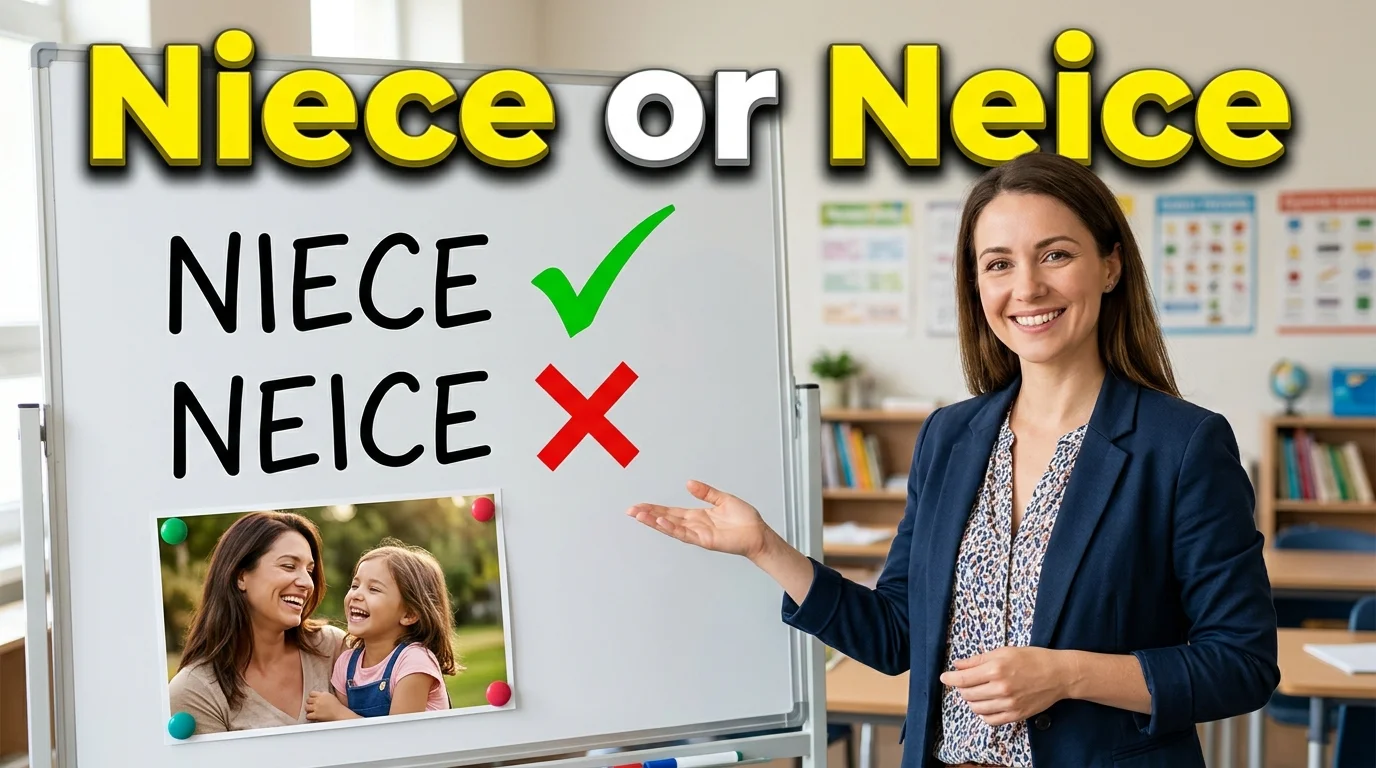
The correct spelling is “niece,” not “neice.” A niece is the daughter of your brother or sister, or the daughter of your spouse’s brother or sister. For example, you might write, “My niece is celebrating her birthday today,” when talking about your sibling’s daughter. The word can refer to a girl or woman in your extended family, regardless of her age.
On the other hand, “neice” is a common misspelling and is not accepted as the standard spelling in modern English. People often make this mistake because they remember the familiar “i before e” spelling pattern incorrectly. A helpful way to remember “niece” is to notice that the i comes before the e in this word.
Quick Answer: Niece or Neice?
Niece is the correct spelling. Neice is a common spelling mistake and is not the standard English form.
A niece is the daughter of your brother or sister. The word has the same spelling and meaning in both British English and American English.
- Correct: My niece is visiting us this weekend.
- Incorrect: My neice is visiting us this weekend.
Therefore, whenever you mean a female relative who is the daughter of your sibling, choose niece.
Meaning of the Correct Form: Niece
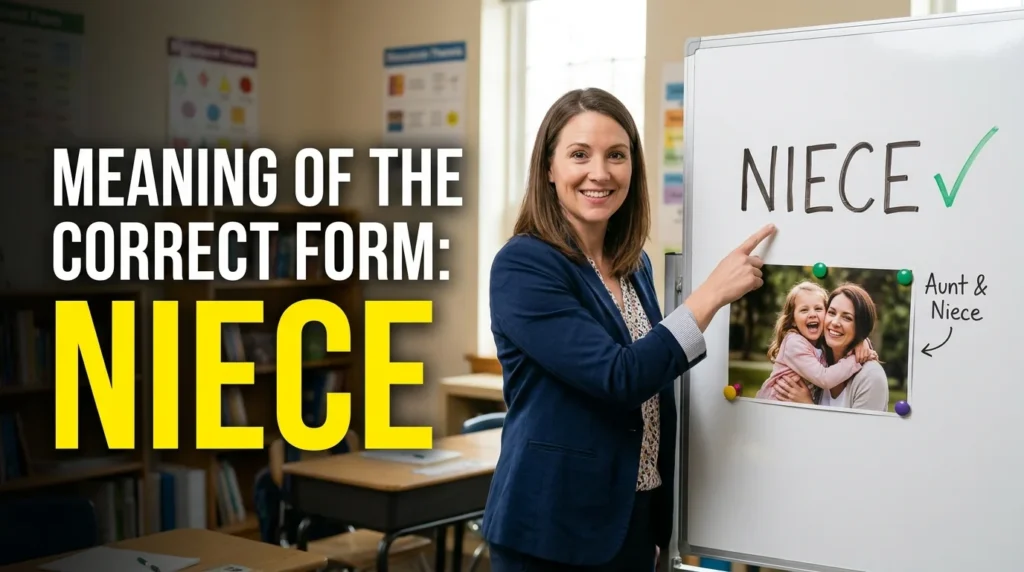
The word niece is a noun used to describe a family relationship. It refers to the daughter of your brother or sister.
For example, if your sister has a daughter, that girl is your niece. Similarly, if your brother has a daughter, she is also your niece.
Simple Definition
Niece: The daughter of your brother or sister.
Examples of the Meaning
- My sister’s daughter is my niece.
- My brother has a young niece who loves drawing.
- I bought a birthday gift for my niece.
- Their niece lives in London.
- His niece is learning to play the piano.
The word describes a family connection, so it often appears in conversations about relatives, birthdays, weddings, holidays, and family events.
Niece in British English
In British English, niece is the standard spelling.
Examples:
- My niece is studying at a university in Manchester.
- We are taking our niece to the seaside during the holidays.
- Her niece sent her a lovely birthday card.
British English does not use neice as an alternative spelling. The correct form remains niece.
Niece in American English
American English also uses niece.
Examples:
- My niece is starting school next week.
- I am taking my niece to the zoo.
- Her niece lives in Chicago.
As you can see, the spelling does not change between the UK and the US. The word is written niece in both varieties.
Meaning of the Incorrect Form: Neice
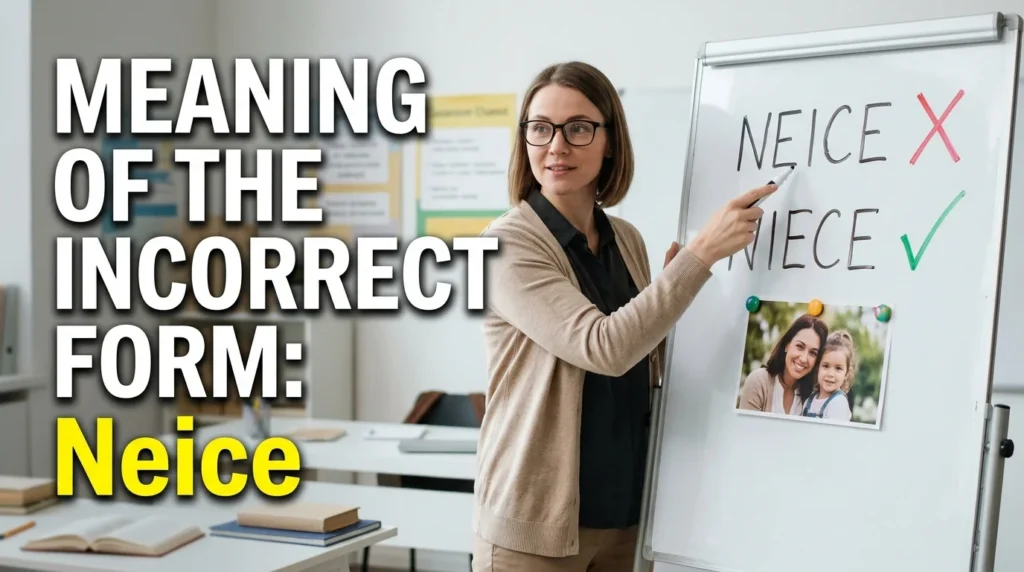
Neice is not the standard spelling of the family relationship. It is usually a misspelling of niece.
Although people may understand what you mean when you write “neice,” dictionaries and standard English usage recognise niece as the correct form.
Why Do People Write “Neice”?
The mistake often happens because English spelling does not always follow pronunciation. Many learners remember the sound of the word but place the letters in the wrong order.
The word niece contains the letter sequence “ie”, not “ei.”
- Correct: n-i-e-c-e
- Incorrect: n-e-i-c-e
This small difference can be easy to miss, especially when typing quickly or writing from memory.
Is “Neice” Ever Correct?
In standard English, neice is not the accepted spelling for your sibling’s daughter. If you are writing an email, school assignment, article, greeting card, or formal document, use niece.
However, you may occasionally see “Neice” used as a surname, username, business name, or personal name. In those cases, it may be a proper name rather than the ordinary English word. That does not make it the correct spelling of the family relationship.
Niece or Neice: Key Differences
The main difference is spelling. The meaning people intend is usually the same, but only niece is correct in standard English.
| Feature | Niece | Neice |
| Spelling | Correct | Incorrect |
| Meaning | Daughter of your brother or sister | Usually intended to mean niece |
| Part of speech | Noun | Misspelling |
| British English | Standard form | Not standard |
| American English | Standard form | Not standard |
| Pronunciation | Usually /niːs/ | Intended pronunciation is usually the same |
| Example | My niece is ten years old. | My neice is ten years old. ❌ |
Does British English Spell It Differently?
No. Unlike words such as colour/color, centre/center, or favourite/favorite, the spelling of niece does not change between British and American English.
Both use:
niece
Therefore, you do not need to learn a separate UK and US spelling for this word.
Is the Pronunciation Different?
Generally, niece is pronounced “nees”, with a long ee sound.
You can think of it as sounding like:
- peace
- piece
- fleece
The pronunciation is broadly the same in British and American English, although individual accents may vary slightly.
Why “Niece” Is Easy to Misspell
English contains many words with confusing “ie” and “ei” combinations. Because of this, writers sometimes apply the wrong letter order to niece.
For example:
- niece → correct
- neice → incorrect
- receive → correct
- recieve → incorrect
- believe → correct
- beleive → incorrect
However, spelling rules do not always work perfectly in English. That is why it helps to remember the spelling of niece directly rather than relying only on a general rule.
The “I Before E” Rule
You may have heard:
“I before E, except after C…”
This rule can help with some words, but it has many exceptions and does not explain every spelling pattern.
The word niece follows the “ie” order:
n + ie + ce = niece
It is better to memorise the correct spelling than to depend entirely on the rule.
Common Mistakes People Make
Even native speakers sometimes type neice, especially when writing quickly. Here are some common mistakes and how to correct them.
Mistake 1: Reversing “ie” to “ei”
Incorrect: My neice is coming over.
Correct: My niece is coming over.
The letters i and e appear in the order ie.
Mistake 2: Using “neice” in Formal Writing
Incorrect: I would like to invite my neice to the ceremony.
Correct: I would like to invite my niece to the ceremony.
Formal writing requires standard spelling, so always check this word before submitting an important document.
Mistake 3: Assuming the UK and US Use Different Spellings
Some English words have different spellings in British and American English. However, niece is not one of them.
British: My niece lives in Bristol.
American: My niece lives in Boston.
The spelling remains exactly the same.
Mistake 4: Confusing “Niece” With “Nephew”
A niece is female, while a nephew is male.
- My brother’s daughter is my niece.
- My brother’s son is my nephew.
Remembering this difference helps you use the correct word in family conversations.
Mistake 5: Confusing “Niece” With “Nice”
The words niece and nice sound different and have different meanings.
- Niece: A female relative.
- Nice: Pleasant, kind, or enjoyable.
Examples:
- My niece gave me a card.
- That was a nice thing to do.
Although both words contain similar letters, they are not interchangeable.
Correct Usage in Sentences
The best way to remember a spelling is to see it in real sentences. Below are examples that work naturally in both British and American English.
Everyday Family Conversations
- My niece is visiting us this weekend.
- I spoke to my niece on the phone yesterday.
- My niece loves reading adventure stories.
- We are planning a party for our niece.
- Her niece is learning how to ride a bicycle.
- My brother’s daughter is my niece.
- My niece sent me a lovely photograph.
- I am proud of my niece.
- Their niece enjoys playing football.
- My niece is very interested in music.
Birthday and Celebration Examples
- I bought a birthday present for my niece.
- My niece is turning eight next month.
- We decorated the house for our niece’s birthday.
- Her niece received a beautiful cake.
- I wrote a birthday message for my niece.
- My niece invited us to her graduation.
- We are attending our niece’s wedding.
- My niece looked wonderful in her new dress.
British English Examples
The following sentences use British vocabulary or contexts, but the spelling of niece stays the same.
- My niece is going on holiday with her parents.
- I bought my niece a jumper for Christmas.
- My niece is revising for her exams.
- We are meeting our niece at the railway station.
- Her niece lives in a small village near Leeds.
American English Examples
These examples use common American vocabulary or contexts.
- My niece is going on vacation with her parents.
- I bought my niece a sweater for Christmas.
- My niece is studying for her exams.
- We are meeting our niece at the train station.
- Her niece lives in a small town near Dallas.
Notice that the family word niece remains unchanged. Only other vocabulary may vary depending on the variety of English.
Examples With Possessive Forms
The possessive form shows that something belongs to your niece.
- My niece’s bicycle is blue.
- We attended our niece’s graduation.
- Her niece’s birthday is tomorrow.
- I helped my niece’s children with their homework.
When you mean something belongs to one niece, add an apostrophe and s:
niece + ’s = niece’s
Examples With Plural Forms
The plural of niece is nieces.
- My two nieces live nearby.
- I bought gifts for my nieces.
- Her nieces enjoy visiting during the holidays.
- Both of my nieces are learning French.
Do not write niece’s when you simply mean more than one niece. The apostrophe changes the meaning.
| Form | Meaning | Example |
| Niece | One female relative | My niece is here. |
| Nieces | More than one female relative | My nieces are here. |
| Niece’s | Belonging to one niece | My niece’s bag is red. |
Niece vs. Nephew: Understanding the Difference
People sometimes confuse niece and nephew because both words describe children of siblings.
| Word | Meaning | Example |
| Niece | Daughter of your brother or sister | My niece is five years old. |
| Nephew | Son of your brother or sister | My nephew is six years old. |
Easy Examples
- Your sister’s daughter = your niece
- Your sister’s son = your nephew
- Your brother’s daughter = your niece
- Your brother’s son = your nephew
Both British and American English use these definitions.
Tips to Remember the Correct Spelling
If you often confuse niece and neice, try one of these simple memory tricks.
Tip 1: Remember “I” Comes Before “E”
The correct spelling begins with:
n + ie
Think:
Never Ignore Every Correct Ending.
This is not a formal spelling rule, but it can help you remember the order.
Tip 2: Connect It With “Piece”
The words niece and piece share the “ie” spelling pattern.
- niece
- piece
You can remember:
A niece is a piece of your family.
It is a playful memory trick, but it makes the letter order easier to recall.
Tip 3: Break the Word Into Parts
Write the word as:
NIE + CE
Or simply:
N I E C E
Seeing the letters in the correct order can help prevent the common ei mistake.
Tip 4: Remember the Sound
Niece sounds like “nees.” It does not sound like “nice.”
Try saying:
“My niece is nice.”
This sentence helps you remember both the meaning and the spelling.
Tip 5: Add It to Your Personal Dictionary
If your phone or writing software repeatedly autocorrects or suggests the wrong spelling, add niece to your memory list. You can also practise typing it several times:
niece — niece — niece
A little repetition can make the correct spelling automatic.
How to Use “Niece” in Different Types of Writing
The word niece can appear in casual messages, formal writing, and online content. Its spelling stays the same in every context.
In Text Messages
- “My niece just learned to walk!”
- “I’m taking my niece to the park.”
- “My niece has a birthday tomorrow.”
In Emails
- “I will be attending my niece’s graduation next Friday.”
- “Please send my best wishes to your niece.”
- “My niece is staying with us during the school holidays.”
School Assignments
- “My niece is an important member of my family.”
- “I enjoy spending time with my niece.”
- “My niece lives in another city.”
In Social Media Posts
- “Happy birthday to my amazing niece!”
- “A special day with my niece.”
- “Watching my niece grow up is such a joy.”
Regardless of the writing style, niece is the correct spelling.
Does “Niece” Have Any UK or US Variations?
No major spelling variation exists between British and American English.
Some family-related words may have regional preferences, but niece is consistent in both varieties.
British and American Comparison
| Phrase | British English | American English |
| Female sibling’s child | Niece | Niece |
| Male sibling’s child | Nephew | Nephew |
| More than one niece | Nieces | Nieces |
| Belonging to one niece | Niece’s | Niece’s |
| Correct spelling | Niece | Niece |
The main differences between British and American English usually involve vocabulary, pronunciation, punctuation, or spelling in other words—not this one.
A Short Spelling Practice Exercise
Try choosing the correct spelling in each sentence.
- My (niece / neice) is coming to dinner.
- I bought a gift for my (niece / neice).
- Her (niece / neice) lives in New York.
- We are celebrating our (niece’s / neice’s) birthday.
- My two (nieces / neices) love playing together.
Answers
- niece
- niece
- niece
- niece’s
- nieces
The key is to remember that the correct base word is always niece.
Frequently Asked Questions About Niece or Neice
1. Is “niece” or “neice” correct?
Niece is correct. Neice is a common misspelling.
2. What does niece mean?
A niece is the daughter of your brother or sister.
3. Is “niece” spelled differently in British and American English?
No. Both British English and American English use niece.
4. How do you pronounce niece?
Niece is usually pronounced “nees”, with a long ee sound.
5. What is the plural of niece?
The plural is nieces.
Example: I have three nieces.
6. What is the possessive form of niece?
The possessive form is niece’s.
Example: My niece’s book is on the table.
7. Is “neice” a word in English?
Neice is not the standard spelling of the family relationship. It may appear as a surname or personal name, but the correct family word is niece.
8. What is the difference between a niece and a nephew?
A niece is the daughter of your sibling, while a nephew is the son of your sibling.
9. Why do people spell niece as neice?
People often reverse the “ie” letters because English spelling can be confusing. The pronunciation does not clearly show the letter order.
10. Is “niece” a noun?
Yes. Niece is a noun because it names a person or family relationship.
Example: My niece is visiting today.
Conclusion
So, when you are choosing between niece or neice, remember that niece is the correct spelling. It means the daughter of your brother or sister, and it is used in both British English and American English.
The incorrect form neice usually appears because writers reverse the letters i and e. However, once you remember the correct pattern n-i-e-c-e the word becomes much easier to spell.