Have you ever stopped while writing an email, filling out a form, or addressing a letter because you were unsure whether to use Ms, Mrs, or Miss? You are not alone. These three titles look similar, but they can communicate different things about a woman’s name, marital status, or personal preference. Choosing the right one helps you sound polite, professional, and confident.
The confusion becomes even more common when you communicate with people in both the UK and the US. Although British and American English use these titles in largely the same way, pronunciation, punctuation, and personal preferences can vary.
Therefore, understanding the difference between Ms, Mrs, and Miss is useful for students, job seekers, business owners, writers, and anyone who wants to address people respectfully.
Quick Answer: Ms, Mrs, or Miss?
Miss traditionally refers to an unmarried woman or girl. Mrs traditionally refers to a married woman. Ms is a neutral title that does not reveal or depend on a woman’s marital status.
| Title | General meaning | Common use |
| Miss | Traditionally an unmarried woman or girl | Young women, unmarried women, or when the person prefers it |
| Mrs | Traditionally a married woman | Married women who use or prefer this title |
| Ms | A neutral title that does not indicate marital status | Professional, formal, or everyday situations |
The safest choice when you do not know someone’s preference is usually Ms. However, if a woman has clearly stated that she prefers Mrs or Miss, use her chosen title.
Meaning of Ms, Mrs, and Miss
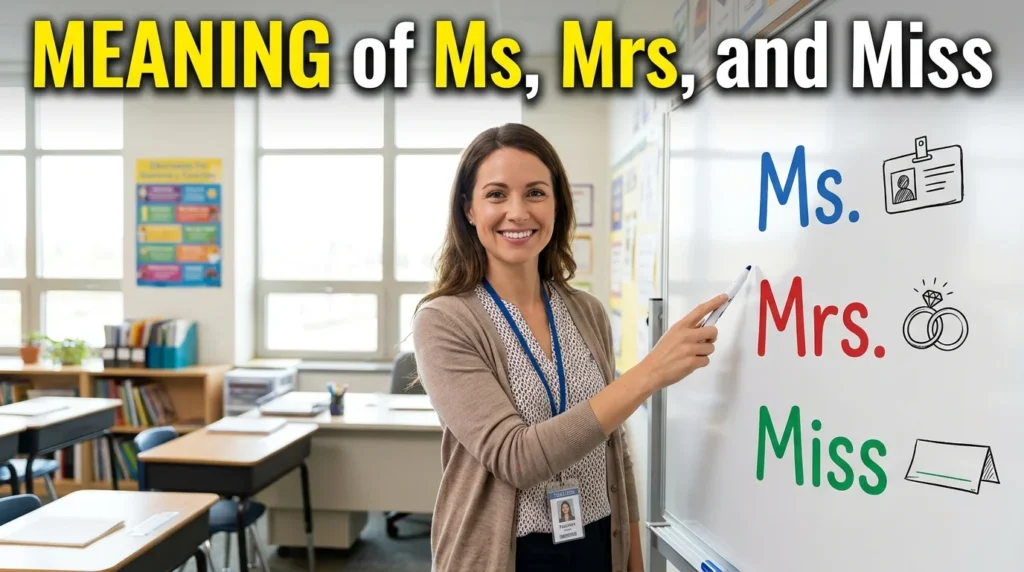
The titles Ms, Mrs, and Miss are called honorifics or titles. They appear before a person’s name to show respect or identify how someone should be addressed.
For example:
- Ms Taylor is a neutral form of address.
- Mrs Taylor traditionally indicates that Taylor is a married woman.
- Miss Taylor traditionally indicates that Taylor is unmarried.
However, these meanings are not strict rules about a person’s identity. A woman may choose a title for personal, professional, cultural, or practical reasons.
What Does Ms Mean?
Ms is a title used for a woman without referring to whether she is married.
It is especially common in workplaces, official correspondence, schools, and situations where marital status is irrelevant.
Examples:
- Dear Ms Johnson,
- Please ask Ms Ahmed to call me.
- Ms Brown will lead the meeting.
- I sent the documents to Ms Wilson.
Ms is often the best option when:
- You do not know whether a woman is married.
- You do not want to assume her marital status.
- You are writing a formal email or letter.
- You are addressing a professional contact.
- The person has asked you to use Ms.
Ms in British English
In British English, Ms is widely used in professional and formal settings.
Example:
Dear Ms Patel, Thank you for your email. I look forward to meeting you on Monday.
Ms in American English
American English also uses Ms frequently, especially in business communication, education, and official documents.
Example:
Dear Ms Carter, Thank you for applying for the position.
Important: Ms does not mean that a woman is unmarried. It simply avoids specifying marital status.
What Does Mrs Mean?
Mrs is traditionally used before the surname of a married woman.
For example:
- Mrs Smith
- Mrs Khan
- Mrs Williams
Traditionally, a married woman might use her husband’s surname, such as Mrs John Smith. However, modern usage often uses the woman’s own first name and surname:
- Mrs Sarah Smith
- Mrs Aisha Khan
A woman may also keep her original surname after marriage. In that case, she might use Mrs with her own surname if that is her preference.
Examples:
- Mrs Green teaches mathematics.
- I spoke to Mrs Lewis yesterday.
- Mrs Ahmed is attending the conference.
- Please send the invitation to Mrs Taylor.
Mrs in British English
British English uses Mrs in both formal and everyday situations.
Example:
Mrs Roberts has asked the school to contact her.
However, many British women prefer Ms, particularly in professional environments.
Mrs in American English
American English also uses Mrs for married women who choose that title.
Example:
Mrs Davis will meet you at the reception desk.
In the US, Mrs may appear on forms, invitations, school records, and formal correspondence.
Remember: Marriage does not automatically determine which title a woman wants you to use.
What Does Miss Mean?
Miss traditionally refers to an unmarried woman or girl. It is also commonly used for girls and young women.
Examples:
- Miss Brown is my English teacher.
- Excuse me, Miss, could you help me?
- Miss Emily Jones won the competition.
- Miss Khan is speaking at the event.
In schools, Miss may be used by pupils when addressing a female teacher, even if they do not know her marital status.
Miss in British English
In British English, Miss is common in schools and can also be used as a polite form of address.
Example:
Excuse me, Miss, may I ask a question?
However, some adults may prefer Ms or another title.
Miss in American English
American English uses Miss for unmarried women and girls, and it is also common in school settings.
Example:
Miss Johnson is our new teacher.
Miss can also be part of a name or a traditional title, such as Miss America or Miss Universe.
Ms vs Mrs vs Miss: Key Differences
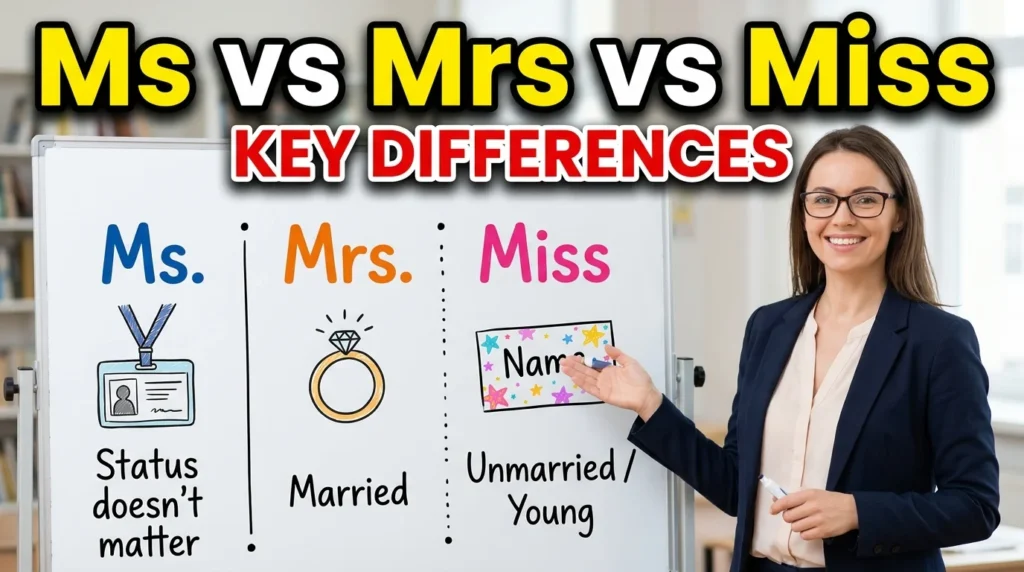
The main difference between these titles is whether they traditionally communicate marital status.
| Feature | Ms | Mrs | Miss |
| Indicates marital status? | No | Traditionally yes | Traditionally yes |
| Common for married women? | Yes | Yes | Sometimes, if preferred |
| Common for unmarried women? | Yes | Traditionally no | Yes |
| Suitable for professional use? | Yes | Yes | Yes |
| Suitable when preference is unknown? | Usually the safest choice | Not always | Not always |
| Used in the UK? | Yes | Yes | Yes |
| Used in the US? | Yes | Yes | Yes |
Is Ms More Formal Than Mrs or Miss?
No. Ms, Mrs, and Miss can all be formal titles. The difference is not mainly about formality. It is about meaning and personal preference.
For example:
- Dear Ms Evans,
- Dear Mrs Evans,
- Dear Miss Evans,
All three can appear in a formal letter. However, the appropriate choice depends on how the person prefers to be addressed.
Is Ms Only for Unmarried Women?
No. Ms is not limited to unmarried women. Married, unmarried, divorced, widowed, and separated women may all use Ms.
For example:
Ms Morgan is married, but she prefers Ms in all professional correspondence.
This is completely acceptable.
Is Mrs Only for Women Who Use Their Husband’s Surname?
No. A woman may use Mrs while keeping her own surname.
For example:
- Mrs Sarah Jones
- Mrs Emily Brown
The title does not require a woman to change her surname. Her personal preference determines the correct form.
Is Miss Only for Young Girls?
Not necessarily. Miss traditionally refers to unmarried women, and it can also be used for girls. Some adult women continue to prefer Miss.
For example:
Miss Taylor, who is 35, prefers to use Miss in formal correspondence.
Although Ms is often more neutral, Miss is not automatically incorrect for an adult woman.
Why Do People Confuse Ms, Mrs, and Miss?
The confusion often comes from older naming traditions. In the past, a woman’s title frequently communicated whether she was married. Today, many people consider marital status private or irrelevant, especially in professional settings.
Traditional Naming Customs
Traditionally:
- Miss was used for unmarried women.
- Mrs was used for married women.
- Ms became popular as a neutral alternative.
These customs still influence how people learn English. However, modern English gives individuals more freedom to choose the title they prefer.
Different Personal Preferences
Two women with the same marital status may choose different titles.
For example:
- A married woman may prefer Mrs.
- Another married woman may prefer Ms.
- An unmarried woman may prefer Miss.
- Another unmarried woman may prefer Ms.
Therefore, marital status alone does not always tell you which title to use.
Differences Between UK and US Usage
British and American English generally follow the same basic meanings. Nevertheless, you may notice differences in pronunciation, punctuation, and context.
| Area | British English | American English |
| Ms | Common in formal and professional writing | Common in formal and professional writing |
| Mrs | Common for married women | Common for married women |
| Miss | Common in schools and traditional address | Common in schools and traditional address |
| Full stops | Often omitted: Ms Smith | Often omitted: Ms Smith |
| Pronunciation | Usually /mɪz/, /ˈmɪsɪz/, /mɪs/ | Usually /mɪz/, /ˈmɪsɪz/, /mɪs/ |
Punctuation Differences: Ms. vs Ms
One noticeable difference is punctuation.
In British English, titles are often written without full stops:
- Ms Smith
- Mrs Jones
- Miss Brown
In American English, traditional style guides have often used full stops:
- Ms. Smith
- Mrs. Jones
- Miss Brown
However, modern American usage increasingly omits full stops, especially in professional and institutional writing.
Both forms may be acceptable depending on the style guide. The most important thing is to remain consistent.
Pronunciation Differences
The titles are pronounced differently:
| Title | Common pronunciation |
| Ms | “Miz” |
| Mrs | “Miss-iz” |
| Miss | “Miss” |
For example:
- Ms Green → “Miz Green”
- Mrs Green → “Miss-iz Green”
- Miss Green → “Miss Green”
The pronunciation is generally similar in British and American English, although individual accents may vary.
Common Mistakes People Make
Understanding the meaning is helpful, but using these titles correctly also requires attention to context.
Mistake 1: Assuming Every Married Woman Uses Mrs
Incorrect assumption:
She is married, so I must call her Mrs.
Better approach:
She is married, but I should use the title she prefers.
A married woman may choose Ms, Mrs, or another form of address.
Mistake 2: Assuming Ms Means Divorced
Some people incorrectly believe that Ms means a woman is divorced or separated.
That is not correct. Ms is a neutral title and does not reveal marital status.
Example:
Ms Parker is married and uses Ms professionally.
Mistake 3: Using Miss for Every Woman
Miss is not the universal title for women.
Less appropriate:
Dear Miss Williams,
This may be correct if the person prefers Miss. However, if you do not know her preference, Dear Ms Williams is usually a safer choice.
Mistake 4: Writing “Misses” Instead of Mrs
The plural of Mrs is Mmes in some formal contexts, but “misses” is not the correct written form of the title Mrs.
Incorrect:
Mrs. Ahmed
Actually, this is not incorrect in American English. The common mistake is confusing the pronunciation “miss-iz” with the spelling.
Correct forms:
- Mrs Ahmed
- Mrs. Ahmed
Mistake 5: Adding an Apostrophe
Titles do not normally require apostrophes.
Incorrect:
- Mr’s Smith
- Ms’s Brown
Correct:
- Mr Smith
- Ms Brown
Mistake 6: Using the Wrong Title in a Formal Email
A title may seem small, but using the wrong one can make your message feel careless.
Less suitable when preference is unknown:
Dear Mrs Ahmed,
Safer:
Dear Ms Ahmed,
However, if the person signs her emails as Mrs Ahmed, you can follow that preference.
Mistake 7: Thinking Ms Is Pronounced “Miss”
Ms is pronounced “Miz,” not “Miss.”
- Ms Carter → “Miz Carter”
- Miss Carter → “Miss Carter”
This distinction matters when speaking on the telephone or introducing someone.
Mistake 8: Believing Titles Must Always Be Used
In many modern workplaces, people prefer to use first names.
For example:
Hi Sarah,
may be more natural than:
Dear Ms Smith,
if Sarah has introduced herself by her first name.
However, formal situations may still require titles.
Correct Usage in Sentences
Here are practical examples for both British and American English readers.
Examples with Ms
- Ms Taylor will contact you tomorrow.
- Dear Ms Wilson, thank you for your application.
- I spoke with Ms Ahmed about the project.
- Ms Brown is the head of the department.
- Please address the envelope to Ms Jones.
- Ms Morgan has requested a copy of the report.
- The receptionist asked Ms Davis to wait.
- Ms Patel will present the findings.
With Mrs
- Mrs Smith is attending the meeting.
- I sent the invitation to Mrs Khan.
- Mrs Williams teaches science.
- Please ask Mrs Brown to sign the form.
- Mrs Johnson has lived here for ten years.
- Mrs Taylor prefers to use her married title.
- The school contacted Mrs Ahmed yesterday.
- Mrs Evans will speak at the event.
Examples with Miss
- Miss Brown is our English teacher.
- Excuse me, Miss, may I ask something?
- Miss Taylor won the award.
- The letter was addressed to Miss Wilson.
- Miss Khan is preparing for the examination.
- Miss Jones prefers to use Miss.
- Miss Davis is the youngest participant.
- The children thanked Miss Smith for her help.
In British English Contexts
- Ms Patel is the new manager at our office.
- Mrs Green has written to the council.
- Miss Brown is teaching the class today.
- Dear Ms Wilson, I am writing to confirm your appointment.
- Mrs Taylor has asked for a copy of the timetable.
Examples in American English Contexts
- Ms. Johnson is the director of the programme.
- Mrs. Davis will attend the school meeting.
- Miss Carter is our new teacher.
- Dear Ms. Smith, thank you for your message.
- Mrs. Brown has submitted the application.
Note: In American English, both Ms Johnson and Ms. Johnson may be used, depending on the style guide.
How to Choose the Right Title
Choosing the correct title does not have to be difficult. Follow these simple steps.
Step 1: Check the Person’s Preference
If the person has provided a title, use it.
For example, if someone signs an email:
Ms Emily Brown
you should normally use Ms Brown in your reply.
Step 2: Use Ms When You Are Unsure
If you do not know the person’s preference, Ms is usually the safest neutral option.
Example:
Dear Ms Wilson,
This avoids making assumptions about marital status.
Step 3: Follow the Context
In schools, Miss may be common. In professional settings, Ms may be more appropriate. Family or traditional contexts, Mrs may be preferred.
Step 4: Be Consistent
If you use full stops in titles, use them consistently throughout your document.
For example:
- Ms. Smith
- Mrs. Brown
- Miss. Jones
Or:
- Ms Smith
- Mrs Brown
- Miss Jones
Step 5: Respect the Person’s Choice
Ultimately, the person’s preference matters more than traditional assumptions.
Ms, Mrs, or Miss in Emails and Letters
Formal correspondence is one of the most common places where people need to choose a title.
Formal Email Examples
When preference is unknown:
Dear Ms Ahmed, I am writing to ask about the position advertised on your website.
When the person prefers Mrs:
Dear Mrs Ahmed, Thank you for your invitation.
When the person prefers Miss:
Dear Miss Ahmed, Thank you for your response.
Informal Email Examples
If someone has introduced themselves by their first name, you may not need a title.
Hi Aisha, Thanks for getting back to me.
However, if the relationship is formal, a title may still be appropriate.
Cover Letters and Job Applications
When applying for a job, use the title shown in the job advertisement or the person’s professional signature.
Example:
Dear Ms Roberts,
If you do not know the hiring manager’s preferred title, Ms is generally a suitable choice.
Official Forms
Forms may ask you to select:
- Miss
- Ms
- Mrs
- Other
Choose the option that matches your preference. If the form requires a title, do not assume that marriage determines the answer.
Ms, Mrs, or Miss in Schools
Schools often use Miss as a traditional form of address for female teachers.
For example:
Good morning, Miss.
However, not every female teacher prefers Miss. Some may prefer Ms, Mrs, or their first name.
British School Usage
In British schools, pupils may say:
Excuse me, Miss.
This is a familiar and traditional form of address.
American School Usage
In American schools, students may use:
Miss Johnson
or simply:
Ms. Johnson
depending on the teacher’s preference and local custom.
The important point: School traditions do not override an individual’s preferred title.
Ms, Mrs, or Miss in Professional Settings
Professional communication often favours neutral and respectful language.
Why Ms Is Common at Work
Ms is useful because it avoids assumptions about marital status. It also works well when you do not know someone personally.
Examples:
- Ms Ahmed is the project manager.
- Please contact Ms Brown.
- Dear Ms Wilson, thank you for your time.
When Mrs or Miss Is Appropriate
Use Mrs or Miss when:
- The person has clearly chosen that title.
- The title appears in their official professional details.
- The context is traditional or personal.
- The person asks you to use it.
What If You Make a Mistake?
If you accidentally use the wrong title, a simple correction is usually enough.
I’m sorry, Ms Taylor. Thank you for correcting me.
You do not need to make the situation awkward. Just use the preferred title going forward.
Tips to Remember Ms, Mrs, and Miss
These simple memory tricks can help you remember the difference.
Tip 1: Ms = Marital Status Not Specified
Think:
Ms = neutral
It does not tell you whether a woman is married.
Tip 2: Mrs = Married Traditionally
Think:
Mrs = married traditionally
This is the traditional association, although some married women prefer Ms.
Tip 3: Miss = Traditionally Unmarried
Think:
Miss = unmarried traditionally
It is also commonly used for girls and in school settings.
Tip 4: Use Ms When Unsure
If you do not know which title to choose, remember:
When in doubt, Ms is usually a safe choice.
Tip 5: Ask Politely
If the situation matters, you can ask:
Which title do you prefer?
This is respectful and avoids guessing.
Tip 6: Check the Email Signature
A person’s email signature often shows the title they prefer.
For example:
Ms Sarah Khan Marketing Manager
Use the same title in your reply.
FAQs About Ms, Mrs, and Miss
1. What is the difference between Ms, Mrs, and Miss?
Ms is a neutral title that does not indicate marital status. Mrs traditionally refers to a married woman, while Miss traditionally refers to an unmarried woman or girl.
2. Should I use Ms or Mrs for a married woman?
Use the title the woman prefers. If you do not know her preference, Ms is usually a safe neutral choice.
3. Is Ms used in both British and American English?
Yes. Ms is widely used in both British and American English, especially in professional and formal communication.
4. Is Miss only for unmarried women?
Traditionally, Miss refers to an unmarried woman or girl. However, some adult women prefer Miss regardless of age or marital status.
5. Does Ms mean divorced?
No. Ms does not indicate whether a woman is married, unmarried, divorced, or widowed.
6. Should I write Ms with a full stop?
Both Ms and Ms. are used. British English often omits the full stop, while American English may use it depending on the style guide. Follow the style required by your workplace or publication.
7. How do you pronounce Ms?
Ms is usually pronounced “Miz.” Mrs is pronounced “Miss-iz,” and Miss is pronounced “Miss.”
8. Can a married woman use Miss?
Yes. A woman may choose Miss for personal or professional reasons. The best approach is to respect her preference.
9. Can an unmarried woman use Mrs?
Traditionally, Mrs refers to a married woman. However, titles are personal choices, so the person’s stated preference should guide you.
10. Is Ms more respectful than Miss or Mrs?
No title is automatically more respectful. Ms, Mrs, and Miss can all be respectful when used correctly and according to the person’s preference.
11. What title should I use if I do not know a woman’s marital status?
Ms is generally the safest neutral choice in formal and professional situations.
12. Are Ms, Mrs, and Miss used differently in the UK and US?
Their basic meanings are similar in both varieties of English. The main differences involve punctuation, pronunciation details, and local preferences.
Conclusion
Understanding Ms, Mrs, or Miss is easier when you remember one key idea: Ms is neutral, Mrs traditionally refers to a married woman, and Miss traditionally refers to an unmarried woman or girl. However, personal preference matters more than assumptions.
Both British and American English use these titles in similar ways, although punctuation and pronunciation may vary slightly. Therefore, when you are unsure, Ms is usually a safe and professional choice. If someone has clearly stated a different preference, respect it.