Confusing “whether or not” with “weather or not” is a common spelling mistake because both phrases sound exactly the same when spoken. However, only one is correct when you want to express a choice, possibility, or uncertainty. Understanding the difference will help you write more clearly in emails, school assignments, social media posts, and everyday conversations.
The correct phrase is “whether or not.” It is used when discussing possibilities or showing that something will happen regardless of a particular condition. For example, “I will attend the meeting whether or not it rains” means that the speaker plans to attend in either situation. In contrast, “weather” refers to atmospheric conditions, such as rain, sunshine, wind, or snow. For instance, “The weather is beautiful today” describes the conditions outside.
Because these expressions sound identical, it is easy to choose the wrong spelling when writing quickly. The key is to remember that “whether” deals with choices and possibilities, while “weather” relates to the atmosphere. Once you understand this simple distinction, you can avoid mixing them up.
Quick Answer: Is “Wheather or Not” Correct?
“Wheather or not” is incorrect when you mean “whether or not.” The correct spelling is “whether or not.”
Use whether or not when you are talking about a choice, possibility, uncertainty, or two alternatives.
- Correct: I do not know whether or not she will come.
- Incorrect: I do not know wheather or not she will come.
Remember: whether is the word you need when you mean “if” or “regardless of whether something happens.”
Meaning of the Correct Form: “Whether or Not”

The phrase whether or not expresses uncertainty between two possibilities. It can also mean that something remains true regardless of what happens.
For example:
I am not sure whether or not I should apply for the job.
This sentence shows uncertainty. The speaker is considering two possibilities:
- I should apply.
- I should not apply.
Similarly:
We will go for a walk whether or not it rains.
Here, the meaning is that the decision will remain the same in both situations. Rain will not change the plan.
What Does “Whether” Mean?
Whether is a conjunction that introduces alternatives or expresses uncertainty. It often appears before:
- Or not
- Or
- A choice between two possibilities
- A question involving uncertainty
Examples:
- I cannot decide whether to stay or leave.
- She asked whether I needed help.
- We do not know whether the shop is open.
- Tell me whether or not you agree.
What Does “Whether or Not” Mean?
The phrase can have two closely related meanings.
1. Uncertainty About Two Possibilities
In this use, whether or not means “if something is true or if it is not true.”
- I wonder whether or not he knows.
- They are discussing whether or not to move.
- She has not decided whether or not she wants to attend.
2. Regardless of What Happens
In this use, whether or not means “no matter if” or “regardless of if.”
- I will support you whether or not you succeed.
- You must submit the form whether or not you agree with the decision.
- We will continue the project whether or not the weather improves.
British English Examples
British English uses whether or not in the same way as American English.
- I am unsure whether or not the train will arrive on time.
- She has to decide whether or not to accept the offer.
- We will attend the meeting whether or not the manager comes.
- He asked whether or not I had received the letter.
American English Examples
American English follows the same spelling and meaning.
- I don’t know whether or not the store is open.
- She needs to decide whether or not to take the course.
- We will finish the work whether or not the client responds.
- He asked whether or not I wanted to join.
Key point: There is no UK-versus-US spelling difference in whether or not. Both varieties use whether.
Meaning of the Incorrect Form: “Wheather or Not”
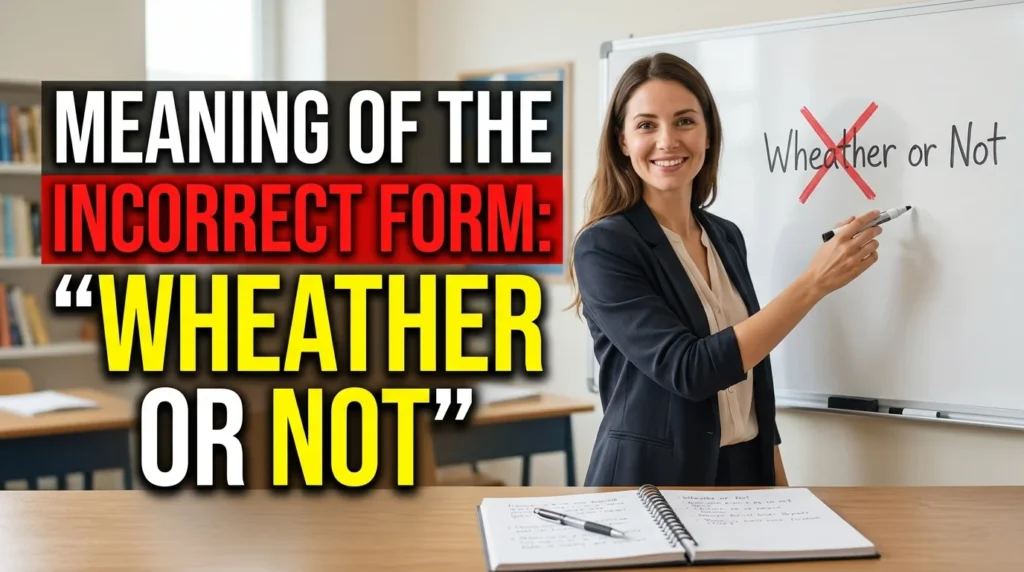
“Wheather” is not a standard English word. It is usually a spelling mistake caused by confusion between whether and weather.
When someone writes:
I don’t know wheather or not he will come.
They almost certainly mean:
I don’t know whether or not he will come.
The incorrect spelling may appear in:
- Informal messages
- Social media posts
- Search queries
- Drafts
- Typing mistakes
- English-learning exercises
However, it should not be used in formal writing, academic work, professional emails, or published content.
Why Do People Spell It “Wheather”?
The mistake usually happens because whether and weather sound alike in many accents. People may remember the sound but not the exact spelling.
The word wheather can also look familiar because it combines letters from both words:
- Whether
- Weather
Nevertheless, English spelling depends on the meaning, not only on pronunciation.
“Wheather” Is Not an Alternative Spelling
Some people wonder whether wheather is a British or American spelling. It is neither.
| Form | Correct? | Meaning |
| Whether | Yes | Introduces alternatives or uncertainty |
| Whether or not | Yes | Expresses two possibilities or regardless of what happens |
| Weather | Yes | Conditions in the atmosphere |
| Wheather | No | Common spelling mistake |
Therefore, changing from British English to American English will not make wheather correct.
“Whether” vs “Weather”: The Key Difference
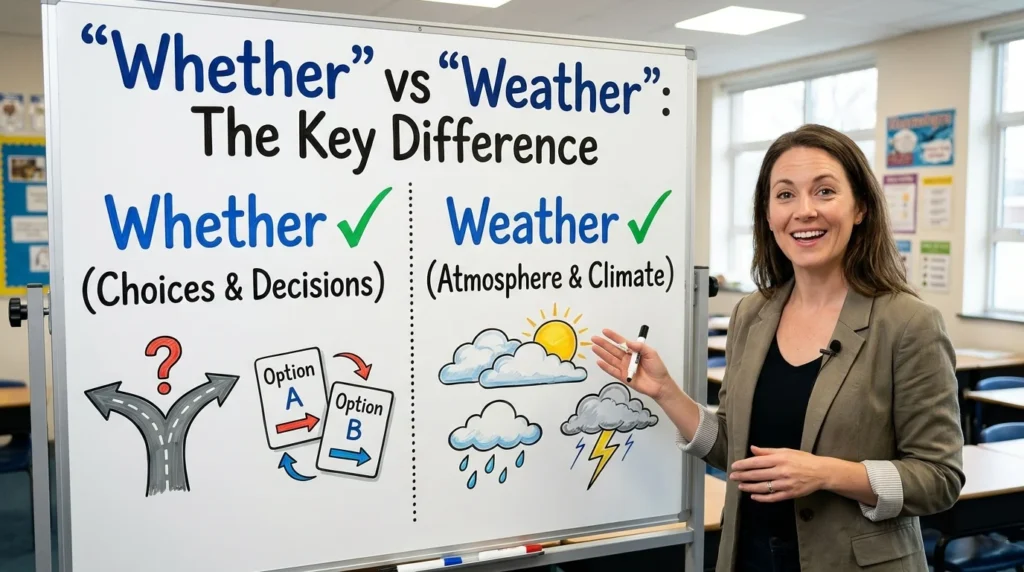
The most important way to remember the correct spelling is to understand the difference between whether and weather.
Whether
Used for choices, alternatives, and uncertainty.
Example: I don’t know whether she will come.
Weather
Used for rain, sunshine, wind, temperature, and atmospheric conditions.
Example: The weather is lovely today.
Comparison Table
| Word or phrase | Meaning | Example |
| Whether | Introduces a choice or uncertainty | I don’t know whether he is ready. |
| Whether or not | Refers to two possibilities or an unchanged decision | We will go whether or not it rains. |
| Weather | Conditions outside | The weather is cold today. |
| Wheather | Incorrect spelling | Avoid this form. |
Easy Examples to Compare
Whether:
I cannot decide whether to buy the blue shirt or the black one.
Weather:
The weather is too cold for a picnic.
Whether or not:
I will go to the picnic whether or not the weather changes.
Notice how whether relates to a choice, while weather relates to the atmosphere.
British English vs American English: Is There Any Difference?
The phrase whether or not is spelled and used the same way in both British and American English.
Spelling
| British English | American English |
| whether or not | whether or not |
| weather | weather |
| wheather or not | Incorrect |
| whether | whether |
Unlike words such as colour/color, centre/center, or organise/organize, this phrase does not have a regional spelling variation.
Usage Differences
Both British and American speakers use whether or not to express uncertainty or alternatives.
British English:
I am not sure whether or not the post has arrived.
American English:
I’m not sure whether or not the mail has arrived.
The vocabulary may vary slightly—post is more common in British English, while mail is more common in American English—but the phrase itself remains unchanged.
Formality and Contractions
Both varieties use contractions in informal writing:
- I don’t know whether or not he agrees.
- She hasn’t decided whether or not to go.
In formal writing, some writers prefer full forms:
- I do not know whether or not he agrees.
- She has not decided whether or not to go.
Both are grammatically acceptable. The choice depends on tone and context.
Common Mistakes People Make
Understanding common mistakes can help you avoid repeating them.
Mistake 1: Writing “Wheather” Instead of “Whether”
Incorrect:
I don’t know wheather or not the answer is correct.
Correct:
I don’t know whether or not the answer is correct.
Why? The sentence expresses uncertainty, so whether is the correct word.
Mistake 2: Using “Weather” for a Choice
Incorrect:
She asked weather I wanted tea.
Correct:
She asked whether I wanted tea.
Why? The sentence is about a choice, not atmospheric conditions.
Mistake 3: Confusing “Whether” With “Weather”
Incorrect:
The whether is beautiful today.
Correct:
The weather is beautiful today.
Why? The sentence describes outdoor conditions, so use weather.
Mistake 4: Forgetting “Or Not” When It Is Needed
Sometimes writers use whether correctly but leave out or not when they want to emphasise both possibilities.
Less explicit:
I don’t know whether he will come.
More explicit:
I don’t know whether or not he will come.
Both can be correct. However, whether or not makes the two possibilities clearer.
Mistake 5: Using “If” in Every Situation
Whether and if can sometimes have similar meanings, but they are not always interchangeable.
Natural:
I am unsure whether she will attend.
Also natural:
I am unsure if she will attend.
However, when you are presenting a clear choice between alternatives, whether is often the better choice.
- I cannot decide whether to stay or leave.
- She asked whether I wanted tea or coffee.
Mistake 6: Using “Whether or Not” Incorrectly With “Regardless”
The phrase whether or not already expresses the idea of two possibilities or an unchanged outcome.
Awkward:
Regardless of whether or not he comes, we will begin.
This is not always grammatically wrong, but it can sound unnecessarily repetitive.
Clearer:
Whether or not he comes, we will begin.
Or:
Regardless of whether he comes, we will begin.
Mistake 7: Writing “Weather or Not” in a Choice Sentence
Incorrect:
I need to decide weather or not to accept the offer.
Correct:
I need to decide whether or not to accept the offer.
The phrase is about a decision, so whether is necessary.
Correct Usage in Sentences
The following examples show how to use whether or not naturally in everyday, academic, and professional writing.
Everyday Conversation
- I don’t know whether or not I left my keys at home.
- Are you coming whether or not your friends join?
- She is wondering whether or not to order pizza.
- We need to decide whether or not to leave early.
- Tell me whether or not you need a ride.
- I cannot remember whether or not I locked the door.
- He asked whether or not the event was free.
- We will watch the film whether or not everyone agrees.
British English Contexts
- I am not sure whether or not the bus will arrive on time.
- She asked whether or not I had finished my tea.
- We will visit the seaside whether or not the weather improves.
- He must decide whether or not to take the train.
- I wonder whether or not the shop is still open.
American English Contexts
- I don’t know whether or not the bus will arrive on time.
- She asked whether or not I had finished my coffee.
- We will visit the beach whether or not the weather improves.
- He must decide whether or not to take the train.
- I wonder whether or not the store is still open.
Academic Writing
In academic writing, whether or not helps explain uncertainty, alternatives, and research questions.
- Researchers examined whether or not the treatment improved results.
- The study explored whether or not students benefited from online learning.
- The report discusses whether or not the policy should continue.
- Scientists are investigating whether or not the results can be repeated.
Professional Emails
- Please confirm whether or not you can attend the meeting.
- Let me know whether or not you need additional information.
- We need to determine whether or not the proposal meets the requirements.
- Could you tell me whether or not the payment has been processed?
Formal and Informal Examples
| Informal | Formal |
| I don’t know whether or not he’ll come. | I do not know whether or not he will attend. |
| Tell me whether or not you’re free. | Please confirm whether or not you are available. |
| We need to see whether or not it works. | We need to determine whether or not it is effective. |
Both styles are correct. The formal versions simply use more professional wording.
“Whether” vs “If”: When Should You Use Each?
Many learners confuse whether and if because both can introduce uncertainty.
When “Whether” Is a Good Choice
Use whether when:
- You are presenting two alternatives.
- You use or not.
- You are discussing a choice.
- You want a more formal or precise tone.
Examples:
- I cannot decide whether to stay or leave.
- She asked whether I wanted tea or coffee.
- We need to determine whether or not the plan will work.
When “If” Is Also Possible
In many sentences, if can replace whether without changing the meaning significantly.
- I don’t know if he is coming.
- I don’t know whether he is coming.
Both are common in everyday English.
However, whether is often preferred when the sentence clearly presents alternatives.
- I am deciding whether to buy a car or use public transport.
Quick Comparison
| Sentence | Natural? | Explanation |
| I don’t know whether she is ready. | Yes | Expresses uncertainty |
| I don’t know if she is ready. | Yes | Common alternative |
| I cannot decide whether to stay or leave. | Yes | Clear alternatives |
| I cannot decide if to stay or leave. | Usually incorrect | Use “whether” before “to” |
| We will go whether or not it rains. | Yes | Means regardless of the rain |
How to Use “Whether or Not” Before a Verb
A common structure is:
whether or not + subject + verb
Examples:
- I don’t know whether or not she agrees.
- We will continue whether or not they approve.
- He asked whether or not I understood.
Another common structure is:
whether or not + to + base verb
Examples:
- I cannot decide whether or not to apply.
- She is considering whether or not to move.
- They discussed whether or not to cancel the event.
Correct and Incorrect Structures
Correct:
I don’t know whether or not to go.
Correct:
I don’t know whether to go or stay.
Usually incorrect:
I don’t know if to go or stay.
The word whether works naturally before an infinitive when you are choosing between alternatives.
Tips to Remember the Correct Usage
If you often type wheather or not, these simple memory tricks can help.
Tip 1: Think “Choice” = “Whether”
When you are choosing between two possibilities, use whether.
- Whether to stay or leave
- Whether to buy or rent
- Whether to accept or reject
Memory trick: Whether = choice.
Tip 2: Think “Outside Conditions” = “Weather”
When you are talking about rain, sunshine, wind, clouds, or temperature, use weather.
- The weather is rainy.
- The weather forecast predicts sunshine.
- Bad weather delayed the flight.
Memory trick: Weather = what happens outside.
Tip 3: Remember the “H” in “Whether”
The word whether contains “he” after the “w”:
W + HE + THER = WHETHER
This can help you remember that the correct spelling is not wheather.
Tip 4: Replace It With “If”
If you can replace the phrase with “if” and the sentence still makes sense, you probably need whether.
- I don’t know whether or not she is coming.
- I don’t know if she is coming.
The meaning remains similar, so whether is likely the correct word.
Tip 5: Ask Yourself What You Mean
Before writing, ask:
Am I talking about a choice or uncertainty?
- Yes → whether
- No, I am talking about rain, wind, or temperature → weather
Tip 6: Memorise One Reliable Sentence
I don’t know whether or not it will rain, but I can check the weather.
This sentence uses both words correctly and shows their difference.
Why Correct Spelling Matters
Spelling may seem like a small detail, but it affects how readers understand your writing.
1. It Makes Your Writing Clearer
Correct spelling helps readers understand your intended meaning without stopping to guess.
2. It Builds Professional Credibility
A correctly spelled phrase looks more polished in:
- Business emails
- Reports
- Blog posts
- Applications
- School assignments
- Website content
3. It Helps English Learners Build Strong Habits
Learning the difference between whether and weather improves both spelling and vocabulary.
4. It Supports Better SEO Content
If you are writing an article targeting the keyword “wheather or not,” you can address the common misspelling naturally while teaching readers the correct form. Use the incorrect keyword where relevant, but avoid repeating it unnecessarily.
For example:
Many people search for “wheather or not,” but the correct spelling is “whether or not.”
This approach answers the reader’s question while maintaining clear, professional writing.
FAQs About “Wheather or Not”
1. Is “wheather or not” correct?
No. “Wheather or not” is a common spelling mistake. The correct phrase is “whether or not.”
2. What is the correct spelling: whether or not or wheather or not?
The correct spelling is whether or not. The word wheather is not a standard English spelling.
3. Is “whether or not” the same in British and American English?
Yes. Both British and American English use whether or not with the same spelling and meaning.
4. What does “whether or not” mean?
It means “if something is true or not” or “regardless of what happens.”
Example:
I will attend whether or not my friend comes.
5. What is the difference between “whether” and “weather”?
Whether introduces choices or uncertainty, while weather refers to atmospheric conditions such as rain, sunshine, and wind.
6. Can I use “if” instead of “whether”?
Often, yes. For example:
- I don’t know whether he is coming.
- I don’t know if he is coming.
However, whether is usually preferred when presenting alternatives, especially before to.
7. Is “whether or not” formal or informal?
It is suitable for both formal and informal writing. You can use it in conversations, emails, academic writing, and professional documents.
8. Should I write “whether or not to go” or “if or not to go”?
The natural form is whether or not to go.
Example:
I cannot decide whether or not to go.
9. Is “weather or not” ever correct?
Yes, but only when weather refers to atmospheric conditions and or not is part of a separate grammatical structure. For example, a sentence might discuss weather, but the phrase weather or not is not the standard way to express a choice.
10. How can I remember the spelling of “whether”?
Remember: whether = choice, while weather = outside conditions. If you are discussing uncertainty or alternatives, choose whether.
Conclusion
The phrase “wheather or not” is a common spelling mistake, but the correct form is easy to remember: “whether or not.” Use whether when discussing choices, alternatives, or uncertainty, and use weather when talking about rain, sunshine, wind, or temperature.
The spelling is the same in both British English and American English, so you can confidently use whether or not in conversations, emails, academic writing, and professional content.