Are you unsure whether to write “planning” or “planing”? These two words look almost identical, but they have different meanings and uses in English. Planning is the correct spelling when you are talking about making arrangements, preparing for something, or deciding what to do in the future.
It is the present participle and gerund form of the verb “plan.” For example, “I am planning a family vacation” means you are making arrangements for a trip. Planing, on the other hand, is a real English word, but it has a much more specialized meaning. It refers to smoothing or leveling a surface, usually wood, with a tool called a plane.
It can also describe a boat or other object moving smoothly across the surface of water. For instance, “The carpenter is planing the wooden board” uses the word correctly. The main difference comes from how the words are formed and what you want to describe. When adding “-ing” to “plan,” you double the final consonant, giving you “planning.” However, “planing” follows a different spelling pattern and is not the word you need for ordinary preparation or scheduling.
Quick Answer: Planning or Planing?
Planning is the correct spelling when you mean making arrangements, preparing for something, or deciding what you will do.
For example:
- I am planning a holiday.
- She is planning her wedding.
- We are planning a meeting.
- They are planning to move next year.
Planing is also a legitimate English word, but it has a different meaning. It generally refers to smoothing or shaping a surface with a plane, especially when working with wood. It can also describe a boat or other object moving quickly across the surface of water.
Therefore, if you are talking about preparation or organisation, use planning, not planing.
Meaning of Planning
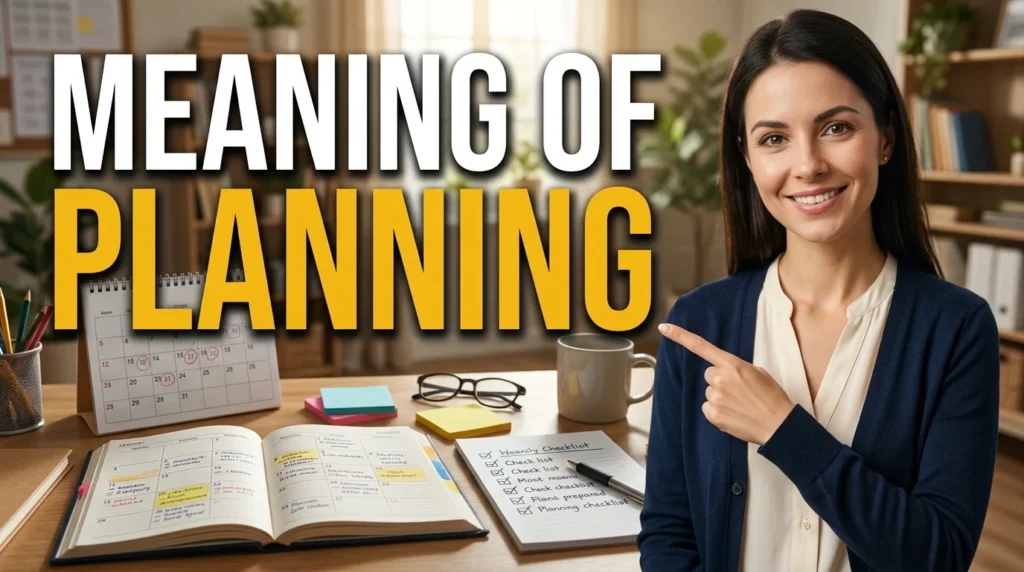
Planning is the present participle and gerund form of the verb plan. It means thinking about something in advance and deciding what you need to do to achieve a particular result.
When you plan something, you usually consider the details before taking action. You might plan a holiday, plan a business project, plan a lesson, plan a meal, or plan your daily schedule.
For example:
We are planning our summer holiday.
Here, planning means making arrangements for the holiday.
Another example is:
She is planning to start a new business.
In this sentence, she is thinking ahead and preparing for the future.
Planning in British English
British English uses planning with the same spelling and meaning.
Examples include:
- We are planning a trip to London.
- The school is planning a new event.
- He is planning his next career move.
- They are planning to renovate the house.
There is no special British spelling of planning.
Planning in American English
American English also uses planning.
Examples include:
- We are planning a road trip.
- She is planning a birthday party.
- The company is planning a new product launch.
- I am planning my schedule for next week.
Therefore, planning is consistent in both major varieties of English.
Why Does Plan Become Planning?
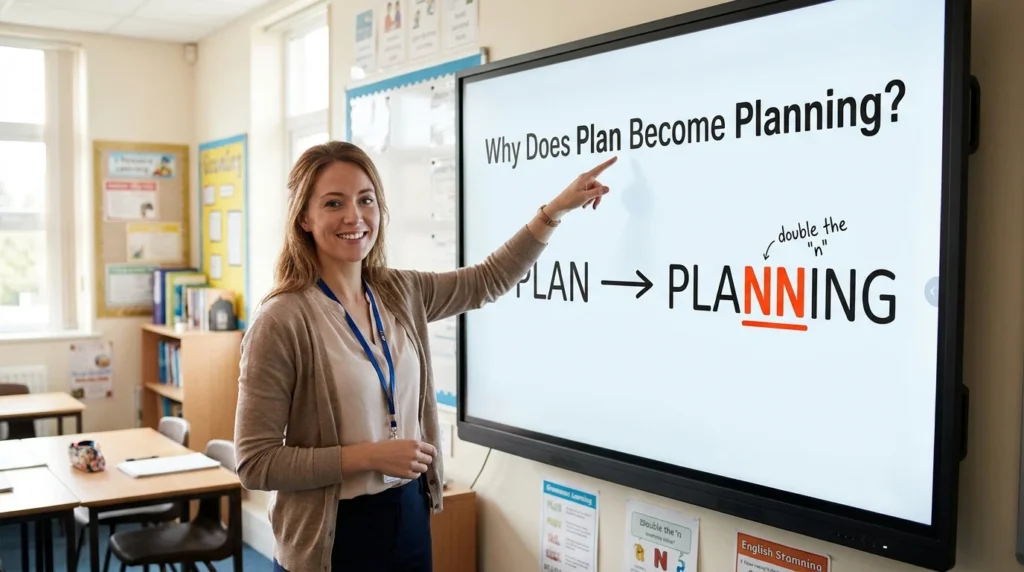
The spelling becomes easier to understand when you look at the original word:
plan + ing = planning
The important point is that plan is a one-syllable verb ending in a single consonant after a short vowel sound. When you add -ing, the final consonant is doubled.
So:
plan → planning
The same pattern appears in several other English words:
- run → running
- sit → sitting
- swim → swimming
- stop → stopping
- begin → beginning
- plan → planning
This spelling pattern helps explain why planing is usually incorrect when you mean making arrangements.
Why Isn’t It “Planing”?
If you write:
I am planing my holiday.
you have removed the second n. Standard English does not use that spelling for the ordinary verb plan when adding -ing.
The correct sentence is:
I am planning my holiday.
The extra n is not optional. It is part of the correct spelling.
Meaning of Planing
Although planing is usually a spelling mistake when someone intends to write planning, it is not technically a meaningless word.
Planing is the present participle of plane.
The verb plane can mean to smooth or shape a material, particularly wood, using a tool called a plane.
For example:
The carpenter is planing the wooden board.
Here, planing is correct because the carpenter is using a plane to smooth the wood.
Another example:
He spent the afternoon planing the rough surface of the table.
Again, planing refers to working on a surface with a plane.
Planing Can Also Relate to Boats
The word planing can also describe a boat moving rapidly across water with much of its hull lifted above the water.
For example:
The speedboat was planing across the lake.
In this context, planing has nothing to do with making arrangements.
Therefore, the two words have different meanings:
- Planning = organising or preparing for something.
- Planing = smoothing/shaping with a plane or moving across water in a particular way.
Planning vs Planing: Key Differences
The easiest way to understand the difference is to compare the words directly.
| Word | Meaning | Example |
| Planning | Preparing or organising something | We are planning a trip. |
| Planing | Smoothing something with a plane | The carpenter is planing the wood. |
| Planning | Thinking ahead and making arrangements | She is planning her wedding. |
| Planing | Moving across water in a fast, gliding manner | The boat is planing across the lake. |
The main difference is therefore meaning and spelling.
If you are talking about future arrangements, choose planning.
If you are talking about woodworking or a boat moving over water, planing may be the correct word.
Is Planning Correct in Both UK and US English?
Yes.
Planning is the standard spelling in both British English and American English.
There is no UK-versus-US spelling difference here.
For example, a British writer might say:
I am planning a holiday.
An American writer might say:
I am planning a vacation.
Notice that the main vocabulary difference is holiday versus vacation, not planning versus planing.
Both writers spell the verb planning with two n letters.
British English Examples
- We are planning a holiday in Spain.
- The teacher is planning a new lesson.
- She is planning to visit Manchester.
- They are planning a family celebration.
American English Examples
- We are planning a vacation in California.
- The teacher is planning a new lesson.
- She is planning to visit Chicago.
- They are planning a family celebration.
So, regardless of whether your audience uses British or American English, planning remains the correct spelling for this meaning.
Why Do People Write Planing Instead of Planning?
The most common reason is simple: people know that the base word is plan, so they naturally add -ing:
plan + ing = planing
However, English spelling rules sometimes require a final consonant to be doubled before adding -ing.
Because plan has a short vowel followed by a consonant, the final n doubles:
plan → planning
This rule can feel confusing at first, especially for English learners. Nevertheless, once you learn the pattern, many similar words become easier to spell.
Common Mistakes People Make
1. Writing “Planing a Trip”
Incorrect:
We are planing a trip to France.
Correct:
We are planning a trip to France.
The sentence refers to organising a trip, so planning is required.
2. Writing “Planing a Wedding”
Incorrect:
She is planing her wedding.
Correct:
She is planning her wedding.
A wedding involves arrangements and preparation, so the correct form is planning.
3. Writing “Planing to Study”
Incorrect:
I am planing to study tonight.
Correct:
I am planning to study tonight.
Here, planning to means intending or preparing to do something.
4. Confusing Planing With Planning
Some people assume planing is simply a shorter spelling of planning.
It is not.
The two words have different meanings.
5. Forgetting the Double N
One useful way to avoid the mistake is to remember:
plan → planning
not:
plan → planing
Correct Usage in Sentences
Here are several examples showing how to use planning correctly.
Everyday Examples
- I am planning my weekend.
- She is planning a surprise party.
- We are planning our next trip.
- They are planning to buy a new house.
- He is planning his study schedule.
- I am planning dinner for tonight.
- The family is planning a celebration.
- She is planning her future carefully.
- We are planning a meeting for Monday.
- The children are planning a school project.
Workplace Examples
Planning is especially common in professional English.
- The manager is planning next month’s schedule.
- Our team is planning a new marketing campaign.
- The company is planning to expand its services.
- We are planning a meeting with the client.
- The department is planning its annual budget.
- The project team is planning the next stage.
School and Education Examples
- The teacher is planning tomorrow’s lesson.
- I am planning my revision schedule.
- The students are planning their presentation.
- She is planning to apply to university.
- We are planning a science project.
Travel Examples
- We are planning a holiday in Italy.
- I am planning a road trip across the country.
- She is planning her itinerary.
- They are planning to travel next summer.
- Have you started planning your vacation?
Examples of Correct Planing
Because planing is a real word, it is useful to see when it can actually be correct.
Woodworking
The carpenter is planing the wooden door.
Here, the carpenter is smoothing the wood.
He is planing the rough board.
Again, planing comes from the verb plane.
Boats
The speedboat was planing across the water.
Here, the word describes the boat’s movement.
Therefore, if you see planing in a sentence, do not automatically assume that it is misspelled. Look at the context first.
Planning or Planing in Questions
The same distinction applies when asking questions.
Correct:
Are you planning a holiday?
Correct:
Are you planning to attend the meeting?
Correct:
What are you planning for the weekend?
Incorrect for the intended meaning:
Are you planing a holiday?
However, planing can be correct in a question about woodworking:
Are you planing this piece of wood?
That question asks whether someone is smoothing the wood with a plane.
Planning or Planing in the Past Continuous
The distinction also applies to past forms.
Correct:
I was planning my trip when you called.
Correct:
They were planning the event all afternoon.
But:
The carpenter was planing the board.
Here, the spelling depends on the verb being used.
- plan → planning
- plane → planing
This is an important difference.
Planning or Planing With “To”
The expression planning to is extremely common.
Examples:
- I am planning to travel next month.
- She is planning to start a business.
- We are planning to move house.
- They are planning to study abroad.
- He is planning to buy a car.
When you mean intending or preparing to do something, always remember the double n:
planning to
not:
planing to
Planning vs Planing in Online Writing
Spelling mistakes can become especially noticeable online because words appear in website articles, social media posts, emails, product descriptions, and search results.
If you are writing for a professional audience, using planning correctly can make your writing clearer and more polished.
For example, compare:
We are planing our next campaign.
with:
We are planning our next campaign.
The second sentence immediately looks correct because planning is the standard spelling.
This matters for:
- Blog posts
- Business websites
- Emails
- School assignments
- Social media
- Reports
- Marketing content
- Job applications
- Professional documents
How to Remember the Correct Spelling
Here are some easy tricks to help you remember planning.
Tip 1: Remember “Plan Has Two Ns When It Is Busy”
You can think of it this way:
The plan is busy, so it needs two Ns.
Plan → planning
This simple mental trick can help you remember the spelling.
Tip 2: Compare Similar Words
Look at these examples:
- run → running
- sit → sitting
- stop → stopping
- plan → planning
The pattern becomes easier to recognise when you see several examples together.
Tip 3: Remember “Planning to”
If you frequently use the phrase planning to, memorise the complete expression.
planning to travel
planning to study
planning to work
planning to move
planning to learn
Seeing the correct spelling repeatedly makes it easier to remember.
Tip 4: Connect Planing With a Plane
A useful memory trick is:
plane → planing
If the sentence involves a plane as a woodworking tool, then planing may be correct.
Otherwise, if you mean making arrangements, use:
plan → planning
A Simple Grammar Rule
When a short verb ends in a consonant after a short vowel, the final consonant is often doubled before -ing.
For example:
- hop → hopping
- run → running
- sit → sitting
- stop → stopping
- plan → planning
This does not mean every verb follows exactly the same pattern. English spelling contains several rules and exceptions. However, this pattern explains why planning has two n letters.
Does British English Spell It Differently?
No.
Unlike words such as colour/color, centre/center, and organise/organize, planning does not have a standard British-versus-American spelling difference.
Both use:
planning
For example:
UK:
I am planning my holiday.
US:
I am planning my vacation.
The spelling of planning remains unchanged.
Planning vs Planing: Quick Comparison Table
| Feature | Planning | Planing |
| Base verb | Plan | Plane |
| Spelling | Two Ns | One N |
| Common meaning | Preparing or organising | Smoothing with a plane |
| Common in everyday writing | Yes | Less common |
| Used in UK English | Yes | Yes, when appropriate |
| Used in US English | Yes | Yes, when appropriate |
| Example | I am planning a trip. | He is planing the wood. |
Common Search Questions About Planning or Planing
People often search for this spelling question because they want to know whether they should write planning or planing in a sentence. Here are some of the most common questions.
Is “planning” spelled with one N or two Ns?
Planning is spelled with two Ns.
Correct:
planning
Incorrect when referring to making arrangements:
planing
Is “planing” ever correct?
Yes. Planing is a real word. It can refer to smoothing or shaping something with a plane, especially wood. It can also describe a boat moving quickly across water.
Is “planning” correct in American English?
Yes. Planning is the standard American English spelling when you mean preparing or organising something.
Is “planning” correct in British English?
Yes. British English also uses planning.
Why do we double the N in planning?
The final consonant of plan doubles before -ing because of the spelling pattern associated with short one-syllable verbs ending in a consonant.
Thus:
plan + ing = planning
Which is correct: “planning to” or “planing to”?
Planning to is correct when you mean intending or preparing to do something.
For example:
I am planning to visit London.
Which is correct: “I am planning a trip” or “I am planing a trip”?
The correct sentence is:
I am planning a trip.
You need two n letters.
Is “planing” a spelling mistake?
It depends on the context. If you mean making arrangements, planing is a spelling mistake. However, planing is a legitimate word when it comes from the verb plane, such as in woodworking.
What is an easy way to remember planning?
Remember:
Plan + ing = planning
You can also associate planing with a plane, such as a woodworking plane.
Planning or Planing: Final Check
Before you finish your sentence, ask yourself what you mean.
If you mean:
- organising something,
- preparing for something,
- deciding what to do,
- making arrangements,
- thinking about the future,
use planning.
If you mean:
- smoothing wood with a plane,
- shaping a surface with a plane,
- describing a boat moving across water,
planing may be correct.
For most everyday sentences, especially those involving future arrangements, planning is the word you want.
Conclusion
The difference between planning or planing becomes much easier once you understand their meanings. Planning is the correct spelling when you are talking about preparing, organising, arranging, or deciding what to do. It is used in both British English and American English, and the spelling remains the same in both varieties.
On the other hand, planing is not simply a misspelled version of planning. It is a genuine English word that comes from plane. It can describe smoothing wood with a plane or, in another context, a boat moving rapidly across water. Therefore, context matters.