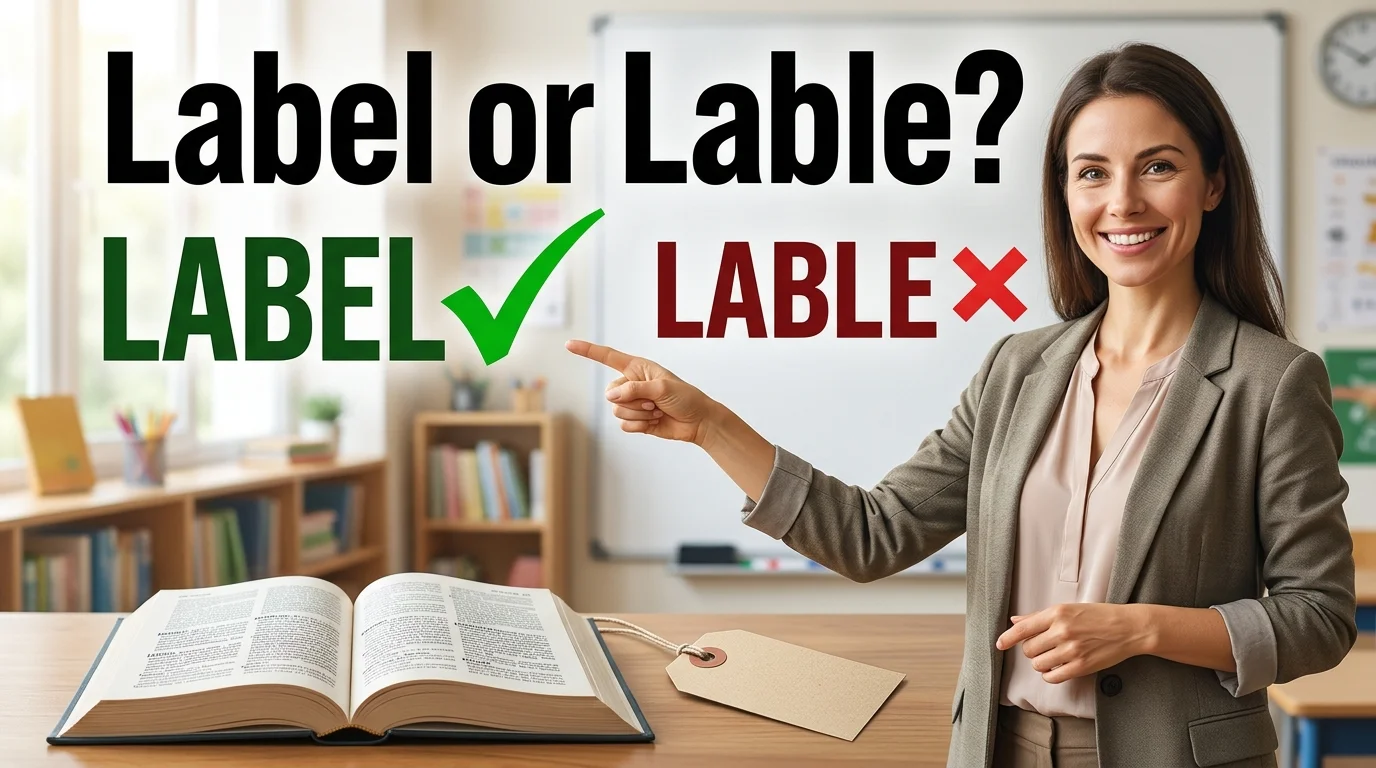
If you have ever typed “label” and wondered whether it should actually be spelled “lable,” you are not alone. These two spellings look very similar, and the confusion often happens because English contains many words where letters appear in a different order than we expect. However, when it comes to label or lable, there is a clear answer: label is the correct standard spelling, while lable is generally a misspelling.
The word label appears frequently in everyday English. You may see a label on a bottle, a shirt, a food package, a file, or a piece of luggage. We also use it as a verb when we describe the act of attaching a name or description to something. Because the word is so common, knowing the correct spelling matters in school, business, emails, websites, product descriptions, and professional writing.
The spelling is also interesting because British and American English use slightly different forms in some situations. For example, British English commonly uses labelled and labelling, while American English usually uses labeled and labeling. However, the base word remains label in both varieties of English.
Quick Answer: Label or Lable?
Label is the correct spelling in both British English and American English.
Lable is not the standard spelling of the word and should generally be avoided in formal and everyday writing.
Examples:
- Correct: Please read the label before using the product.
- Incorrect: Please read the lable before using the product.
The word label can be a noun or a verb. As a noun, it can mean a piece of information attached to something. As a verb, it means to give something a name, description, or category.
For example:
- The label on the bottle says “Keep refrigerated.”
- Please label each box before moving it.
So, whenever you are choosing between label and lable, choose label.
Meaning of the Correct Form: Label
The word label has several related meanings. Its exact meaning depends on how you use it in a sentence.
As a noun, a label can be a piece of paper, plastic, fabric, or another material attached to an object. It usually provides information about the object.
For example:
- The shirt has a washing label.
- Check the label for the ingredients.
- I removed the price label from the box.
- The luggage label contains my contact information.
A label can also be a name or category used to describe a person, thing, group, or idea.
For example:
- People sometimes use the label “expert” too quickly.
- The product carries an environmentally friendly label.
- He does not like being given a particular label.
As a verb, label means to attach a label to something or describe something in a particular way.
Examples include:
- Please label the containers.
- The teacher asked students to label the diagram.
- The company labelled the products before shipping them.
Therefore, label is a flexible word that appears in many different contexts.
Label in British English

In British English, the base spelling is label.
British English commonly uses:
- label
- labels
- labelled
- labelling
For example:
- Please label the folders clearly.
- The boxes were labelled by hand.
- The shop is labelling the new products.
- Check the label before washing the garment.
Notice that British English commonly doubles the final l before adding endings such as -ed and -ing.
Therefore:
British English:
- label → labelled
- label → labelling
This spelling pattern can sometimes confuse learners because the base word itself does not contain two l’s at the end.
Label in American English
American English also uses label as the correct base spelling.
However, American English commonly uses:
- label
- labels
- labeled
- labeling
Examples:
- Please label the boxes.
- The packages were labeled correctly.
- The workers are labeling the products.
- Read the label carefully.
The main difference appears when you add -ed or -ing.
Compare:
| Meaning | British English | American English |
| Base form | label | label |
| Present form | label | label |
| Past form | labelled | labeled |
| -ing form | labelling | labeling |
| Plural noun | labels | labels |
Therefore, label itself does not change between British and American English.
Meaning of the Incorrect Form: Lable
Lable is generally a spelling mistake rather than a standard English word corresponding to label.
People often write lable because the pronunciation of label can make the spelling less obvious. Some writers may also accidentally leave out the second l sound or rearrange the letters.
For example:
- ❌ Please check the lable.
- ✅ Please check the label.
- ❌ The lable contains important information.
- ✅ The label contains important information.
- ❌ I forgot to lable the box.
- ✅ I forgot to label the box.
If you are writing an essay, email, report, product description, application, or website content, use label.
Label or Lable: Key Differences
The biggest difference is simple: label is correct, while lable is usually a misspelling.
| Word | Correct? | Meaning | Example |
| label | Yes | A tag, description, or category | Read the label. |
| lable | No | Usually a misspelling of label | Avoid this spelling. |
There is no British-versus-American difference in the spelling of the base word.
Both British and American English use:
label
The difference appears mainly in certain forms of the word.
British English
- labelled
- labelling
American English
- labeled
- labeling
This distinction is worth remembering because you may encounter both forms online.
Why Do People Spell Label as Lable?
There are several reasons people make this mistake.
1. The spelling does not perfectly match pronunciation
English spelling can be difficult because words do not always look exactly how they sound.
When people say label, the final part can sound relatively quick. As a result, some writers may accidentally produce lable.
2. People confuse the letter order
The correct spelling is:
L-A-B-E-L
The incorrect version is:
L-A-B-L-E
The final e comes after the second l in the correct spelling.
3. Typing quickly causes mistakes
When people type quickly on phones or computers, they may accidentally leave out or move a letter.
For example:
- label → lable
The two forms are visually similar, so spell-checking the word is useful.
4. English contains many unusual spelling patterns
English has many words that require memorization rather than simple pronunciation-based spelling. Consequently, learners may assume that lable follows a pattern that looks familiar.
Common Mistakes People Make
Understanding common mistakes can help you avoid them.
Mistake 1: Writing “lable”
This is the most obvious error.
Incorrect:
The product lable is damaged.
Correct:
The product label is damaged.
Mistake 2: Using “lable” in professional writing
A spelling error on a professional document can make the writing look less polished.
For example:
Please check the lable before sending the package.
A better version is:
Please check the label before sending the package.
Mistake 3: Confusing label with related words
Some learners may confuse label with words such as:
- table
- cable
- stable
- enable
Although these words have similar-looking endings, that does not mean label follows the same spelling pattern.
Mistake 4: Forgetting the second “l”
Remember:
la + bel = label
The word contains two l letters:
Label
One appears at the beginning, and another appears near the end.
Correct Usage in Sentences
Here are several examples showing how to use label correctly.
Everyday Examples
- Please read the label before opening the package.
- The bottle has a new label.
- I cannot find the label on my shirt.
- She removed the price label.
- The box needs a shipping label.
- Check the food label for allergens.
- The label contains the manufacturer’s information.
- Please label each container.
- We need to label these files.
- He forgot to label the package.
Workplace Examples
In an office, labels help people organize documents, equipment, and files.
- Please label each folder with the correct date.
- The storage boxes have clear labels.
- Every document should have a descriptive label.
- The technician labelled the cables.
- The technician labeled the cables.
The first past-tense example follows common British spelling, while the second follows common American spelling.
School Examples
Students frequently encounter the word label in classroom instructions.
- Label the parts of the diagram.
- Please label your notebook.
- The teacher asked us to label the map.
- Each section should have a clear label.
- The students labelled their drawings.
- The students labeled their drawings.
Again, the first version reflects British spelling and the second reflects American spelling.
Shopping Examples
Labels provide important information when you shop.
- Always read the label before buying a product.
- The clothing label shows the washing instructions.
- The price label fell off the item.
- The food label lists the ingredients.
- The package has a recyclable label.
Technology Examples
You can also use label as a verb or noun in technology.
- Add a label to the chart.
- Please label the files.
- The email system allows users to create labels.
- I created a new label for important messages.
- Each button needs a clear label.
Label as a Noun
When label functions as a noun, it identifies a person, object, product, category, or piece of information.
Consider these examples:
The label on the bottle is difficult to read.
Here, label means a physical piece of information attached to the bottle.
Another example:
The product has an organic label.
Here, the label communicates information about the product.
You can also use label in a more abstract way:
He does not like the label “genius.”
In this sentence, label refers to a description or category rather than a physical tag.
Label as a Verb
When label functions as a verb, it describes the action of giving something a name, category, or description.
For example:
Please label the boxes.
The speaker wants someone to attach identifying information to the boxes.
Another example:
The teacher asked students to label the diagram.
Here, students need to identify different parts of the diagram.
Label can also describe categorizing people or ideas:
It is unfair to label someone without knowing the full story.
In this sentence, label means to assign a particular description or category.
Labelled vs Labeled
This is one of the most important British-versus-American differences connected to this word.
British English: Labelled
British English generally doubles the final l when forming the past tense:
The package was labelled correctly.
American English: Labeled
American English usually does not double the l:
The package was labeled correctly.
Both forms are standard in their respective varieties.
More Examples
British English:
- The boxes were labelled.
- The products are being labelled.
- The diagram was clearly labelled.
American English:
- The boxes were labeled.
- The products are being labeled.
- The diagram was clearly labeled.
Therefore, do not assume that one spelling is automatically a mistake. The difference comes from the spelling conventions of British and American English.
Labelling vs Labeling
The same pattern appears with the -ing form.
British English generally uses:
labelling
American English generally uses:
labeling
Examples:
British:
The staff are labelling the new products.
American:
The staff are labeling the new products.
Both are correct according to the relevant spelling convention.
However, neither variety normally changes label into lable.
Label or Lable in Formal Writing
When writing formally, always use label.
This applies to:
- School assignments
- University essays
- Business emails
- Reports
- Resumes and CVs
- Product descriptions
- Websites
- Instructions
- Presentations
- Professional documents
For example:
Incorrect:
The lable on the package contains important information.
Correct:
The label on the package contains important information.
The corrected version is appropriate for both British and American audiences.
Label or Lable in Online Writing
Online writing often contains spelling mistakes because people type quickly. Nevertheless, if you are creating content for a website, spelling accuracy still matters.
For example, a product page might say:
Check the label for complete product information.
It should not say:
Check the lable for complete product information.
Using the correct spelling helps readers understand your content and makes the page look more professional.
Label or Lable in Product Descriptions
Businesses frequently use the word label when describing packaging, clothing, food, and other products.
Examples:
- Read the care label before washing.
- The product label includes usage instructions.
- The bottle label provides nutritional information.
- Remove the old shipping label before returning the package.
In all these examples, label is the correct spelling.
Label or Lable in School and Academic English
Students should pay particular attention to this spelling because teachers may ask them to label diagrams, maps, charts, and illustrations.
For example:
Label the five parts of the flower.
Not:
Lable the five parts of the flower.
The same applies when students write their own sentences:
The label identifies each part of the diagram.
Using the correct spelling makes academic writing clearer and more accurate.
Easy Ways to Remember the Spelling
If you frequently confuse label and lable, a few simple tricks can help.
Trick 1: Remember “LABEL”
Think of the word as:
LA + BEL
This gives you:
L-A-B-E-L
The final part is BEL, not BLE.
Trick 2: Say “label” while spelling it
Slowly pronounce the word:
la-bel
Then spell it:
L-A-B-E-L
This can help you remember where the second l belongs.
Trick 3: Think about a physical label
Imagine a clothing tag.
The tag is a label.
Picture the word printed on the tag:
LABEL
Connecting the spelling with a real object can make it easier to remember.
Trick 4: Remember that “lable” looks incomplete
When you see:
lable
Ask yourself:
Where did the “e” go in the “bel” ending?
Then correct it to:
label
Trick 5: Use the phrase “label it”
A useful phrase to memorize is:
Label it correctly.
Both words reinforce the correct spelling.
Label vs Lable: Quick Comparison
| Feature | Label | Lable |
| Standard English spelling | Yes | No |
| Used in British English | Yes | No |
| Used in American English | Yes | No |
| Can be a noun | Yes | No |
| Can be a verb | Yes | No |
| Common spelling mistake | No | Yes |
| Example | Read the label. | Avoid this spelling. |
The key point is straightforward: label is the standard form in both British and American English.
British and American Examples Side by Side
Here are some examples that make the difference easier to see.
| British English | American English |
| Please label the box. | Please label the box. |
| The box was labelled yesterday. | The box was labeled yesterday. |
| We are labelling the products. | We are labeling the products. |
| Check the label carefully. | Check the label carefully. |
| The labels are clear. | The labels are clear. |
Notice that the base form label remains unchanged.
Is “Lable” Ever Correct?
For standard modern English writing, lable should not be used as the spelling of the common word label.
If you mean a tag, category, description, or the act of identifying something, use:
label
For example:
Please label the folders.
Not:
Please lable the folders.
If you encounter lable somewhere online, it is usually best understood as a spelling error unless it is being used as a specific name, username, brand, or other proper term.
Common Search Questions About Label or Lable
People often search for this spelling because the two versions look so similar. Here are some quick answers.
Is it label or lable?
The correct spelling is label. Lable is generally a misspelling.
Is “label” British or American?
Label is used in both British and American English.
Do British people spell it “labelled”?
Yes. Labelled is the common British English spelling of the past tense.
Do Americans spell it “labeled”?
Yes. Labeled is the common American English spelling.
Is “labelling” British English?
Yes. Labelling is the common British English spelling.
Is “labeling” American English?
Yes. Labeling is the common American English spelling.
Why do people spell label as lable?
People may confuse the order of the final letters, type quickly, or spell the word according to how they think it sounds. However, the standard spelling is label.
FAQs
1. Which is correct, label or lable?
Label is correct. Lable is generally a misspelling and should be avoided in standard English writing.
2. Is label spelled the same in British and American English?
Yes. The base word is label in both British and American English.
3. Is labelled or labeled correct?
Both are correct, but they follow different spelling conventions. Labelled is common in British English, while labeled is common in American English.
4. Is labelling or labeling correct?
Both are standard. Labelling is generally used in British English, while labeling is generally used in American English.
5. What does label mean?
As a noun, a label can be a tag or piece of information attached to something. As a verb, label means to identify, name, categorize, or describe something.
6. Why is lable wrong?
Lable does not follow the standard spelling of the word meaning a tag, category, or description. The correct spelling is label.
7. How can I remember the spelling of label?
Think of the word as LA + BEL: L-A-B-E-L. You can also remember the phrase “label it.”
8. Can label be a noun and a verb?
Yes. For example, “The label is missing” uses label as a noun, while “Please label the box” uses it as a verb.
9. Should I use label in formal writing?
Yes. Label is the standard spelling and is appropriate for formal, academic, professional, and everyday writing.
10. Is lable ever acceptable?
Generally, no, when you mean the standard English word label. You should use label instead. A special name, brand, username, or other proper term may be an exception, but that is different from ordinary English spelling.
Final Thoughts on Label or Lable
When deciding between label or lable, the answer is simple: label is the correct standard spelling. It works as both a noun and a verb and appears in everyday conversations, school assignments, professional documents, product packaging, websites, and countless other situations.
The spelling lable is generally a mistake. Therefore, if you are writing a sentence such as “Please check the ___,” the correct choice is label. It is also important to remember the British and American differences that appear in related forms. British English commonly uses labelled and labelling, while American English commonly uses labeled and labeling. However, both varieties use label as the base form.