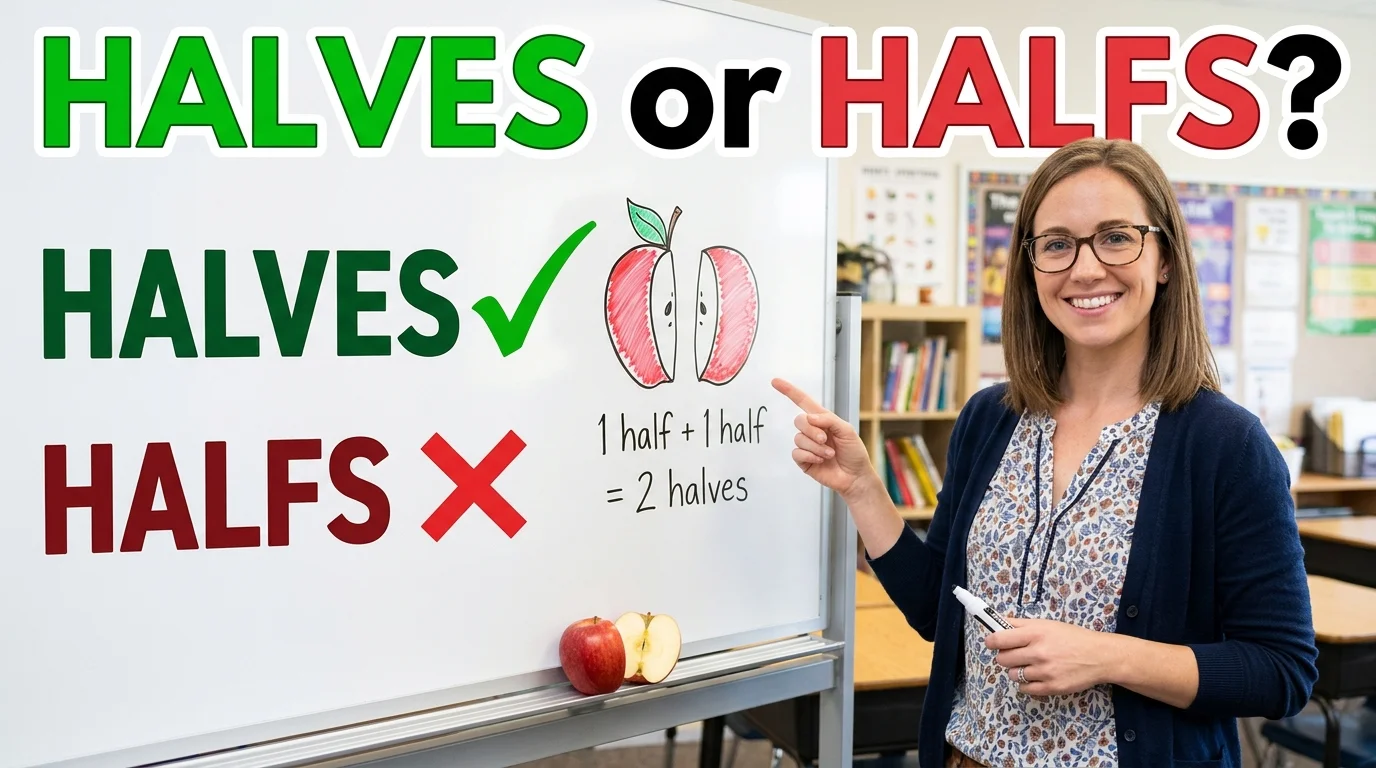
English spelling can sometimes be tricky, especially when a small change turns a familiar word into a spelling mistake. If you are wondering whether to write “halves or halfs,” the correct choice is almost always “halves” when you need the plural form of “half.” For example, you would say, “Cut the apple into two halves,” or “We divided the cake into equal halves.”
The word “half” follows a common English spelling pattern in which a noun ending in -f changes to -ves in the plural. Similar examples include “leaf” becoming “leaves” and “wolf” becoming “wolves.” Although some English nouns simply add an -s to form their plurals, “half” does not normally follow that pattern. As a result, “halfs” is considered incorrect in standard English when referring to more than one half.
Understanding this rule can help you write more accurately in school assignments, emails, recipes, reports, and everyday conversations. It is also useful when describing fractions, dividing objects, or talking about two parts of something.
Quick Answer: Halves or Halfs?
Halves is the correct standard plural form of half. The word halfs is generally considered an incorrect spelling when you mean more than one half.
- Singular: half
- Plural: halves
For example:
- UK English: “Cut the sandwich into two halves.”
- US English: “Cut the sandwich into two halves.”
Both sentences use the same correct plural spelling. The word halves means two or more equal parts of something, or two or more portions that represent half of a whole.
Meaning of the Correct Form: Halves
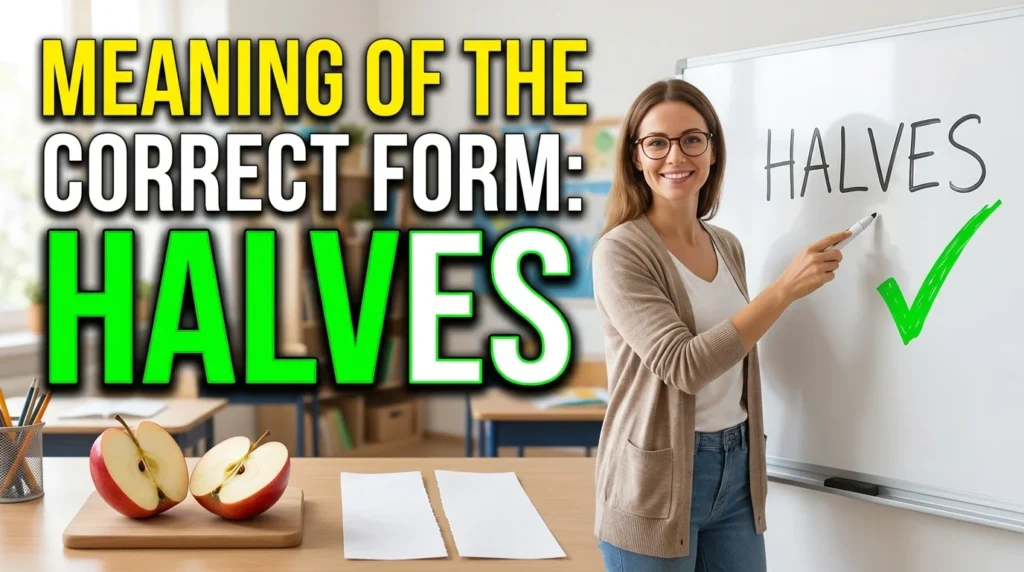
The word halves is the plural form of half. It refers to two or more parts, each representing one-half of a whole.
A half is one of two equal parts of something. When you have more than one half, you use halves.
Simple Examples
- One half of an apple
- Two halves of an apple
- One half of a pizza
- Two halves of a pizza
- Several halves of different objects
For example:
“The teacher divided the class into two halves.”
This means the teacher divided the class into two groups, with each group representing half of the class.
Halves in Everyday English
People use halves in many situations, including:
- Food and cooking
- Mathematics
- Sports
- Time
- Measurements
- Business
- Schoolwork
- Daily conversations
Consider these examples:
- “Please cut the orange into two halves.”
- “The two halves of the book are equally interesting.”
- “We spent the first half of the day working and the second half relaxing.”
- “The football match ended with both halves producing exciting moments.”
- “She divided the money into two halves.”
In each sentence, halves is the correct plural form.
British English Examples
British English uses halves in exactly the same way as American English.
- “The children shared the cake between two halves.”
- “The match had two halves of 45 minutes each.”
- “Cut the pear into halves.”
- “The two halves of the garden look different.”
English may use different vocabulary or punctuation in some situations, but the plural spelling of half does not change.
American English Examples
American English also uses halves.
- “The recipe calls for two halves of an avocado.”
- “The basketball game has two halves.”
- “Divide the paper into two halves.”
- “The two halves of the team worked together.”
Therefore, whether you write for a British or American audience, halves remains the correct choice.
Why Does Half Become Halves?
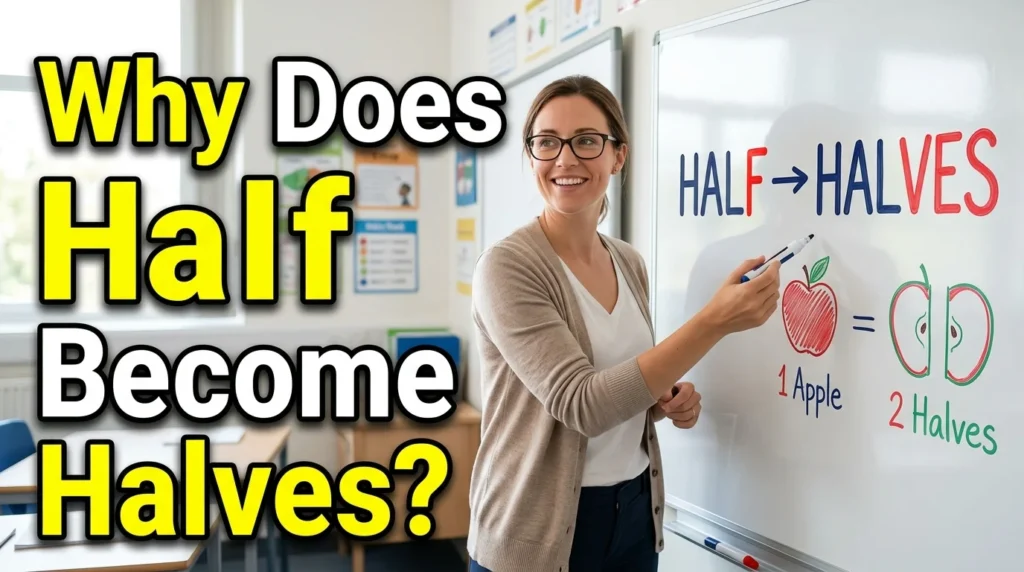
The spelling changes because half belongs to a group of English words that form their plurals by changing the ending.
Instead of simply adding -s, the word changes from f to v and adds -es:
half → halves
This is a spelling pattern that English learners often need to memorise.
The Spelling Pattern
The transformation looks like this:
half + plural ending → halves
The final f changes to v, and the word ends in -ves.
Compare:
- half → halves
- calf → calves
- leaf → leaves
- loaf → loaves
- shelf → shelves
- wolf → wolves
- knife → knives
- wife → wives
- life → lives
However, English has exceptions. Not every word ending in -f changes to -ves.
For example:
- roof → roofs
- chief → chiefs
- belief → beliefs
- proof → proofs
- chef → chefs
Therefore, it is helpful to learn the plural of each word rather than assuming every -f noun follows the same rule.
Meaning of the Incorrect Form: Halfs
The spelling halfs is generally incorrect in standard English when you want to use the plural of half.
For example:
❌ “The two halfs of the orange are on the plate.”
✅ “The two halves of the orange are on the plate.”
The incorrect spelling often appears because people apply the regular plural rule:
half + s = halfs
That pattern works for many English nouns, but not for half.
Why Do People Write Halfs?
There are several common reasons:
- They apply the regular plural rule. Many nouns form plurals by adding -s, so learners may naturally write halfs.
- They hear the word but do not notice the spelling. The pronunciation of halves can make the spelling less obvious.
- They confuse similar words. Words such as roofs and chiefs correctly use -fs, which can create uncertainty.
- They type quickly. When writing a message or searching online, people may use halfs without checking the spelling.
- They have not learned the irregular plural. English contains many irregular plurals, and halves is one of them.
Is Halfs Ever Acceptable?
In standard modern English, halves is the accepted plural form of half.
The spelling halfs may occasionally appear as a mistake, a typo, or in unusual nonstandard contexts. However, you should not use it in formal writing, educational content, professional communication, or standard everyday English.
If you mean more than one half, always choose halves.
Halves or Halfs: Key Differences
The main difference is simple: halves is correct, while halfs is generally incorrect as the plural of half.
| Feature | Halves | Halfs |
| Singular form | Half | Half |
| Standard plural form | Halves | Incorrect |
| Meaning | Two or more halves | Not the standard plural |
| British English | Correct | Incorrect |
| American English | Correct | Incorrect |
| Example | “Cut it into two halves.” | “Cut it into two halfs.” |
| Recommended for formal writing | Yes | No |
UK vs US English: Is There Any Difference?
No. Halves is spelled the same in both British and American English.
This is important because some English words have different spellings across the two varieties:
- colour / color
- favourite / favorite
- organise / organize
- centre / center
However, half → halves does not change between the UK and the US.
Pronunciation
The word halves is usually pronounced like:
/hɑːvz/ in many British accents /hævz/ in many American accents
The exact vowel sound may vary by accent, but the plural ending sounds like -vz, not -fs.
This pronunciation can help you remember the spelling:
half → halves
The f changes to a v sound.
Common Mistakes People Make
Even though the rule is simple, writers often make a few mistakes when using halves. Understanding these errors can help you avoid them.
Mistake 1: Adding Only -s
❌ “The two halfs were equal.”
✅ “The two halves were equal.”
The word does not follow the regular -s plural pattern. You must change f to v and add -es.
Mistake 2: Using Half When You Mean More Than One
❌ “The two half of the cake are different.”
✅ “The two halves of the cake are different.”
Because the sentence refers to two parts, the plural halves is necessary.
Mistake 3: Confusing Halves With Half
Compare:
- “I ate half the sandwich.”
- “I ate both halves of the sandwich.”
The first sentence refers to one portion. The second refers to two portions.
Mistake 4: Forgetting the Change in Spelling
❌ “She divided the apple into two halfs.”
✅ “She divided the apple into two halves.”
Remember that the plural ending is -ves, not -fs.
Mistake 5: Using Halfs in Formal Writing
You might see halfs in informal online writing, but that does not make it standard English.
For essays, articles, reports, and professional messages, use halves.
Mistake 6: Assuming Every -f Word Becomes -ves
Some learners memorise the rule and then apply it to every word ending in -f.
For example:
❌ “The building has many leafs.” ✅ “The building has many leaves.”
But:
❌ “The house has new halves.” ✅ “The house has new roofs.”
The correct plural depends on the individual noun.
Correct Usage in Sentences
The best way to understand halves is to see it in real-life sentences. The following examples cover common situations for both UK and US readers.
Food and Cooking Examples
- “Cut the apple into two halves.”
- “The recipe requires two halves of a lemon.”
- “She placed the sandwich halves on separate plates.”
- “We shared the pizza halves with our friends.”
- “The chef arranged the orange halves on a serving dish.”
- “Add the avocado halves to the salad.”
- “The children ate both halves of the banana.”
- “Place the potato halves in the oven.”
- “The cake was divided into equal halves.”
- “Each guest received two halves of a biscuit.”
Mathematics Examples
- “Two halves make one whole.”
- “The teacher asked us to divide the circle into two halves.”
- “The fraction represents one of two equal halves.”
- “The students coloured both halves of the shape.”
- “The diagram shows two halves of a rectangle.”
- “Add the two halves together to find the whole.”
- “The line divides the square into equal halves.”
- “Each half contains the same number of objects.”
Time Examples
- “The day has two halves: morning and afternoon.”
- “We spent the two halves of the day in different places.”
- “The match was exciting in both halves.”
- “The first half was busy, while the second half was quiet.”
- “The programme is divided into two halves.”
- “Both halves of the presentation lasted twenty minutes.”
Sports Examples
- “The football match consists of two halves.”
- “The team played well in both halves.”
- “The coach spoke to the players between the two halves.”
- “The first half ended without a goal.”
- “The second half began after the break.”
- “The basketball game had two competitive halves.”
- “The players improved during the final half of the match.”
Note: Sports terminology can vary. For example, football and rugby commonly use halves, while some sports use periods, quarters, or innings instead.
School and Education Examples
- “Draw a line to divide the page into two halves.”
- “The teacher gave each student two halves of a worksheet.”
- “The class discussed the two halves of the story.”
- “The students compared the halves of the experiment.”
- “Fold the paper into two equal halves.”
- “The diagram contains two halves of a triangle.”
Business and Work Examples
- “The company divided the project into two halves.”
- “The report contains two halves: research and analysis.”
- “The manager reviewed both halves of the proposal.”
- “We completed the first half of the task before lunch.”
- “The budget was split into two halves.”
- “The two halves of the team worked on separate projects.”
Everyday Conversation Examples
- “Can you give me both halves?”
- “The two halves do not fit together.”
- “I saved the other halves for later.”
- “We divided the work into two halves.”
- “The halves of the broken object were easy to join.”
- “She placed the two halves side by side.”
Halves in British and American English
Although the spelling remains the same, some surrounding vocabulary may differ between UK and US English.
British English Examples
- “The football match was exciting in both halves.”
- “She cut the jacket potato into two halves.”
- “The programme was divided into two halves.”
- “The children shared the biscuit halves.”
American English Examples
- “The soccer game was exciting in both halves.”
- “She cut the baked potato into two halves.”
- “The program was divided into two halves.”
- “The kids shared the cookie halves.”
Notice that halves stays the same. The differences appear in words such as football/soccer, programme/program, and biscuit/cookie.
A Quick UK vs US Comparison
| British English | American English |
| “The football match had two halves.” | “The soccer game had two halves.” |
| “The programme had two halves.” | “The program had two halves.” |
| “Cut the biscuit into halves.” | “Cut the cookie into halves.” |
| Halves | Halves |
Therefore, you can confidently use halves for both audiences.
Singular vs Plural: Half and Halves
Understanding the difference between singular and plural forms makes your writing more accurate.
| Singular | Plural |
| One half | Two halves |
| A half | Several halves |
| Half of the cake | Both halves of the cake |
| Half an hour | Two halves of an hour |
Examples
- “I ate half the apple.”
- “I ate both halves of the apple.”
- “The class completed half the assignment.”
- “The teacher divided the assignment into two halves.”
- “We watched half the film.”
- “The film was divided into two halves.”
The key is to identify whether you are talking about one part or more than one part.
Related Words That Follow a Similar Pattern
The plural halves belongs to a larger group of words that change f to v before adding -es.
Here are some useful examples:
| Singular | Plural |
| Half | Halves |
| Calf | Calves |
| Leaf | Leaves |
| Loaf | Loaves |
| Shelf | Shelves |
| Wolf | Wolves |
| Knife | Knives |
| Wife | Wives |
| Life | Lives |
| Thief | Thieves |
Example Sentences
- “The tree has many leaves.”
- “The farmer owns several calves.”
- “The books are on the shelves.”
- “The baker prepared fresh loaves.”
- “The hunter saw two wolves.”
- “The chef used sharp knives.”
These examples can help you recognise the spelling pattern.
Important Exceptions
Not every noun ending in -f follows this rule.
| Singular | Plural |
| Roof | Roofs |
| Chief | Chiefs |
| Chef | Chefs |
| Belief | Beliefs |
| Proof | Proofs |
| Cliff | Cliffs |
| Safe | Safes |
For example:
- “The houses have new roofs.”
- “The company appointed two chiefs.”
- “The chef prepared three dishes.”
So, while half → halves is a useful example, you should still check unfamiliar words.
Tips to Remember the Correct Usage
If you often forget whether to write halves or halfs, try these simple memory tricks.
Tip 1: Remember the V
Think:
Half has an F, but halves has a V.
The spelling changes from f to v.
half → halves
This is one of the easiest ways to remember the correct form.
Tip 2: Connect Half With Calf
Both words follow a similar pattern:
- half → halves
- calf → calves
If you remember calves, you can also remember halves.
Tip 3: Think of Two Equal Parts
Whenever you see the meaning “two equal parts,” remember the word halves.
For example:
- Two halves make one whole.
- Cut it into halves.
- The two halves are equal.
Tip 4: Use the Phrase “Two Halves”
The phrase two halves is common and easy to memorise.
Repeat it a few times:
“One half, two halves.”
This helps your brain connect the singular and plural forms.
Tip 5: Watch the Ending
The correct plural ends in:
-ves
Not:
-fs
So:
✅ halves ❌ halfs
Tip 6: Check the Word Before Publishing
If you are writing an article, essay, or professional message, use a dictionary or spell-checker when you are unsure. However, once you remember the rule, you will rarely need to check halves again.
How to Use Halves in Different Sentence Structures
The word halves can appear in several grammatical structures. Understanding these patterns can make your writing more natural.
“Two Halves”
Use two halves when you mean two equal parts.
- “The orange was divided into two halves.”
- “The two halves of the picture match.”
“Both Halves”
Use both halves when referring to two specific parts.
- “Both halves of the sandwich were delicious.”
- “The team performed well in both halves.”
“Several Halves”
Use several halves when referring to more than two half-sized portions.
- “The baker prepared several halves of the cake.”
- “The children received several halves of different fruits.”
“Into Halves”
Use into halves when describing division.
- “Cut the apple into halves.”
- “The paper was folded into halves.”
“In Halves”
Use in halves when describing something arranged or divided into two parts.
- “The fruit was served in halves.”
- “The task was completed in halves.”
“Equal Halves”
Use equal halves when both parts have the same size or value.
- “The teacher divided the circle into equal halves.”
- “The two equal halves fit together perfectly.”
Frequently Asked Questions
1. Is it halves or halfs?
Halves is the correct standard plural form of half. The spelling halfs is generally incorrect.
2. What is the plural of half?
The plural of half is halves.
Example: “Two halves make one whole.”
3. Is halves correct in British English?
Yes. Halves is the correct plural spelling in British English.
Example: “The football match had two halves.”
4. Is halves correct in American English?
Yes. American English also uses halves.
Example: “Cut the sandwich into two halves.”
5. Why does half change to halves?
The word half follows an irregular plural pattern. The final f changes to v, and -es is added:
half → halves
6. Can I use halfs in informal writing?
It is best to avoid halfs, even in informal writing. Use halves whenever you mean more than one half.
7. What is the difference between half and halves?
Half refers to one of two equal parts, while halves refers to two or more such parts.
- “I ate half the cake.”
- “We shared the two halves of the cake.”
8. Do halves and halfs sound different?
In standard English, halves is pronounced with a v sound. The incorrect spelling halfs does not represent the standard pronunciation of the plural.
9. Is “two halves” grammatically correct?
Yes. Two halves is a standard and grammatically correct phrase.
Example: “The teacher divided the class into two halves.”
10. Are there other words like halves?
Yes. Words such as calves, leaves, loaves, shelves, wolves, knives, and wives follow a similar spelling pattern.
Conclusion
When choosing between halves or halfs, the answer is clear: halves is the correct standard plural form of half. The word refers to two or more equal parts, and it follows an irregular spelling pattern in which f changes to v before -es.
This rule applies equally to British and American English. You are writing about food, mathematics, sports, time, or everyday activities, use halves instead of halfs.